The one moment firms read behaviour
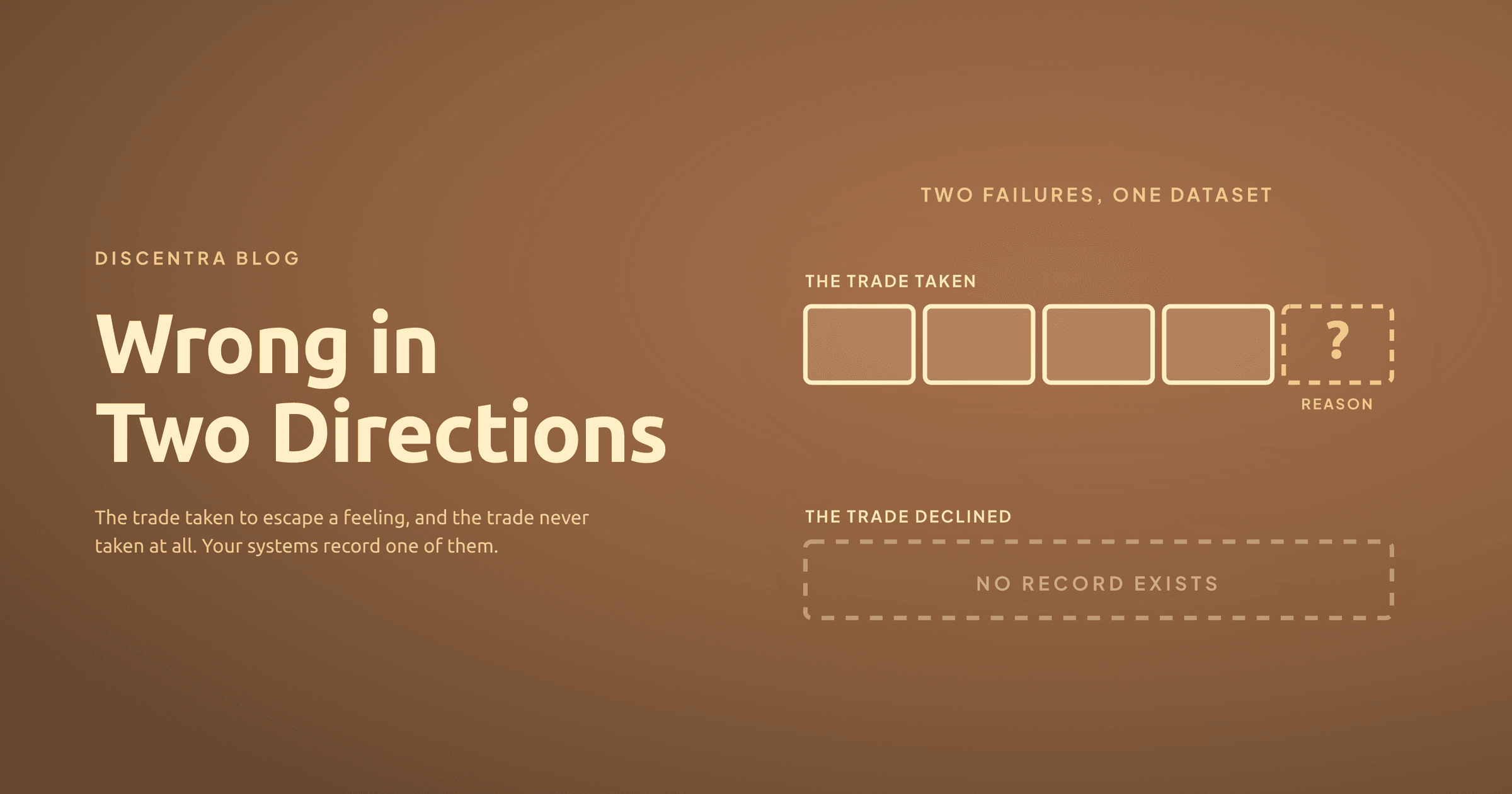
This month a trader published an account of finishing an evaluation in profit, around $4,000, and requesting a payout. The firm disqualified the account in review. The grounds he was given: profit concentration and execution behaviour, assessed by internal behavioural models. None of those metrics appear in the firm's published rules, so there was nothing to check against while trading, and nothing to verify after the ruling. This is the trader's public account; the firm has not answered it.
The same month, a second firm began winding down after retroactive rule changes cancelled profits its traders believed they had earned.
Neither account is unusual. Reports of denied payouts repeat one sequence: the trader passes, requests payment, and then learns about a rule. Violations surface only after the withdrawal request. The categories invoked, "gambling behavior," "tick scalping," "prohibited strategies," are vague enough to be applied at payout time to almost any profitable account.
That architecture admits something. Whatever the firm reads at review, it was reading all along: sizing patterns, concentration, execution style, session behaviour. It is pointed at one moment, the withdrawal request, and at one purpose, adjudication.
What it looks like from the outside
One number shows the surface all of this ends up on. A top-3 US futures prop firm's Trustpilot rating fell from 4.5 to 3.4 in 12 months, across roughly 13,000 reviews (Discentra Trustpilot scrape, May 2026; a trajectory observation for one anonymised firm, not an industry average, and the scrape attributes the decline to no single practice). A denial the trader cannot verify usually ends up as a review. The review joins a pattern, and traders shopping for their next challenge read the pattern before they buy.
Behavioural churn used to be invisible in the aggregate, and review platforms made it public. When we sampled 44 negative reviews from a corpus of 3,000+ and categorised each one, payout complaints landed in the operational bucket rather than the behavioural one. That placement is the useful part. Operational failures are the ones a firm can already see in its own tickets and logs, which makes a payout dispute the rare complaint that is both fully visible internally and aimed at the firm's core promise rather than its platform.
The economics of denial compound in the dark. Each withheld payout saves the firm one payment and places the dispute where future customers read it, so the case closes inside the firm while the reviews outlast it.
The industry's fix repairs the ruling, not the trader
By March this year the backlash had a name. Trade coverage of a movement marketed as "Zero Payout Denial" describes firms moving toward objective, quantifiable rule sets in place of vague categories, compliance flags raised in real time during the evaluation instead of surprise audits at payout, and publicly verifiable payout records. Later coverage reports firms competing on payout speed, some guaranteeing settlement within a day.
This is real progress. The discretion was the defect. But removing a firm's ability to invoke behaviour at payout time leaves the behaviour where it was.
The rules, vague or objective, were doing a second job. One firm demonstrated it this month by launching an evaluation product with the structural rules removed. One of its own traders called the outcome in public: a small set of aggressive accounts would game the product until the limits came back. Within about a week the firm relaunched it with payout caps reintroduced and its scope narrowed. Rules cap a firm's exposure to the accounts most likely to blow up, and the exposure survives their deletion. An objective rule measures conduct after the fact.
The movement's endpoint is a fairer adjudication of the same failures. The trader still tilts, still oversizes, still revenge trades.
Point the same data the other way
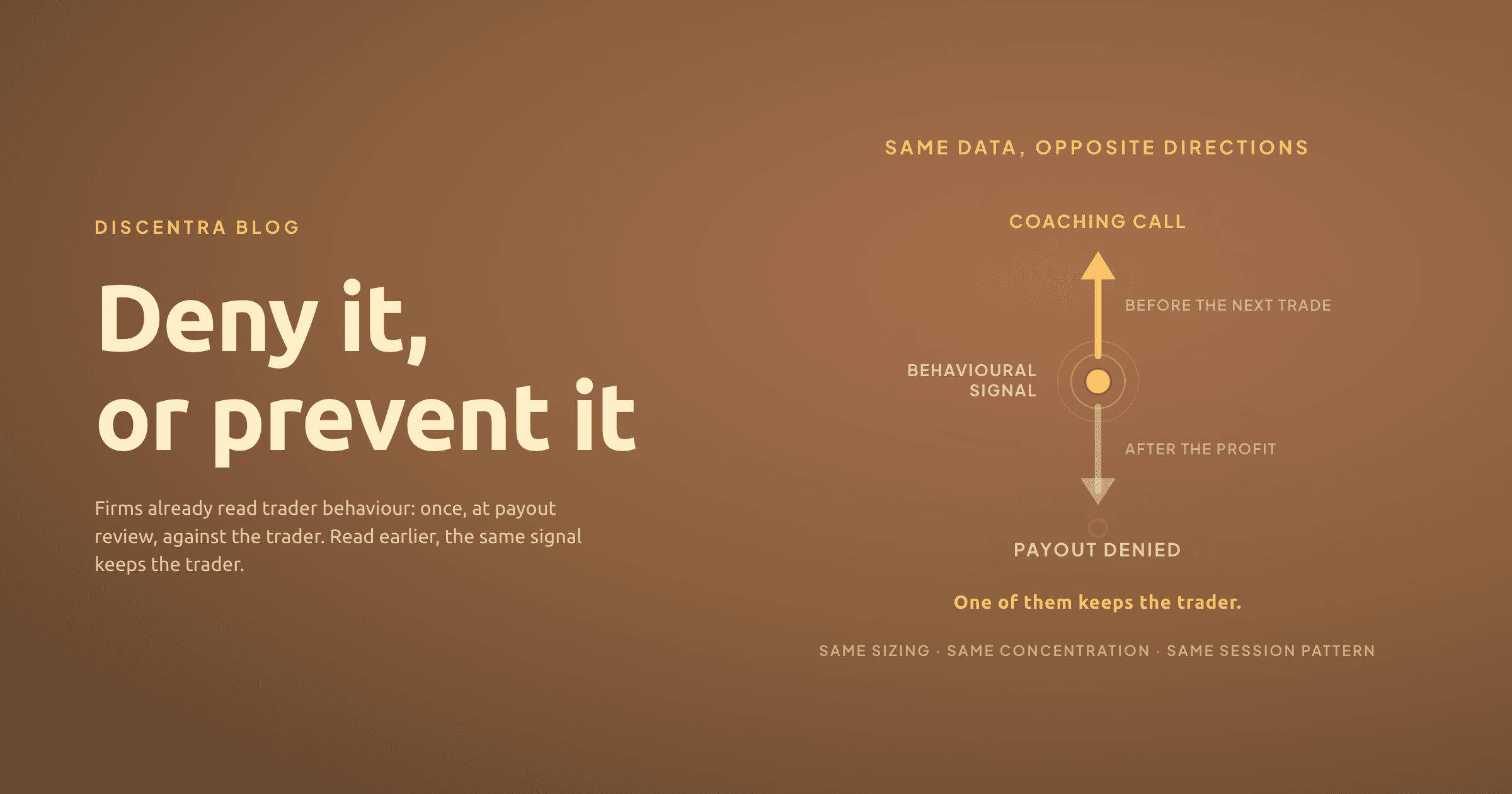
The unmanaged risk sits upstream, in the window between a trigger and the next trade. The signals that read as violations at payout review are the same signals that read as distress in real time: size creeping above plan after a loss, re-entry seconds after a stop, concentration building in one instrument, a session running long past the plan.
The overlap is not total, and the distinction matters. A review desk is usually hunting a prohibited strategy rather than a deteriorating trader, and copy-trade correlation speaks to intent rather than state. But sizing, concentration and session pattern sit in both reads, and those are the ones carrying the distress signal. The question changes even where the inputs do not: a review desk asks whether the trader broke a rule, and a behavioural layer asks whether a legitimate trader is coming apart.
Three changes separate the two architectures:
| Read at payout review | Read in the window | |
|---|---|---|
| When | After the profit, at withdrawal | In real time, between trigger and next trade |
| Who sees it | An internal review desk | The trader, in the moment |
| What it does | Adjudicates: pay or deny | Intervenes: support before the next trade |
One caveat belongs here. A review desk reads a finished account as a batch job. Reading the same signals in the window means processing live trade events as they land, which is a build rather than a setting, and any firm evaluating this should cost it as one.
The first architecture produces rulings and disputes. The second produces an intervention aimed at keeping the trader trading: the trigger fires, the trader gets a call while the state that caused it is still active, and the next trade happens on different terms. This is the layer the movement's real-time compliance flags gesture at but stop short of, since a flag tells the trader a rule is at risk while a conversation addresses the state that is about to break it. It also fills the long silence between funding and first payout with something other than surveillance, which is what a retention layer is.
Transparency runs the same direction. Disclosure obligations arriving on AI systems point one way: software that acts on people must say so. A firm that can show a trader the behavioural read, and show its own compliance function the intervention log, arrives at procurement with the evidence already assembled. That is retention you can defend.
What to ask before you buy any of this
The vocabulary here is doing a lot of work, and most of it is a vendor's. Four questions separate the two architectures faster than any demo:
- Which question does your model answer? Is this trader cheating, or is this trader coming apart? Integrity monitoring and behavioural risk management both get sold as "behavioural analytics", so make the vendor say which one is on offer.
- When does it fire? At review, at the breach, or in the window between the trigger and the next trade.
- What does the trader see, and did they agree to it? A metric the trader cannot inspect can justify a ruling after the fact. To change a decision, the trader has to see it while trading, and to have opted into being contacted at all.
- What does it leave behind? If a compliance officer asks in nine months why a trader was contacted, the answer has to be a record rather than a recollection.
Discentra answers all four, which is a reason to check the answers rather than take them.
The direction you point it
The industry is racing to promise traders that behavioural data will not be used against them. The promise is worth making. The next cycle belongs to the firms that use it for them: the same sizing, the same concentration, the same session patterns, read minutes earlier, shown to the trader, arriving as a voice instead of a verdict.
A payout denial and a coaching call are built from the same signal. One of them keeps the trader.
Sources and notes
- Trustpilot trajectory (4.5 to 3.4, roughly 13,000 reviews): Discentra's own Trustpilot scrape, May 2026. One anonymised top-3 US futures firm, not an industry average. A trajectory observation only: the scrape attributes the decline to no single practice, including payout denials.
- Review categorisation (44 of a 3,000+ corpus): Discentra hand-categorisation of sampled negative reviews for one major prop firm, published in full here. The denominator matters: 3,000+ is the corpus, 44 is the analytical sample.
- The "Zero Payout Denial" movement: trade-press reported, not audited. The three characteristics described are the coverage's account of the movement rather than a verified survey of firm practice.
- The two July cases: the disqualification is a trader's public account, sourced from review platforms and rated medium confidence. The wind-down is trade-press reported. Neither firm has answered the trader account publicly, and Discentra has approached neither for comment. Firms are unnamed throughout by policy.
- The intervention window (the few minutes between the trigger and the next trade): a Discentra operational construct, not a peer-reviewed term.