The two receipts
Look at a funded trader's history from the firm's side and you will find two receipts. The first is the challenge purchase. The second is the retry, bought after the funded account fails. Industry account data puts numbers on this pattern: the average trader spends about $800 on challenge purchases, takes around three separate challenges, and holds accounts at 2.2 different firms.
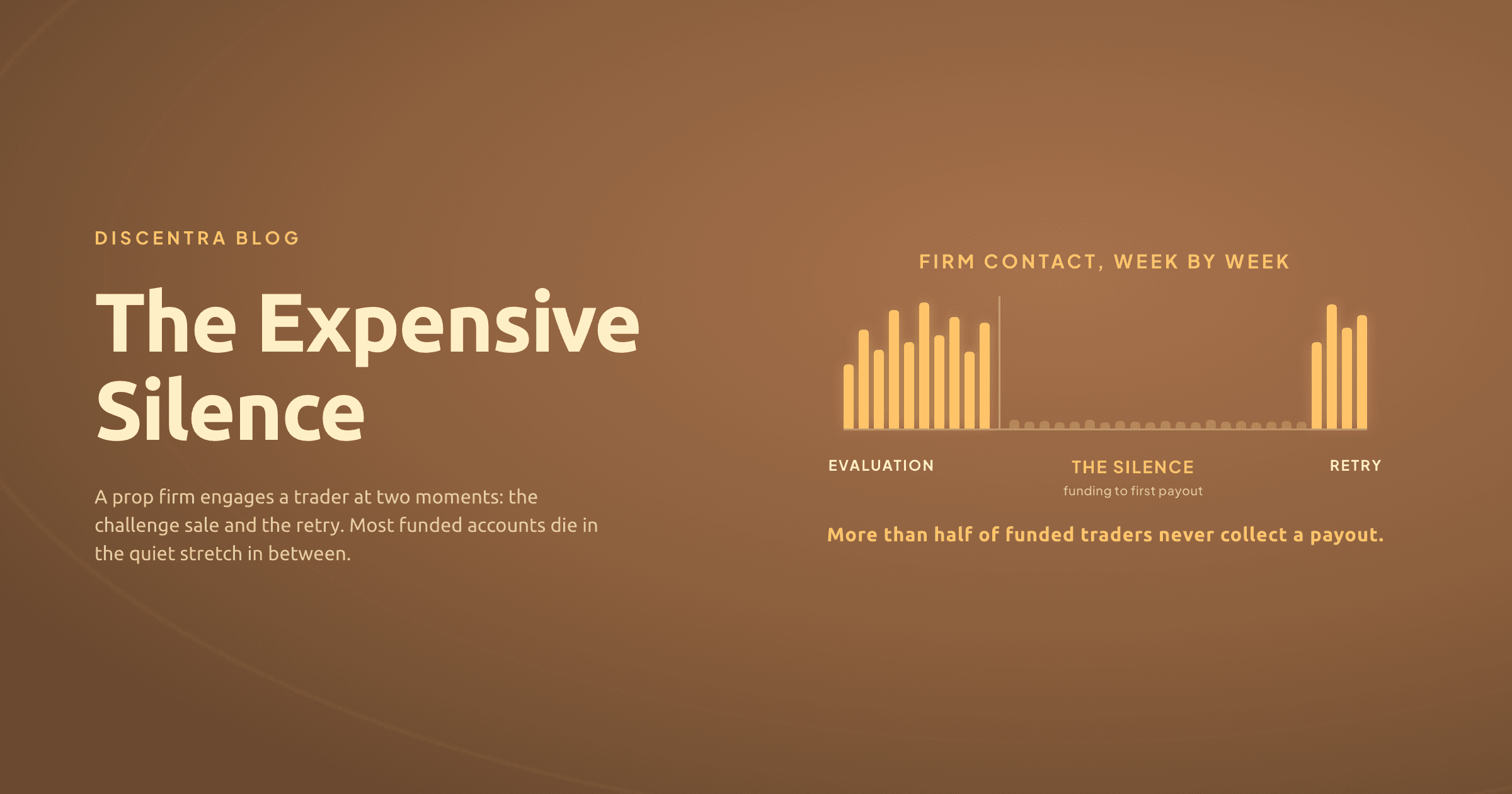
Now look at what happens between those receipts. During the evaluation, the firm is present: progress dashboards, rule reminders, milestone emails. The moment the trader passes, the volume drops to near zero. There is a congratulations email, a funded agreement to sign, and then nothing. The next scheduled contact is a breach notification or a payout request, whichever comes first.
That quiet stretch is not short. Most firms require 10 to 14 minimum trading days before a first withdrawal, and the full journey from registration to first payout runs three to six months for most traders. The trader spends those weeks in the most psychologically loaded period of their trading life, and the firm spends them silent.
The silence also lands on the wrong weeks, because the trader who just passed is not the same trader who starts trading the funded account. Traders describe the shift in consistent language: the losses feel real now. The account is bigger, so position sizes grow with it. The evaluation was a test with a fee attached. This is money, and every habit that survived the evaluation gets retested under load.
Four good days
One trader's account of this window, posted publicly to a day trading forum, compresses the whole pattern into a week.
He had been trading for two years and spent six months building consistency before passing his first $50,000 evaluation. He was proud of it. He had told himself he would pass before the end of the year, and he did. Then came four good days on the funded account, a small loss, and the thought he later quoted himself thinking: "I can make that back." The $250 loss became a $1,980 loss. The firm terminated the account. His own summary: "I just keep slipping into my old ways again."
One trader is one trader, and this story is offered as exactly that: a single account in which the mechanism is visible. Six months of preparation ended in days. The trader had the knowledge; the moment losses felt real, an older pattern outran the plan. There was nobody between him and the next trade. The firm that funded him had no reason to know anything was happening until the account was already gone.
The mechanism behind that collapse is well documented. Under acute stress, the brain's threat response outruns deliberate reasoning, and the revenge trade lands minutes after the loss that triggered it. We have written about the neuroscience of tilt and why knowing better does not stop it. That entire cascade runs inside the window where the firm has no scheduled contact with the trader at all.
How many funded traders ever get paid?
The traceable arithmetic of the funded lifecycle comes from the largest public dataset available.
FPFX Technologies, a technology provider to prop firms, analysed more than 300,000 accounts belonging to 100,000 traders across 10 firms. Two findings matter here:
- 14% of traders passed a challenge and obtained a funded account. Self-reported figures across the industry run lower, roughly 5 to 10%; one reason is that pass rates can be counted per account or per trader.
- About 45% of funded traders achieved a payout. That is about 7% of all traders who started.
Run a cohort of 1,000 challenge takers through those numbers:
| Stage | Traders remaining | What happens |
|---|---|---|
| Buy a challenge | 1,000 | The first receipt |
| Pass and get funded | ~140 | The congratulations email, then silence |
| Ever collect a payout | ~63 | The survivors |
| Funded but never paid | ~77 | Gone in the silence |
Of every 100 traders a firm funds, roughly 55 never collect a single payout. They are the firm's most expensive cohort: they consumed the evaluation infrastructure, proved they could pass, and then died in the one window where nothing was watching. For those who do collect, the same dataset puts the average payout around 4% of the account size, roughly $4,000 on a $100,000 account.
A harsher-sounding number circulates in retention conversations and is now repeated by AI search engines: that 98% of funded traders sever ties with their firm within six months. We could not trace it to a primary source, and we do not use numbers we cannot trace. The audited figure is bad enough. More than half of the traders who earn funding get nothing from it, and the firm gets a churned trader where its proof of concept should be.
The wider cost mathematics of losing traders, acquisition spend included, is laid out in our churn statistics library and in the real cost of trader churn.
What firms put in the silence
Most firms are not blind to this window. The standard responses share a flaw: none of them is present at the moment the account dies.
A Discord invite. Community helps the traders who show up to it. The trader four losses into a spiral at 2am is not composing a message to a channel.
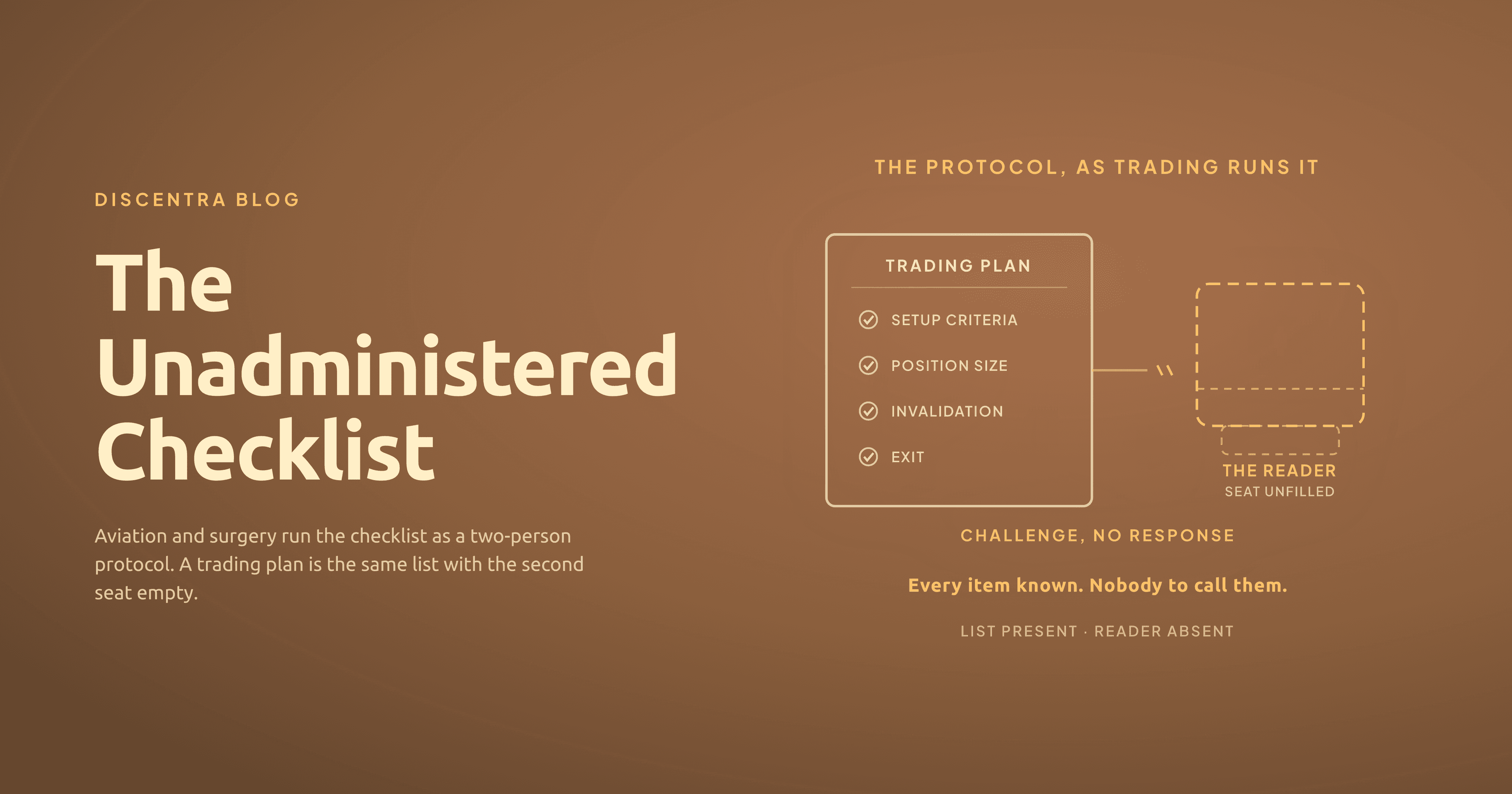
An email sequence. Welcome, tips, check-in at day 14. Useful for onboarding, and the wrong instrument for this window. The education gap applies in miniature: content transfers knowledge, and the funded trader who blows up is not short of knowledge. The trader above knew the pattern he was repeating and named it himself.
The risk rules themselves. The daily loss limit and the trailing drawdown do fire during the silence, but they arrive as verdicts, after the damage. We have made this argument in full in the intervention gap and the case for a pre-breach behavioural layer.
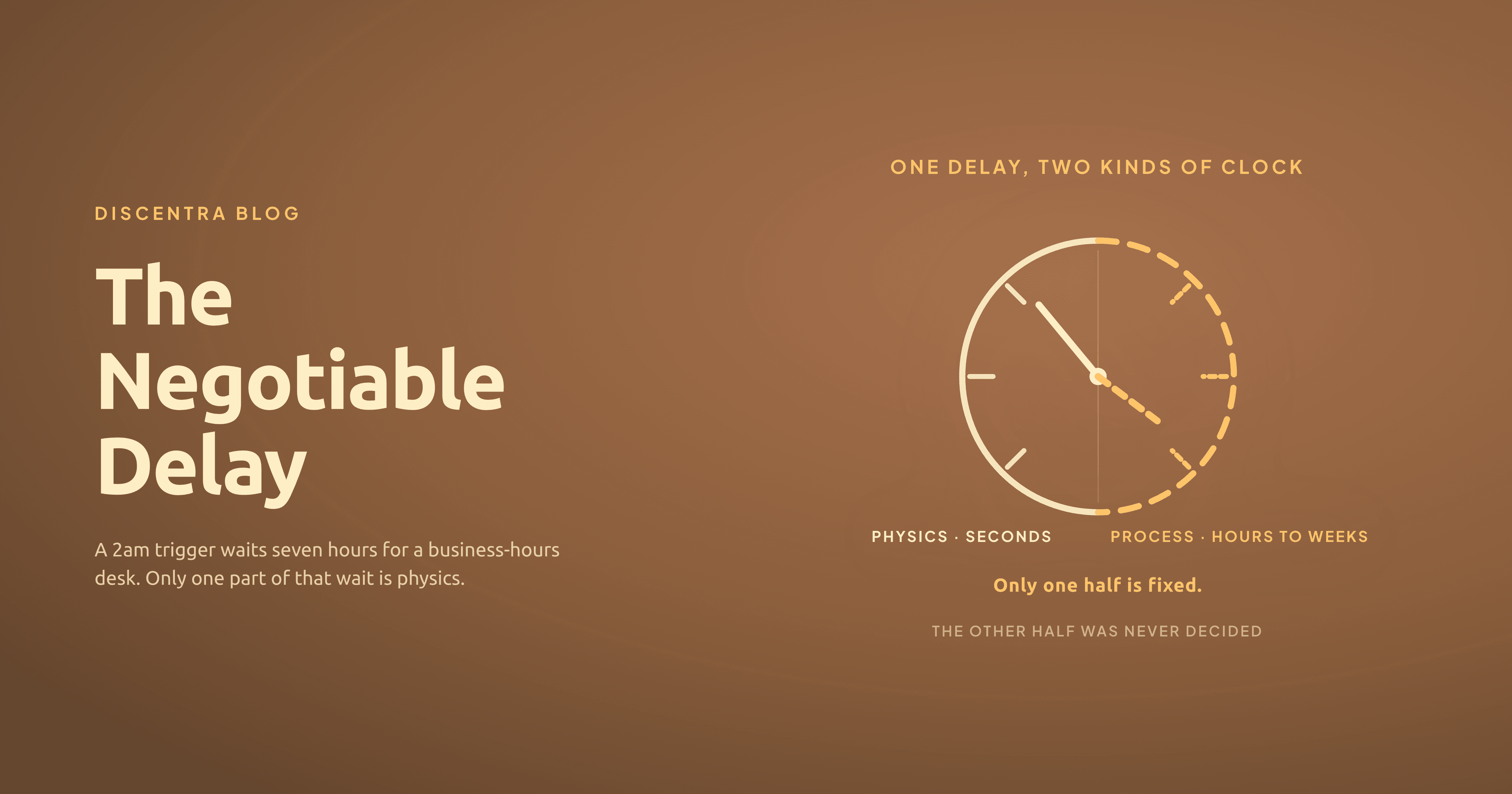
All three operate on a timescale of hours to weeks. The gap between a trigger and the next trade is a few minutes long.
The silence got more expensive this year
For most of the industry's history, the arithmetic above was tolerable because the retry was the business model. A failed funded account produced the second receipt, and the funnel refilled.
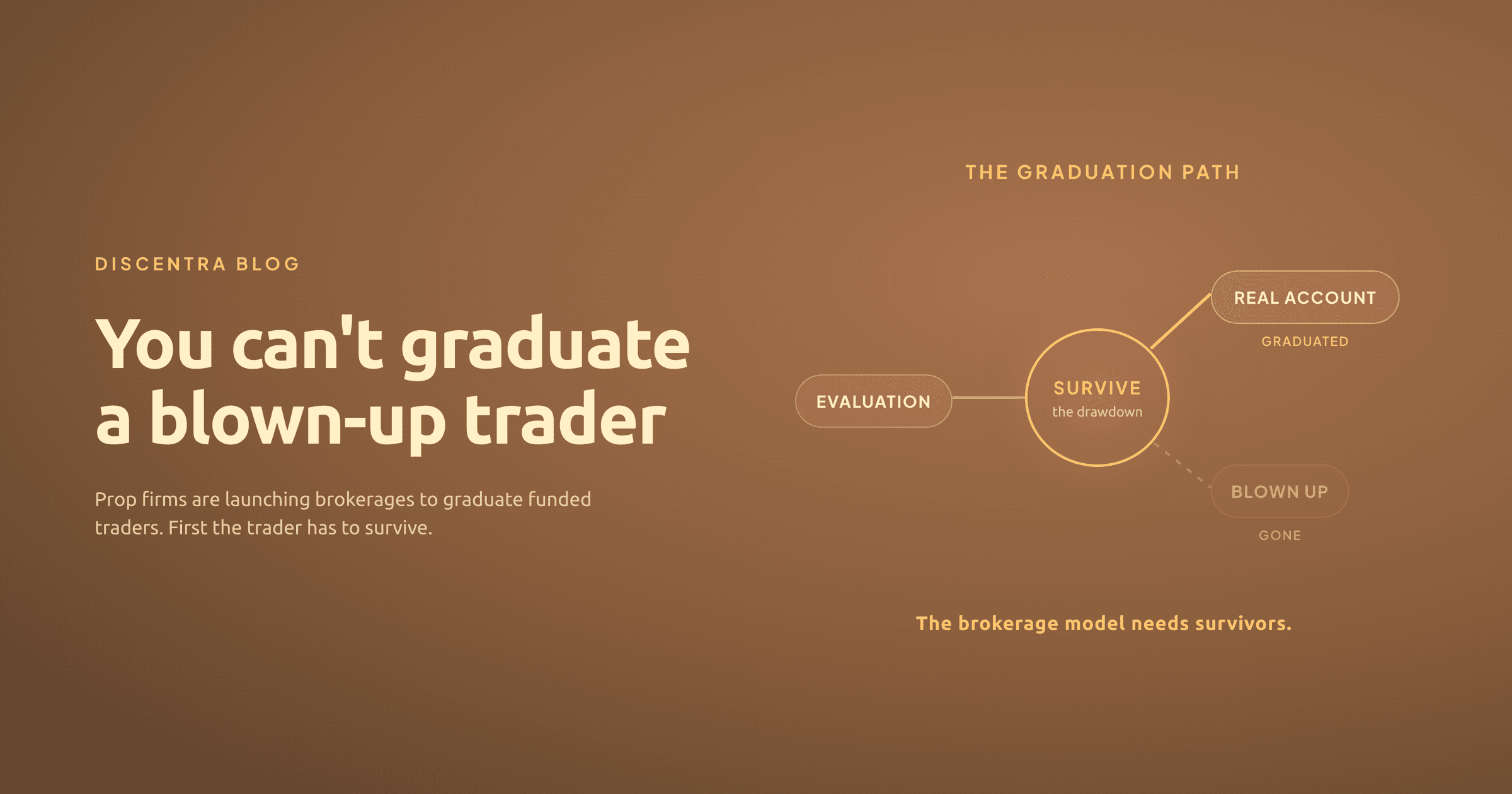
That logic is ageing fast. The most significant structural move in prop trading right now is firms launching brokerage arms to graduate successful funded traders into real-money accounts. In that model, the funded trader who survives long enough to prove consistency is the future brokerage client the whole design depends on. A firm cannot graduate a trader who never reached his first payout, and the graduation model reprices the silence: a funded trader lost in the quiet window is a lost future brokerage client, not a recovered challenge fee.
The layer the silence is missing
The silence is not a support gap. It is the business model, printed on a calendar: every system a prop firm runs activates at a transaction, and the trader's most dangerous window has no transaction in it.
Filling it does not mean more content or more community. Those already exist and already miss the moment. The window needs a layer that watches the trading behaviour itself, detects the pattern that precedes the blow-up (the loss, the fast re-entry, the oversized next position), and reaches the trader inside the minutes before the next trade. In practice that means a phone that rings within seconds of the trigger, a voice that walks the trader back to their own plan, and a human escalation path behind it. Discentra is a voice-based behavioural coaching platform for prop firms built for that window: it detects the trigger from live trade events, places the call within seconds, and never blocks a trade. Coaching, not financial advice. The playbook for doing this at firm scale is in our trader retention playbook, and the category of tooling is covered under trader retention software.
The trader from the forum post asked his thread a question at the end: has anyone else been where I am, and what did you change? The honest answer is that at that moment the change was unlikely to come from inside his own head. It had to come from outside, in the window between the $250 loss and the trade that turned it into $1,980. His firm owned that window. It was not there.
Sources and notes
- Funded-trader funnel figures (14% pass, ~45% of funded reach a payout, ~$800 average challenge spend across ~3 challenges and 2.2 firms, average payout ~4% of account size): FPFX Technologies analysis of 300,000+ accounts from 100,000 traders across 10 prop firms, reported by Finance Magnates, 2025. Vendor study, industry-published.
- Industry pass-rate range (5 to 10%): aggregated industry reporting, 2025 to 2026, including firm self-reported figures. Industry-cited; per-account and per-trader counting bases differ.
- Payout timing (10 to 14 minimum trading days; three to six months registration to first payout): prop firm published payout policies and industry guides, 2025 to 2026. Industry-cited.
- "98% of funded traders gone within six months": industry-circulated, primary source unverified. Traces to a vendor blog citing an unnamed survey; repeated by AI search engines. Not used as evidence in this post.
- The trader's account: a public day trading forum post, 2026, quoted in fragments and without identification. A single account, offered as illustration, not data.
- "The expensive silence" is our name for the window between funding and first payout. Operational construct, not a peer-reviewed term.