The risk stack every prop firm already runs
Prop firm risk management is built on enforcement. A daily loss limit ends the session when the day's losses cross a line. A trailing drawdown fails the account when equity falls too far from its peak. Liquidation-only mode lets a trader close positions but not open them. Some firms add a read-only downgrade, and a consistency rule to filter windfall passes.
These tools work at what they do. They cap the firm's capital exposure with mechanical certainty. No risk desk can watch ten thousand accounts, and the hard limit never sleeps or negotiates. A firm that removed them would be reckless.
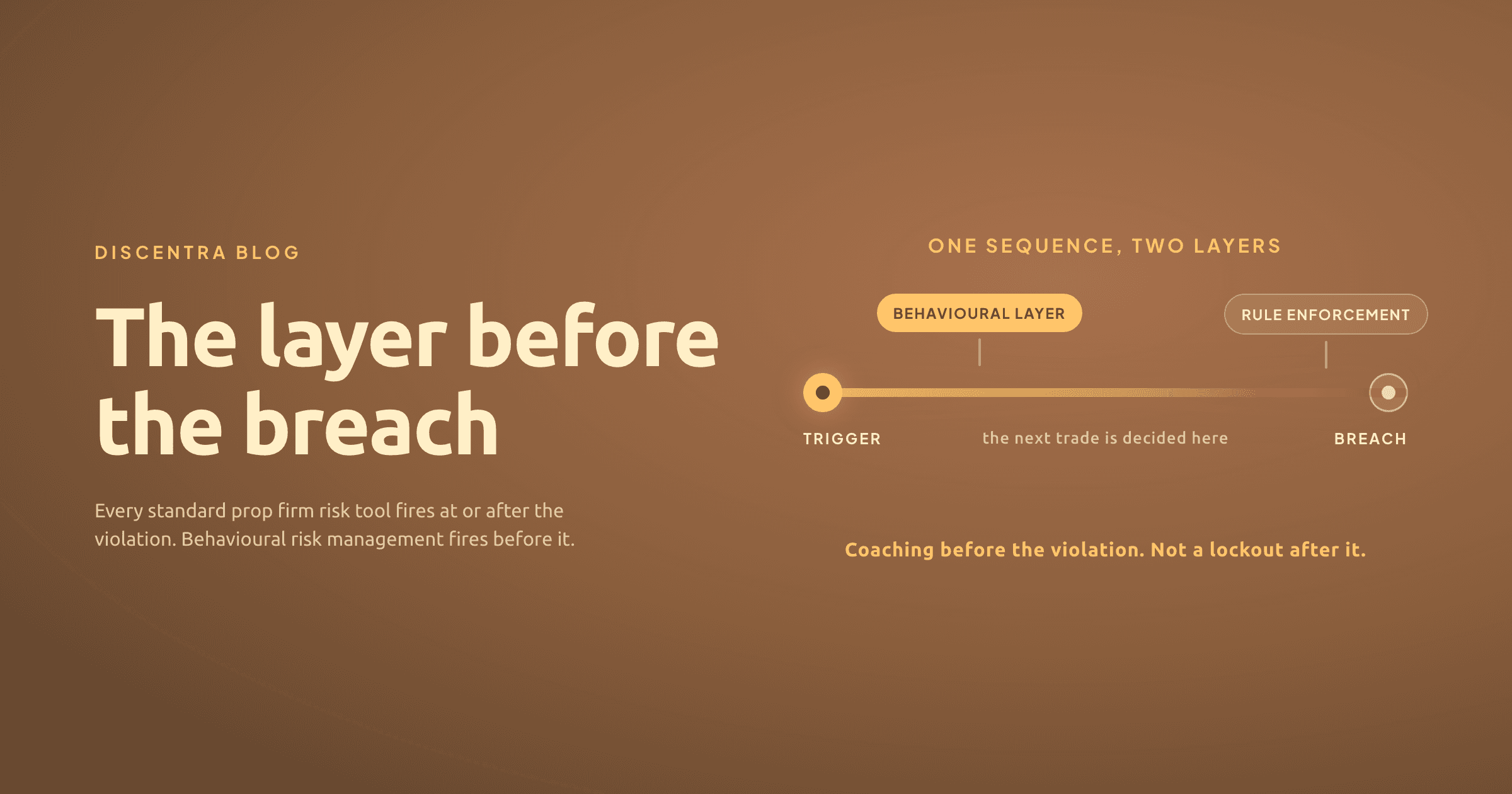
But look at when each one fires. The loss limit fires after the losses. The drawdown fails the account after the fall. Liquidation-only arrives after the damage is priced in. The entire stack activates at or after the violation. It is a system for ending bad sequences, and nothing in it can interrupt one.
Three things called "risk management" that are not the same thing
Search for prop firm risk software and the results blur three different jobs into one label. They answer different questions and fire at different moments.
| Layer | The question it answers | When it fires |
|---|---|---|
| Integrity monitoring | Is this trader cheating? | On exploit patterns: news-gap trades, copy-trading correlation, hedging abuse |
| Rule enforcement | Did this trader break a limit? | At or after the violation |
| Behavioural risk management | Is this trader about to break? | Before the violation, at the trigger |
The first two are well served. Platform vendors sell breach detection, and most now market "behavioural analytics" that means catching cheaters, not catching tilt. The vocabulary collision matters: if a vendor says behavioural, ask which question they answer. Integrity monitoring watches for bad actors. Behavioural risk management watches for good traders starting to come apart. The same collision shows up at the other end of the account, where the behavioural read a firm runs at payout review shares its inputs with this one and asks a different question of them.
That third row is the gap. It is the only layer that addresses the cause of a breach rather than the fact of one.
The blunt instrument problem
Ask why funded accounts breach, and prop firms' own guidance answers it: revenge trading after a loss, not a bad trading strategy, is the most common cause. The sequence is well documented: a loss lands, the re-entry comes faster, the size gets bigger, and the daily limit trips within the same session. The breach is behavioural. The complaint data says the same thing.
Now put the fix next to the cause. The daily loss limit is a financial answer to an emotional problem. It fires after the money is gone, and it locks the trader out of the whole session, the tilted trades and the disciplined ones alike. Firms frame the pause as a chance to step away and come back fresh tomorrow, which is true, and which concedes the point: the tool's job begins after the damage.
A lockout is a sledgehammer. It works, and a firm should keep it. But nobody should mistake it for intervention. By the time it swings, the trader it was protecting has already paid for the lesson, and the account it was protecting is often the churn statistic the firm reads about next quarter. Industry-cited attrition figures put ~75% of retail traders gone within 90 days, and the behavioural sequence above is how most of them go.
What the pre-breach layer looks like
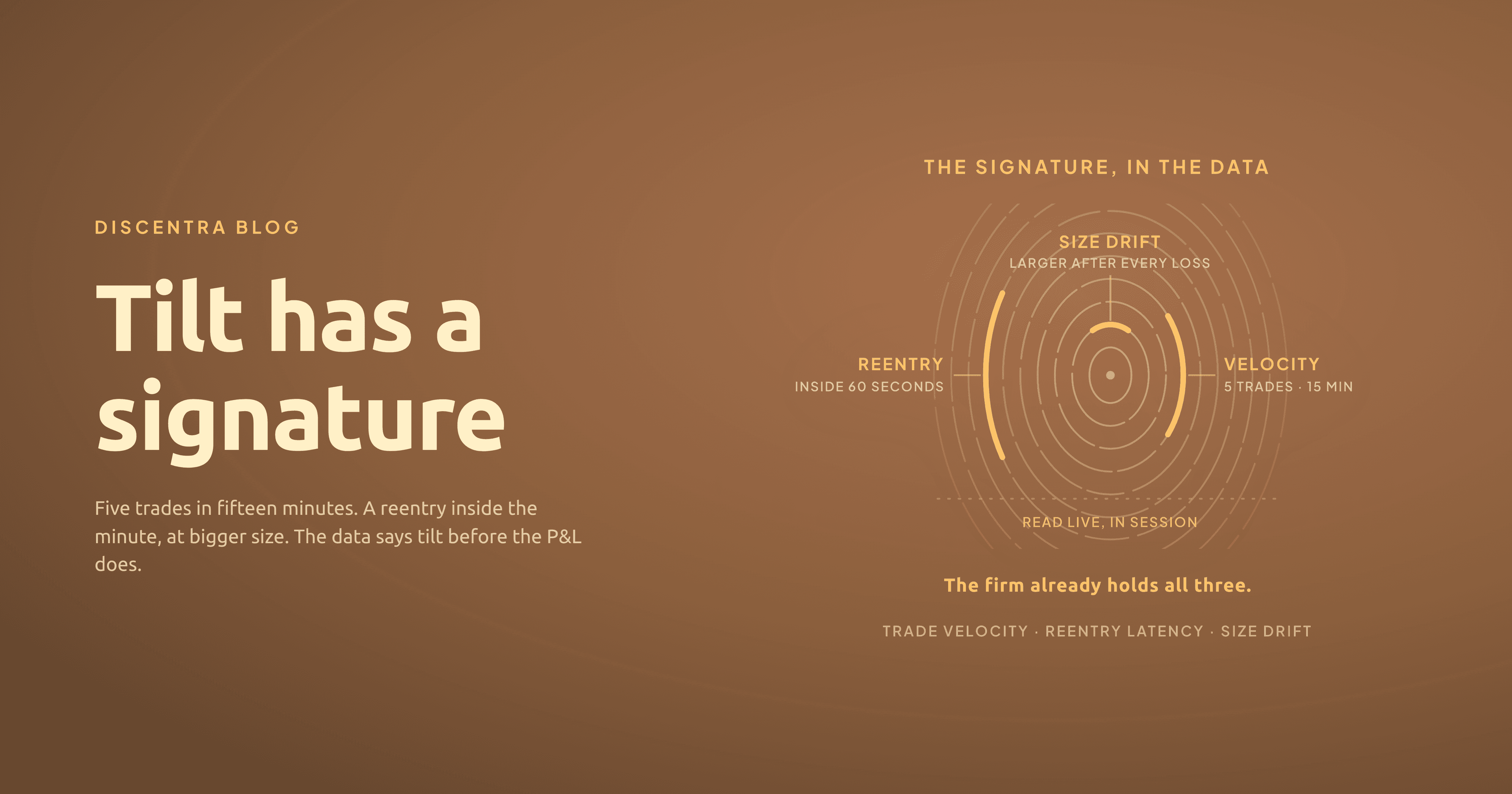
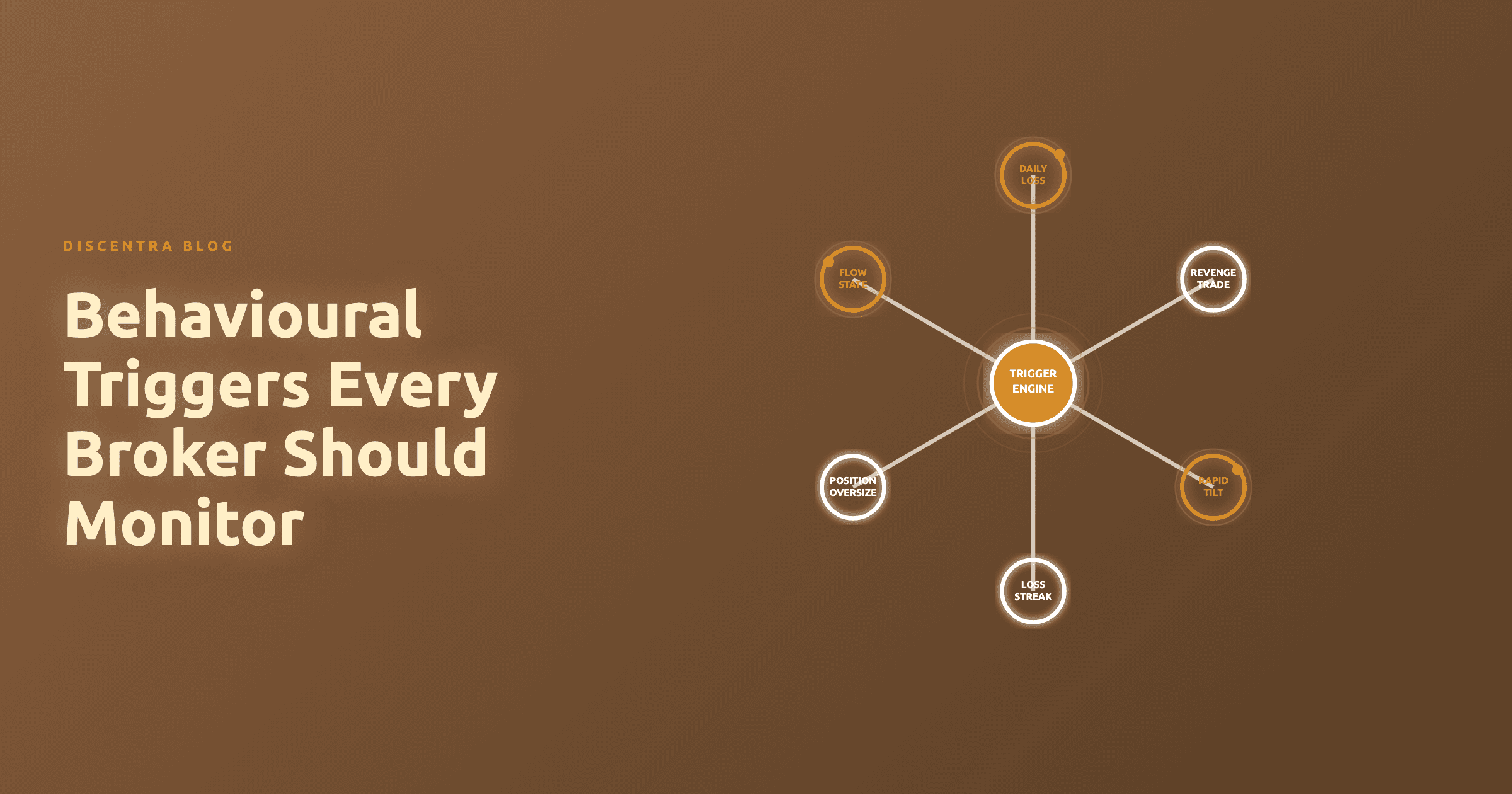
The sequence that ends in a breach is visible in the trade data before the breach happens. A loss followed by a re-entry inside sixty seconds at larger size. Trade frequency spiking to five in fifteen minutes. Position size climbing against a falling win rate. These are the behavioural triggers that precede a blow-up, and they are leading indicators, not lagging ones: they appear minutes before the violation, not in the morning report after it.
A pre-breach layer does two things with that signal. First, it detects in real time, from live trade events, processing each one in under a second. A dashboard the risk desk reviews tomorrow arrives too late to change the next trade. Second, it acts inside the intervention window, the few minutes between the trigger and the next trade where the sequence can still change. In practice that means reaching the trader within seconds of the trigger, by voice, because a call interrupts a tilt loop where a notification gets swiped away.
The intervention itself is coaching. The trader hears a voice that names what the data shows and prompts them back to their own trading plan. The next trade is still theirs to take.
The behavioural framing is not ours alone. Prop firm operators have started saying it in public:
Traders who get paid are usually not the ones taking the biggest shots, they are the ones who stay eligible, controlled, and consistent.
Staying eligible is a behavioural outcome. A risk layer that only punishes ineligibility does nothing to produce it.
What behavioural risk management is not
Vendors describe this layer as something it is not, often enough that the boundaries are worth stating outright.
It does not block trades. It never closes a position, cancels an order, or sizes anything. The enforcement layer already owns hard stops, and the two should not be confused: a system that flattens positions is rule enforcement, whatever its marketing says.
It is not surveillance. Traders opt in, consent to the calls and the monitoring, and can leave the programme. A trader who receives a coaching call at the right moment tends to read it the way it is meant: someone watching out for them.
And it is not financial advice. The coaching never recommends a trade, predicts a price, or suggests a position size. It is performance coaching aimed at the trader's own process. Coaching, not financial advice.
The questions a Head of Risk should ask
Any firm evaluating a behavioural layer can separate the real thing from a rebadged dashboard with four questions.
Does it detect from live trade events, or batch-process at end of day? Does it act inside the intervention window, or file a report? Does it coach the trader, or block the trade? And does it arrive with the compliance work done: consent, AI-voice disclosure, a data-protection assessment, an audit trail?
The last one decides procurement. A layer that phones traders and records the calls carries real regulatory weight, and the compliance package is most of what separates a product from a demo.
Discentra is a behavioural risk management platform for prop firms built to answer those four questions: it detects behavioural triggers from live trade events, places a coaching voice call within seconds, and arrives with the compliance work done. It never blocks a trade. Coaching, not financial advice.
Rule enforcement protects the firm from the trader's worst hour. Behavioural risk management protects the trader from it. The firms that run both stop paying for the same lesson twice: once in the breached account, and again in the $200 to $2,000 acquisition cost of replacing the trader who never came back.