Every trader has a plan. Most abandon it in seconds.
Three consecutive losses. A position that reversed hard. A drawdown that breached a limit the trader swore they would respect. Within seconds, the plan is gone. The stop-loss gets widened. The position size doubles. A revenge trade fires before the trader has finished processing what just happened.
This is a brain chemistry problem. The neuroscience behind it explains why willpower, education, and good intentions fail at the exact moment they matter most.
What tilt is
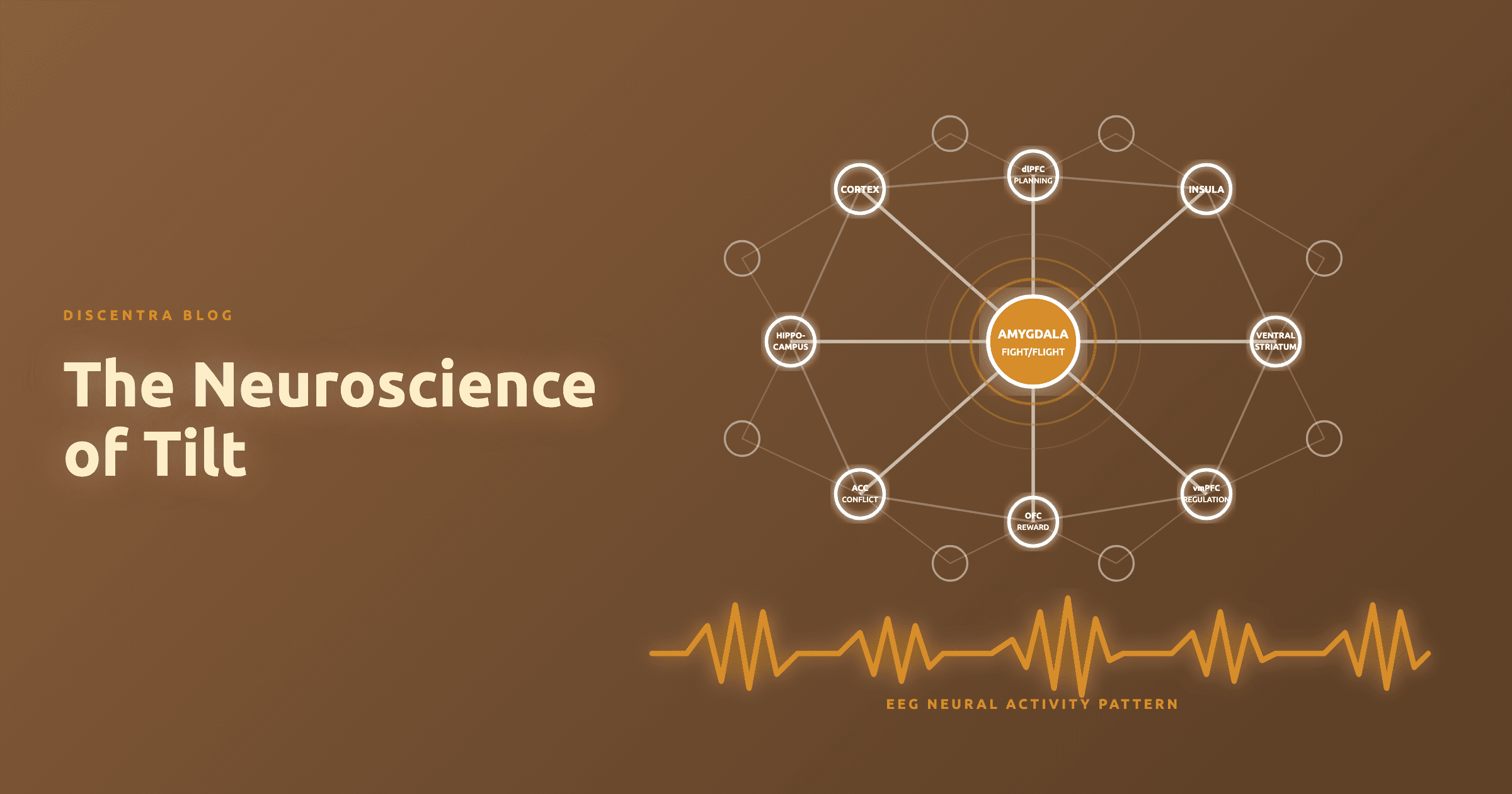
The word "tilt" comes from poker. It describes a player who has gone off-strategy after a bad beat. In trading, the definition is similar but the mechanism underneath is more specific. Tilt is a neurological event called an amygdala hijack.
This happens fast. The trader does not decide to abandon their plan. The brain decides for them. The amygdala runs a fast threat-detection pathway that reacts before the prefrontal cortex has finished evaluating the situation. In LeDoux's animal studies the amygdala responded to a threat cue within about 15 milliseconds, ahead of the slower cortical route that supplies context. How wide that gap runs in humans is still debated, so treat it as a direction of travel rather than a measured ratio. By the time the rational mind catches up, the emotional response is already in motion.
Traders describe tilt in retrospect with phrases like "I don't know what I was thinking" or "I knew better." They did know better. The part of the brain that holds that knowledge was temporarily disconnected from the part making decisions.
The cortisol cascade
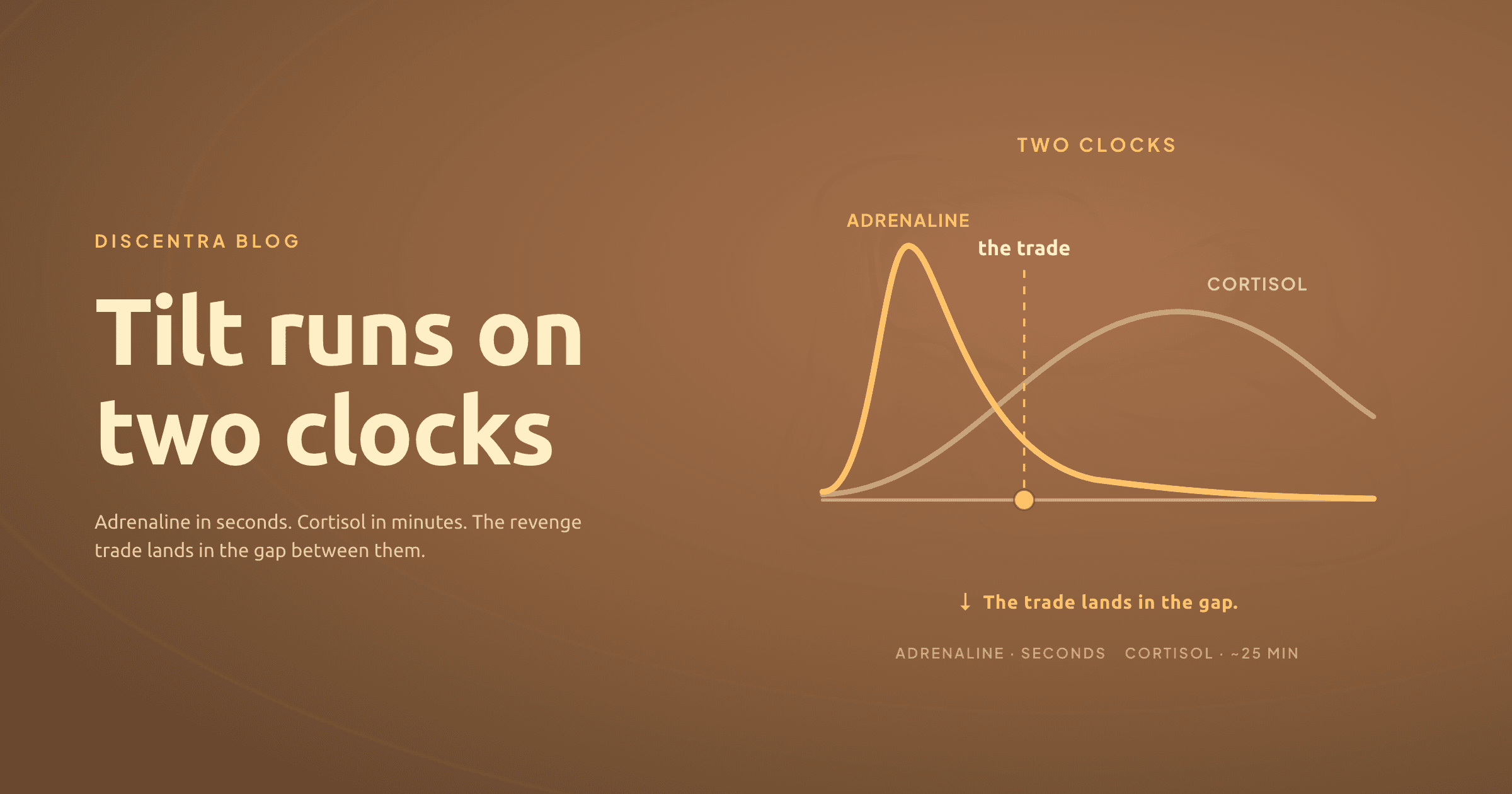
A loss event triggers a neurochemical chain reaction. The sympathetic-adrenal-medullary response fires first: adrenaline and norepinephrine release within seconds, narrowing attention to immediate threats and suppressing broader strategic thinking. Cortisol follows behind it over the next several minutes through the hypothalamic-pituitary-adrenal axis, sustaining the impaired state after the initial spike.
Under the stress response, three things happen simultaneously.
Attention narrows. The trader stops seeing the broader market context, their trading plan, their risk rules. Their visual and cognitive focus collapses onto the position that just lost. This is called attentional tunnelling. It evolved to help humans survive physical threats. In a trading context, it strips away every piece of information except the one causing pain.
Risk evaluation distorts. This is the counterintuitive part. Cortisol does not make a trader bolder or more timid. It changes how the brain prices risk at all. Kandasamy et al. (2014) at Cambridge gave volunteers hydrocortisone over eight days, at cortisol levels measured in working traders, and risk preferences shifted: they became more risk-averse, the certainty equivalent of a gamble falling from £25 to £14. That study describes sustained stress across days rather than the minutes after a single loss, and a single acute dose produced no such effect. The transferable point is narrower, and it holds: a stressed brain no longer prices risk the way a calm one does. Combined with attention locked on the loss, the trader stops judging the next trade on its own merits and starts judging it against the hole they are trying to climb out of.
The prefrontal cortex goes quiet. Functional MRI studies show reduced prefrontal cortex activity during acute stress. The region responsible for planning, impulse control, and weighing consequences is suppressed at the exact moment the trader needs it most. A trader under cortisol influence is not choosing to ignore their risk rules. They cannot neurologically access them.
Measurable, observable, replicable. A specific neurochemical event with predictable behavioural consequences.
The 4-minute window
After a trigger event, whether a single large loss, a drawdown breach, or a series of consecutive losses, there is a window of approximately 4 minutes where the trader is most vulnerable. The cortisol spike peaks within this window. The prefrontal cortex suppression is at its maximum. The trader's capacity for strategic decision-making is at its minimum.
This is when the damage happens. The data is consistent across segments: the revenge trade, the doubled position, the widened stop-loss, the ignored risk limit. These decisions cluster in the minutes immediately following a trigger, not hours later when the trader has calmed down.
Account blow-ups follow this pattern. Not a slow bleed over weeks. A concentrated burst of impulsive decisions in a window measured in minutes. The trigger fires. Adrenaline surges, cortisol rises behind it, the prefrontal cortex goes dark. And the trader makes 3 to 5 decisions in rapid succession that undo weeks of disciplined work.
The window is brief. But the financial damage it creates is not.
Why the common solutions fail
The trading industry has no shortage of advice for managing tilt. Most of it addresses the wrong timescale.
Trading journals
Journals are the most widely recommended tool for managing trading psychology. TraderSync, Edgewonk, Tradervue. They are valuable for pattern recognition over time. But they are retrospective. The trader fills them out after the session. The cortisol has already done its damage. The revenge trade has already fired. Logging the mistake at 8pm does not undo the impulsive entry at 2pm.
Journals help traders understand their patterns. They do not interrupt those patterns in progress.
Meditation and mindfulness
Long-term mindfulness practice does reduce baseline cortisol levels. Experienced meditators show lower amygdala reactivity over time. But the operative word is "over time." Mindfulness is a training adaptation, not an in-session tool.
A trader who meditated for 30 minutes that morning still experiences the same cortisol spike when their account drops 8% in 12 minutes. The amygdala does not check whether you meditated today before it hijacks.
Pre-set risk management rules
Stop-losses, daily loss limits, position size caps. These are essential. They are also the first casualties of tilt. A trader under cortisol influence, with a suppressed prefrontal cortex and narrowed attention, overrides the very rules they set when they were thinking clearly.
The rules were set by the prefrontal cortex. The decisions during tilt are made by the amygdala. Two different decision-makers operating the same account.
Accountability partners
Some traders pair up for mutual accountability. This helps when both are available. It does not help at 2am during a crypto session, or during the overlap of London and New York when both partners are trading their own positions. Accountability requires presence at the exact moment of tilt. Human accountability partners cannot guarantee that.
How to interrupt tilt
If tilt is a neurological event driven by cortisol and amygdala activation, then the intervention must operate at the same level: breaking the chemical cycle before it completes.
The research on interruption theory is clear. An external stimulus, one the person did not initiate and cannot ignore, forces a context switch. The brain re-allocates attention to the new input. The attentional tunnel breaks. The prefrontal cortex, given a momentary reprieve from the cortisol-driven fixation, begins to re-engage.
A phone ringing stops someone mid-argument. A colleague walking into the room changes the dynamic of a heated decision. The interruption creates a gap between stimulus and response. In that gap, the prefrontal cortex re-engages.
Applied to trading: the most effective tilt intervention is an external one, delivered in real time, during the 4-minute window. A voice. A human or human-sounding conversation that forces the trader to stop, listen, and re-engage the strategic part of their brain. Notification badges get dismissed. Text messages get read later. A voice call demands immediate attention.
The mechanism is simple. The voice creates a pattern interrupt. The trader's attention shifts from the losing position to the conversation. Cortisol levels begin to drop once the fixation loop breaks. The prefrontal cortex comes back online. The trader regains access to their plan, their rules, their strategic thinking.
A neurological circuit-breaker applied at the moment of maximum vulnerability.
The industry implication
Most firms treat tilt as a character issue. "That trader lacked discipline." "They should have followed their rules." This framing leads to solutions that address the symptom (bad trades) without addressing the mechanism (cortisol-driven prefrontal cortex suppression).
Firms that understand tilt as neuroscience arrive at a different question: how do we intervene when tilt is already happening?
Education, rules, and post-session review address the before and after. They do not address the during: the 4 minutes where the damage concentrates.
Real-time voice intervention is an emerging approach in this space. The technology to deliver it, sub-5-second response times from behavioural trigger detection to a coaching conversation, has only become viable in the past 18 months. The concept is not new. Performance coaching in elite sport has operated on this principle for decades: interrupt the error pattern in real time, not in the film review session the next morning.
The difference is that voice AI and real-time data processing now make it possible to deliver that coaching at scale, across thousands of traders, 24 hours a day, without requiring a human coach to be sitting in the room.
What this means for prop firms and brokers
Over 250 prop firms offer near-identical rules and fee structures. Brokers compete on spreads measured in fractions of a pip. Product differentiation has run out of road.
Trader retention is the remaining edge. Retention is a behavioural problem. Platforms, pricing, and marketing cannot solve it.
The firms that build systems around the neuroscience of tilt, systems that detect behavioural triggers and intervene during the 4-minute window, will retain traders that their competitors lose. Those retained traders generate 12 to 24 months of additional lifetime value. They leave fewer negative reviews and refer other traders.
The firms that continue treating tilt as a discipline issue will continue losing ~75% of their traders in 90 days and spending millions replacing them.
Tilt is solvable
Tilt is a specific neurological event with a specific chemical signature and a specific behavioural window. The amygdala hijacks the prefrontal cortex. Cortisol floods the system. The trader loses access to their strategic mind for 4 minutes. The damage concentrates in that window.
Willpower fails because the part of the brain that exercises willpower goes offline. Education fails because the knowledge is inaccessible during the event. Rules fail because the rule-following region has been overridden.
The solution is timely interruption at the neurological level. Break the cortisol fixation loop. Re-engage the prefrontal cortex. Give the trader back the 4 minutes that would otherwise destroy weeks of disciplined work.
The neuroscience is clear. The firms that act on it first will keep the traders that everyone else loses.