The treadmill the industry is stepping off
The challenge-fee model has a problem its own operators now say out loud. Money floods in when traders buy evaluations. It floods out when the rare passer gets paid. In between, the firm needs a steady supply of new traders to replace the ones who washed out, and most of them do. Industry-cited estimates put trader churn at around 75 percent within 90 days. Acquisition costs climb, discounts deepen, and a 90 percent off banner is not loyalty. It is a markdown on the way out.
A business that earns most when its customers fail is a business at war with its own funnel. Every operator running that model knows the number that haunts it: the cost of replacing a trader who quit you already paid to acquire. The model works until acquisition gets expensive enough that replacement stops paying for itself. For a crowded field of near-identical firms, that point has arrived.
The exit they all chose
Over the past year a wave of firms has made the same move: stand up a regulated brokerage arm and route funded traders into it. The pitch to the trader is a real account with real capital. The logic for the firm is simpler than that. A brokerage earns commission and spread for as long as the trader keeps trading. Revenue flips from a one-time bet on a trader failing a challenge to a recurring relationship that pays while the trader lasts.
The industry has a phrase for the shift. Aligning incentives. The firm makes money when the trader keeps going, not when the trader breaks. On paper it is the healthiest thing to happen to this market in years.
Aligning incentives is the right instinct
Give the move its due. A firm that earns when its traders survive has a reason to care whether they survive, which the challenge-fee model never did. The economics now point the same direction as the trader's interest. That is real progress, and the firms making the move are reading the market correctly.
But aligning incentives is not the same as protecting them. The new model rewards trader longevity. It does not, by itself, produce it. And the moment a firm bets its revenue on traders lasting, it inherits a liability the old model could afford to ignore.
The liability alignment exposes
Under the challenge-fee model, a blown account was the trader's problem. The fee was already collected. The trader who tilted into a drawdown and lost the account had, in a cold sense, already paid.
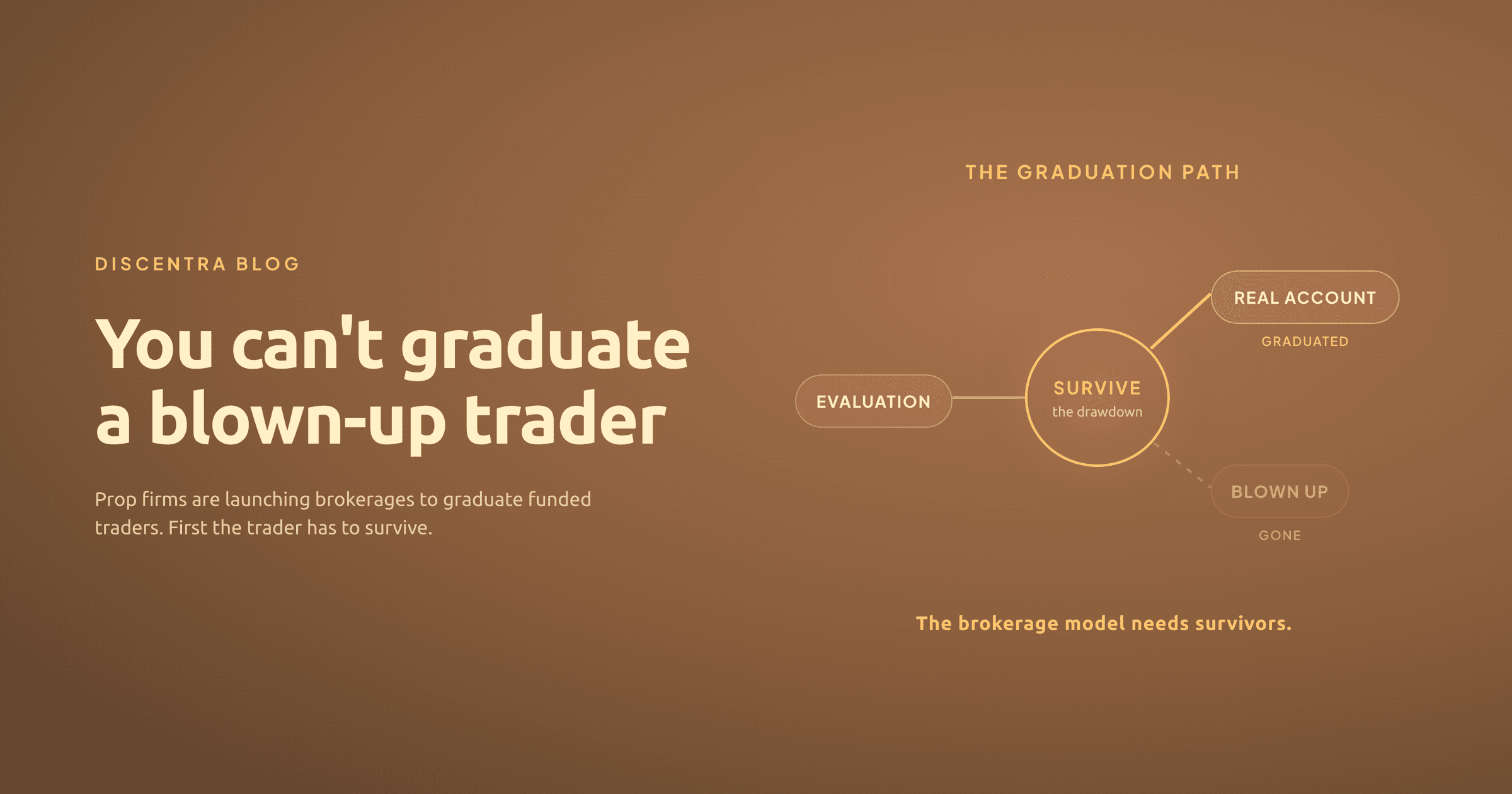
Move that same trader into a brokerage account and the arithmetic inverts. Now the blow-up is the firm's loss too. The commission stream stops. The capital the firm extended is exposed. The trader who self-destructs is no longer churn on a spreadsheet. They are a written-off relationship the firm was counting on for a year of revenue. A model built on trader longevity makes trader self-destruction its single largest unpriced risk.
The dead zone the model inherits
Here is where the new model is fragile. Graduation is a single moment, handled well: an upgrade, a welcome, an account funded. The blow-up is a different moment entirely, and nobody is in the room for it.
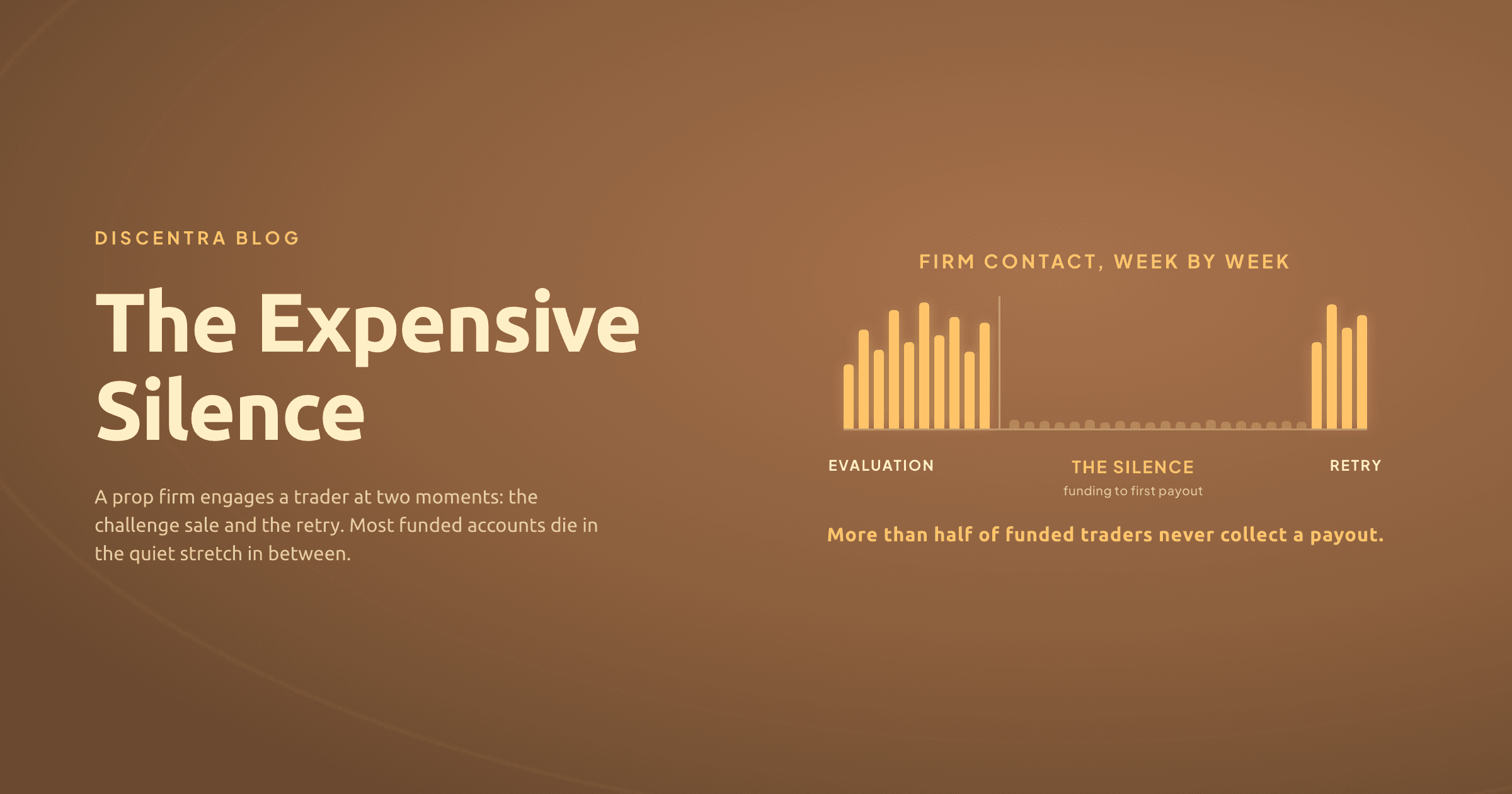
Firms reach a trader at two points. Before they buy, to sell the challenge. After they fail, to sell the retry. The expensive silence is everything in between, and that gap does not close when the account graduates. It travels with the trader into the brokerage. Education runs before the account goes live. Onboarding runs at the start. Neither reaches a trader at the point a loss turns into the next oversized trade, because at that point the trader is staring at a red screen, not opening a course.
What "graduate-ready" actually means
The unspoken assumption behind the brokerage model is that a funded trader is a finished trader, ready for real capital. They are not. Passing an evaluation proves a trader can perform under a rulebook for a few weeks. It does not prove they can hold their plan the day the market moves against them and the account is real.
Survival is not a skill you can teach in a module. Thomas Heinfart, CEO of the prop firm FundedHive, said in an interview reported by Finance Magnates that traders who get paid are usually not the ones taking the biggest shots, they are the ones who stay eligible, controlled, and consistent. You can teach a strategy. You cannot teach a brain to keep its plan under pressure, because the part that holds the plan goes offline first when a trader is in a loss spiral. A graduated trader carries the exact habits that ended their last account, now with more capital and more of the firm's money on the line. Graduation changes the stakes. It does not change the trader.
The missing line item
For any firm building the align-with-traders model, the behavioural layer is not a nice-to-have bolted on after launch. It is the thing that protects the commission revenue the whole model is built on. Monitoring behaviour rather than just trades, and reaching the trader inside the window where discipline fails, is what turns a graduated account from a hopeful bet into a retained one.
This is the layer that does not recommend trades, size positions, or predict prices. It coaches the trader back to the plan they already wrote. Coaching, not financial advice. It is also the layer most firms launching brokerages have not budgeted for, because under the old model they never had to.
You can't graduate a trader who blows up first. Alignment without a behavioural layer is not alignment. It is the same churn, with the firm's money now on the table.