Why you can't stop revenge trading
Start with the part nobody admits in the educational content. You already know.
You know what revenge trading is. You have read the warnings. You have told yourself, out loud, that the next loss will not turn into three. And then a trade goes against you, and twenty minutes later you are down more than the original loss, sizing up, certain that this one comes back. The honest version of the problem is not that traders lack information. It is that the information is sitting right there and changes nothing in the moment that counts.
Read how traders describe it to each other and the pattern is the same every time. They do not say they misread the setup. They say they could not stop. One bad afternoon, a loss they did not expect, and the rest of the session spent trying to win it back. Full awareness, zero control. The most common confession is some version of "I know it is costing me and I do it anyway."
That sentence is not a character flaw. It is a clue. When knowing the answer does not change the behaviour, the problem is not the knowing. It is the timing of when the knowing shows up.
The advice targets the wrong moment
Here is what every piece of revenge-trading advice has in common, and why it keeps missing.
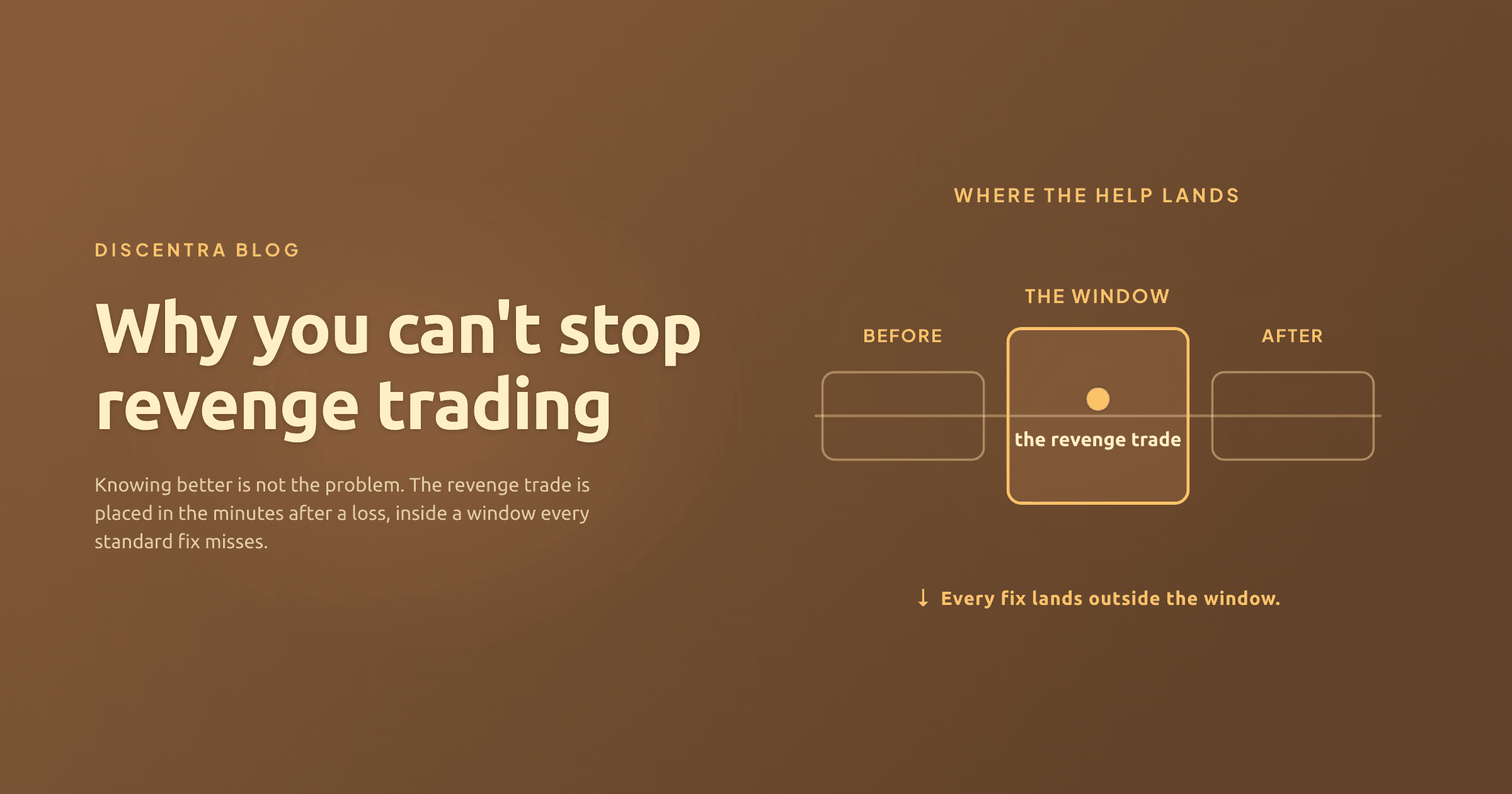
The advice arrives in one of two places. Before the session: read your rules, set your limits, visualise the plan, stay disciplined. Or after the damage: step away, take a break, journal the trade, review it tonight. Both are real, and both skip the only moment that decides the outcome. The revenge trade is not placed before the session, when you are calm and resolved. It is not placed that evening, when you are reviewing it with regret. It is placed in the few minutes after the loss, and that window is exactly the one no standard fix occupies.
Think of a single session on a timeline. The loss lands. Within seconds the urge to act arrives. Within a handful of minutes the re-entry is placed, bigger, faster, certain. Twenty to thirty minutes later you are still impaired and often still trading. An hour after that, the composure returns and you read the damage. Pre-market discipline spoke to you before the loss. The journal will speak to you after the composure returns. The trade happened in the silence between them.
This is the same gap that defeats the tools a firm puts around a trader, the retention stack that fires after the moment has passed. The trader's self-help advice and the firm's dashboards fail for one shared reason. They are both pointed at the wrong minute.
Three fixes, three misses
Take the three things a serious trader actually tries, and watch each one miss the window.
Journaling. A trading journal is a deliberate, reflective act. It asks the analytical brain to slow down and write. That brain is the one a loss puts offline first. So the journal reaches a calm trader hours later and learns a great deal about a decision a different trader made under stress. The insight is real. It just arrives at the wrong address. You cannot journal your way out of a state in which the journaling part of you is not at the desk.
Walking away. "Step away for thirty minutes" is correct advice that depends on the one thing the moment removes: the decision to step away. To walk away you have to choose to, in the exact window where choosing is hardest and the urge to stay is strongest. The traders who can reliably do it did not need the advice. The ones who needed it could not reach for it.
Lockouts and cooldown timers. Some firms ship a daily loss limit or a forced cooldown, and these are the closest anyone gets, because they at least act in the moment. But a lockout removes access. It does not change the state. The urge that wanted the trade is intact on the other side of the timer, so the same decision is simply deferred, not resolved. Taking the keyboard away is not the same as reaching the person holding it.
Three honest attempts, one shared failure. Each targets the trader before or after, or removes the tool instead of reaching the person. None of them is coaching, in the moment, inside the window.
Why the window beats you
The reason the window is so hard to reach is biological, and it is worth understanding at exactly one level of depth.
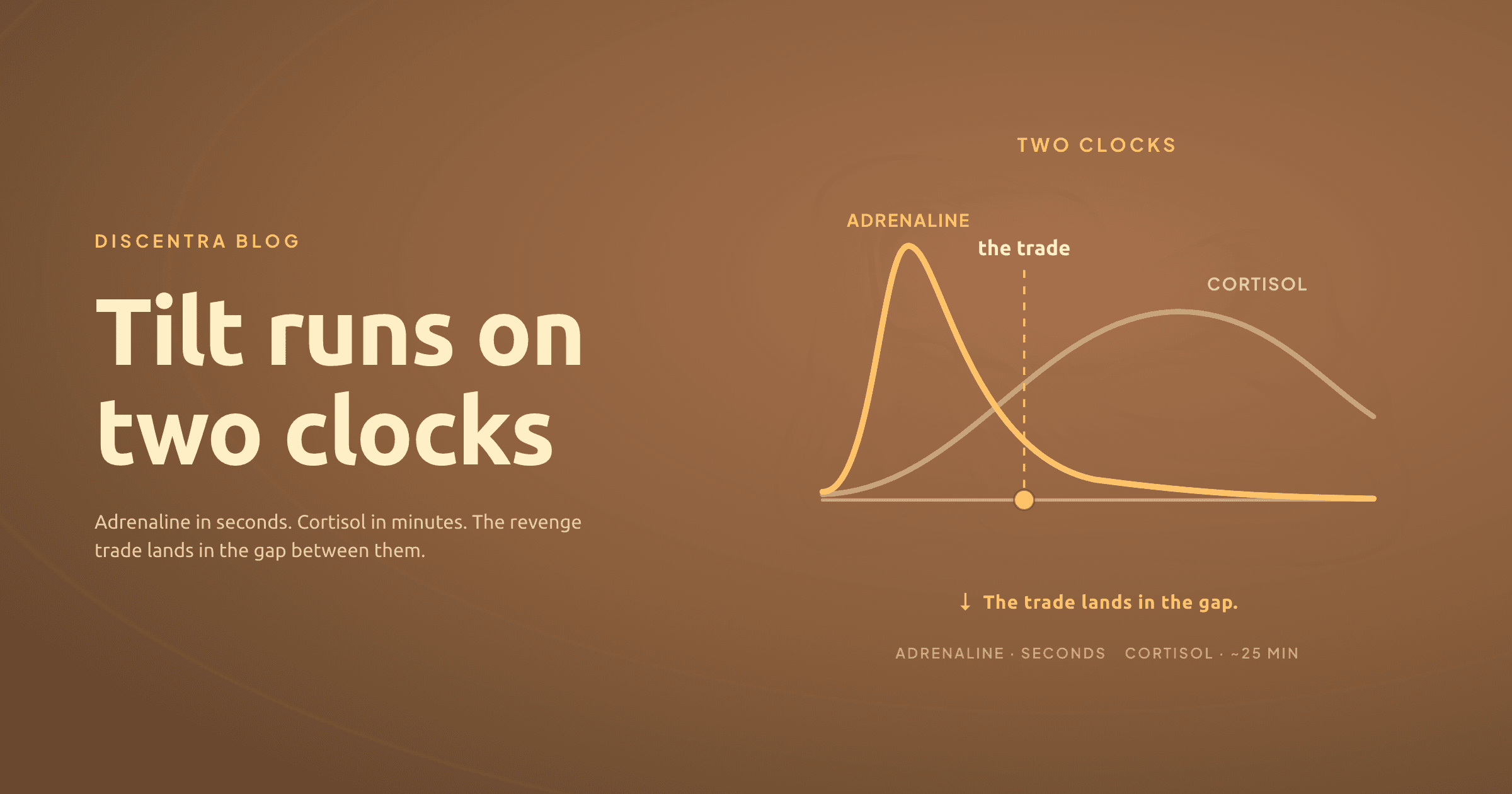
A sudden loss triggers a fast threat response. The amygdala fires before the prefrontal cortex has finished evaluating the situation, and on LeDoux's two-route threat model the fast pathway reaches the amygdala before the cortical route has finished supplying context. The rational brain is not absent. It is a step behind, by a margin that decides the next click. Behind that fast spike, a slower stress hormone, cortisol, rises and peaks around twenty to thirty minutes later, keeping judgement impaired long after the initial jolt fades. (The fuller mechanism, and how long the impairment runs, is in the two clocks behind tilt.)
The practical consequence is simple. For a few minutes after a loss, the trader who would stop the revenge trade is not the one at the controls. We call that gap the four-minute window. It is our own marker for the slice where the trade gets placed, not a figure from the literature. Whatever you name it, it is the part of the session every standard fix steps around.
What this looks like with real money on the line
Move this from the individual to the institution and the cost stops being personal and starts being a number.
A prop firm runs an evaluation to find traders who can follow a plan. The challenge is good at that. It is not built to test what happens after a real loss on a funded account, because the pressure is different and the stakes are different. So a trader passes, proves the strategy, and then blows the funded account in the first session that turns hard, on the exact behavioural break the evaluation never exposed. Operators see this constantly: the account that dies the day after it was earned. The strategy was fine. The trader did not survive the moment the plan got overridden.
This is why retention built on education and dashboards keeps under-delivering. ~75% of traders quit inside 90 days, and a large share of those exits trace not to a bad strategy but to one unmanaged moment that repeated. A tool that reports on the loss after it happens, or teaches discipline before the session starts, is pointed at the same two empty minutes the trader's journal is pointed at. The window stays unguarded.
The honest close
So the question is not how to know better. You already do. The question is what can reach you in the four minutes when knowing is offline.
It is not a notification, which you can ignore. It is not a lockout, which defers the decision without changing it. It is not a journal entry, which arrives once the moment has passed. The only thing that changes the next trade is something that meets the trader inside the window, human-paced, in real time, and prompts them back to the plan they already wrote.
That is a coaching problem, not a willpower one. And it is the one slot none of the usual fixes occupy. Coaching, not financial advice.