How to retain funded traders
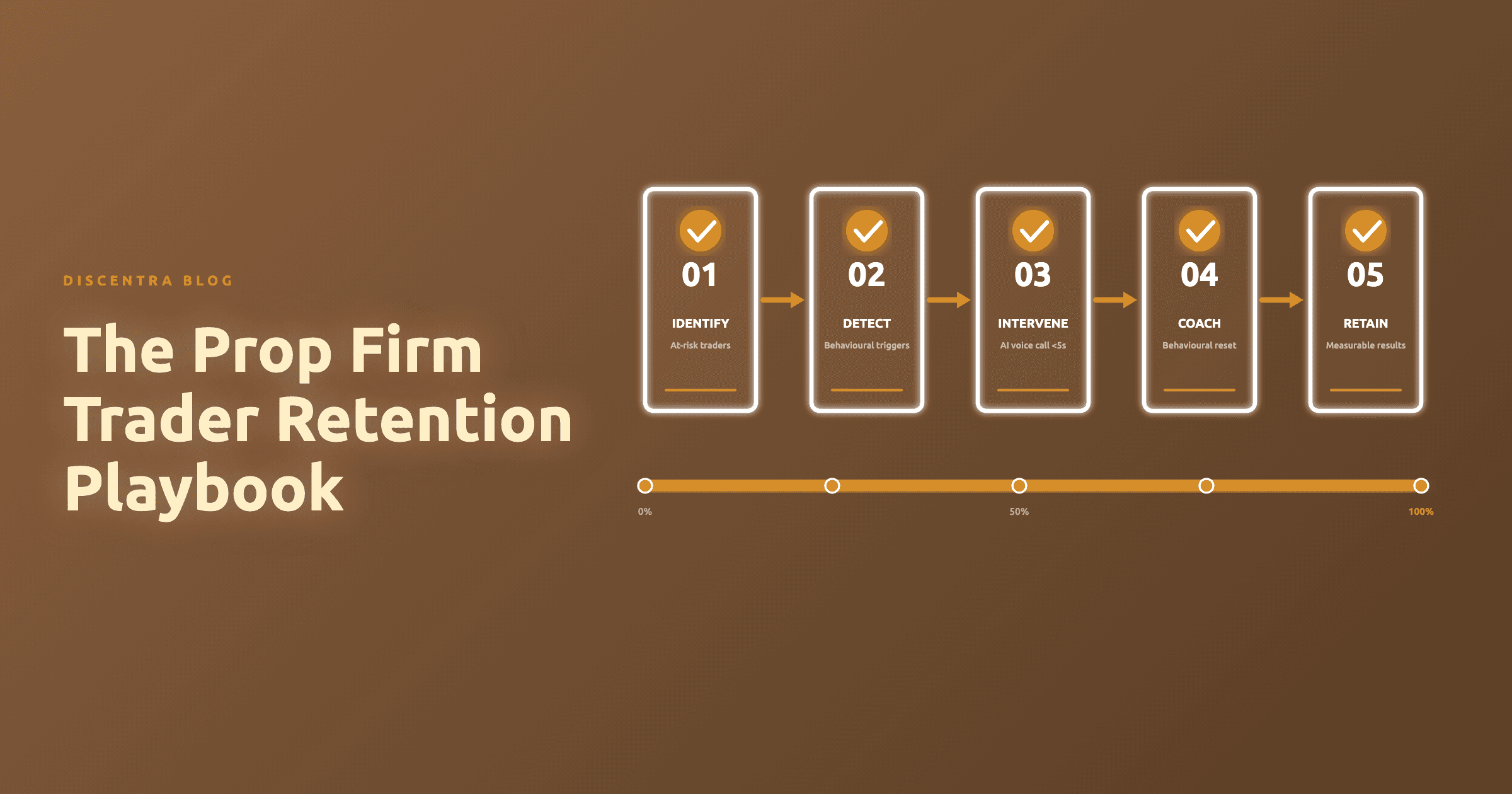
To retain funded traders, a prop firm has to interrupt the behaviour that breaks funded accounts, not out-bid the firm next door on fees, splits, or rules. The usual levers (a higher profit split, a Discord community, a visible scaling plan) help at the margins. None of them reach the trader in the minutes a funded account dies: a losing streak, a tilt episode, then a revenge trade at a larger size placed seconds after the loss. The five plays below address that sequence in real time, before the next trade rather than after the account is gone.
250 firms. One playbook. Zero differentiation.
Count the prop firms operating today. You will stop somewhere past 250. Now compare their offerings. Same drawdown limits. Same challenge structures. Same profit splits within a few percentage points. Same MT5 or TradingView integration. Same Discord server with the same memes.
A trader fails an evaluation at Firm A, pays again at Firm B, fails there, moves to Firm C. The industry calls this growth. It is a rotation treadmill disguised as acquisition.
The firms that break this cycle do five things differently. None of them involve lowering evaluation fees.
The commoditisation trap
Prop firm operators feel the competitive pressure. The instinct is to compete on price (lower evaluation cost), splits (higher payout percentage), or rules (more lenient drawdown limits). All three are wrong.
A trader who leaves because Firm B offers an 85/15 split instead of 80/20 will leave Firm B when Firm C offers 90/10. Price-sensitive traders are structurally disloyal. Competing on price attracts the traders most likely to churn.
The deeper problem: none of these levers address why traders leave. ~75% of retail traders quit within 90 days. They quit because they tilted after a losing streak, revenge-traded into a bigger loss, and blew the account on a Tuesday afternoon. That is a behavioural problem.
The firms winning the retention game address the behaviour directly.
Play 1: Monitor behaviour, not just trades
Most prop firm platforms log trade outcomes. Entry price, exit price, P&L, position size, timestamp. This is a transaction log. It tells you what happened, not why.
The leading firms track six behavioural patterns that predict account failure before it happens:
- Rapid-fire trading. Five or more trades within 15 minutes. This is tilt in progress.
- Revenge entries. A loss followed by a new position within 60 seconds at a larger size. The trader is trying to "win it back."
- Position size spikes. A sudden increase to 2x or 3x the trader's normal sizing. Emotional conviction, not strategic conviction.
- Consecutive loss acceleration. Five losses in a row where the time between trades shortens with each one.
- Daily loss limit approach. A trader at 70% of their daily drawdown limit and still opening positions.
- Session overextension. Trading for 6+ hours without a break after significant losses.
These six patterns are detailed in our behavioural triggers breakdown. The point here is simpler: if your platform only records the trade, you are blind to the sequence of decisions that led to the blow-up.
Trade data tells you what happened last week. Behavioural data tells you what is happening right now. The firms that track both intervene before the account breaches.
Play 2: Intervene in real time
Detection without action is a dashboard. Dashboards do not save accounts.
Research on performance under stress in elite sport, military training, and emergency medicine shows a consistent finding: an external coaching prompt during the stress event reduces error rates more than prior training alone. The neuroscience is clear: once the amygdala hijacks prefrontal decision-making, the trader's plan, journal, and course notes are inaccessible. The rational brain has left the building.
The window between a trigger event and the next trade is approximately 4 minutes. The four-minute figure is our own operational marker, not a number from the literature. That is the gap where discipline collapses. A journal entry tomorrow does not close that gap. A phone call in 5 seconds does.
The intervention model works in tiers:
- Early warning (SMS). The trader is approaching a threshold. A text nudge: "You have taken 3 losses in 12 minutes. Your plan says to pause after 2."
- Active tilt (voice coaching). The pattern has escalated. A call that sounds like a coach, not an alarm: "Walk me through your last three trades. What does your trading plan say about this situation?"
- Crisis escalation. The trader shows signs of financial desperation or severe distress. Human escalation to the firm's designated crisis contact.
This is coaching, not financial advice. No trade recommendations. No position sizing suggestions. No "buy this" or "sell that." The coach reflects the trader's own plan back to them at the moment they are about to abandon it.
What the call protects is the discipline that gets traders paid. Thomas Heinfart, CEO of prop firm FundedHive, put it this way in an interview with ResponsibleTrading.com, reported by Finance Magnates:
Traders who get paid are usually not the ones taking the biggest shots, they are the ones who stay eligible, controlled, and consistent.
Eligible, controlled, and consistent describes a behavioural state. Real-time coaching exists to hold traders inside that state at the moment it starts to slip.
The firms that intervene in real time prevent the breach that causes the churn that causes the 1-star review. The sequence matters. You cannot fix a Trustpilot problem at the Trustpilot layer.
Play 3: Make the evaluation a relationship, not a transaction
Most prop firms treat the evaluation as a gate: a trader pays a challenge fee, receives a set of rules, trades for 30 days, and either passes or fails. If they fail, they pay again. If they pass, they get a funded account. The firm's relationship with the trader begins at funding, and even then the stretch between funding and first payout passes in silence.
This is backwards. The evaluation is where your future churn takes root. A trader who white-knuckles through the challenge with poor habits will repeat those habits on the funded account. The evaluation selected for outcome. It told you nothing about the trader's process.
The firms that retain traders treat the evaluation as a coaching onramp:
- Behavioural baseline. Use the challenge period to establish the trader's normal patterns: average position size, typical session length, response to consecutive losses. This data calibrates the intervention engine for the funded account.
- Proactive check-ins. Contact the trader during the evaluation, not just when they pass or fail. "Day 12: you have been consistent on risk management. Here is one pattern to watch." This signals that the firm cares about the trader's development, not just their fee.
- Failure as feedback. When a trader fails a challenge, the debrief matters more than the discount code. Which behavioural pattern caused the breach? Was it a single revenge trade or accumulated tilt? Give the trader actionable data, not a coupon for their next attempt.
The challenge fee is not the product. The funded account is not the product. The relationship between the firm and the trader's development is the product. Firms that figure this out retain traders at rates the discount-driven firms cannot match.
Play 4: Build a feedback loop
Most prop firms have data. Few have a feedback loop.
A feedback loop requires three components:
1. Track intervention outcomes. A trader receives a coaching intervention (text, call, or check-in). Did they pause? Did they reduce position size? Did they close the session? Or did they ignore it and blow the account anyway? Track the before and after.
2. Segment by trigger type. Not all behavioural triggers are equal. Revenge trading after a single large loss responds differently to intervention than slow-burn tilt accumulated over 4 hours. The five predictive metrics that correlate with churn are not the same five that correlate with recovery. Know the difference.
3. Close the loop with the product. If 80% of your funded account breaches start with a revenge trade within 60 seconds of a loss, that is not a coaching insight. That is a product insight. Your evaluation rules, your drawdown structure, and your intervention timing should all adjust based on what the data shows. The firms that treat behavioural data as a static report miss the compounding value.
The feedback loop also answers a question most firms ignore: which traders should you invest coaching resources in? Not every trader is coachable. Not every intervention works on every personality type. The firms that allocate coaching resources based on responsiveness data retain more traders per dollar spent than the firms that apply a uniform approach.
Play 5: Own the narrative
A churned trader who writes a 1-star Trustpilot review is a marketing cost. A retained trader who writes a 5-star review is a marketing asset. Retention is brand strategy.
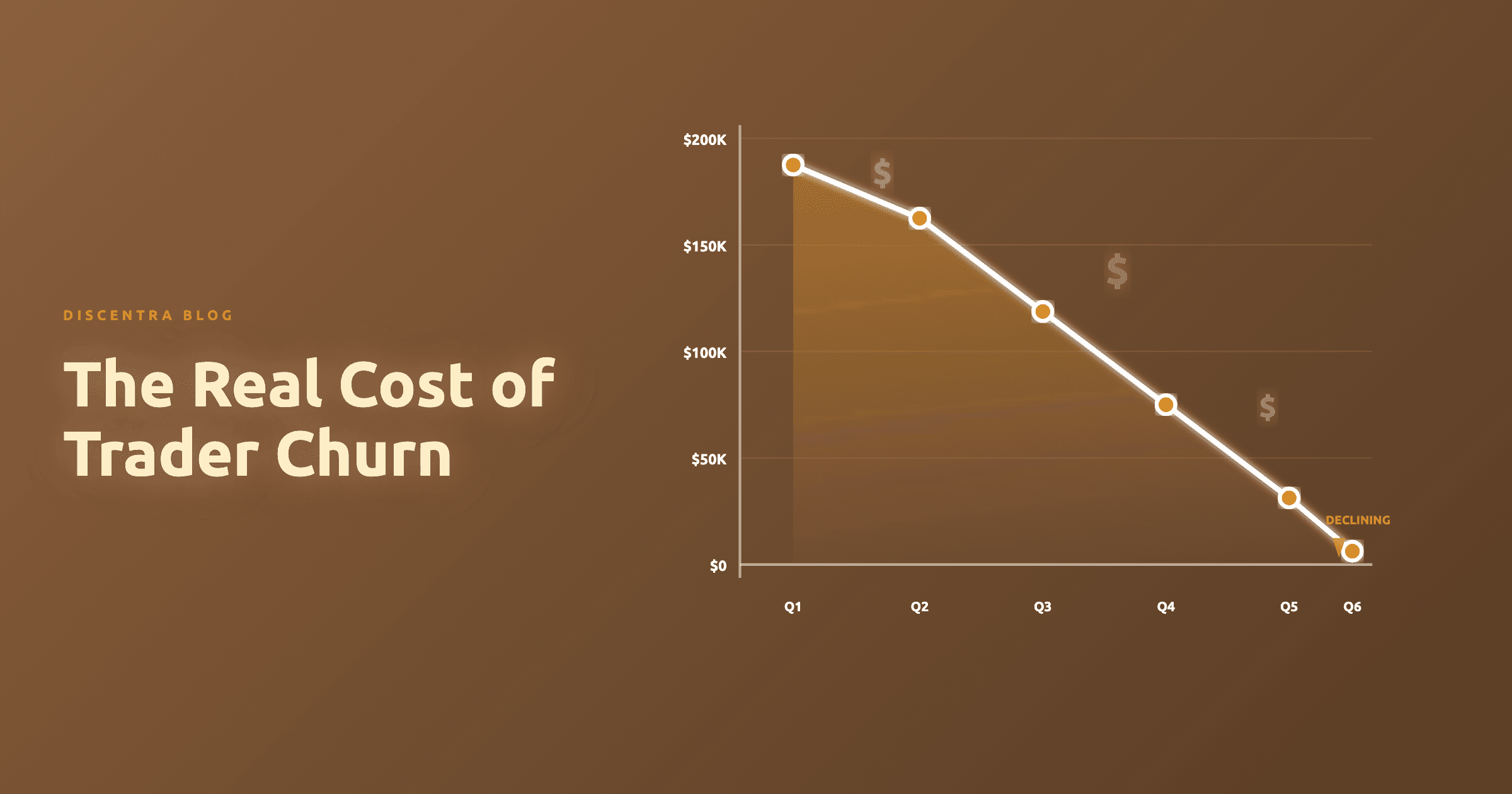
The maths are straightforward. A firm with 1,000 traders churning monthly and a 3% review rate generates 30 negative reviews per month. At an estimated 5 to 10 lost prospects per negative review, that is 150 to 300 traders who never sign up. At $500 CAC equivalent, that is $75,000 to $150,000 in invisible acquisition cost. Every month.
Now reverse it. A firm that reduces churn by 10 percentage points retains 100 more traders per month. Those retained traders generate positive reviews, referrals, and social proof. The organic inbound grows while the treadmill slows.
The narrative shift is concrete:
- From "we have the best rules" to "we have the best trader outcomes." Rules are copiable in a weekend. Outcomes are not. Even the consistency rule measures discipline but cannot build it.
- From "our split is higher" to "our traders stay funded longer." A 90/10 split means nothing if the average funded trader lasts 6 weeks.
- From "sign up for a challenge" to "join a programme that coaches you through it." The positioning changes the type of trader you attract, which changes the retention curve from day one.
Prop firm operators spend significant budget on influencer deals, affiliate programmes, and paid ads. The highest-return marketing investment is keeping the traders you already have. A retained trader who posts "I have been funded for 6 months and the coaching kept me in the game" is worth more than any ad spend.
The playbook at a glance
The five plays in one view:
| Play | What it changes | Time-to-impact |
|---|---|---|
| 1. Monitor behaviour, not just trades | The platform sees the decision sequence that precedes a breach, not just the trade record after it | Current session: behavioural data shows what is happening right now |
| 2. Intervene in real time | A tilt episode gets interrupted before the next trade, by SMS nudge, voice call, or human escalation | Seconds: a call can land inside the roughly four-minute gap between trigger and next trade |
| 3. Make the evaluation a relationship, not a transaction | The challenge becomes a behavioural baseline and coaching onramp instead of a pass/fail gate | Starts during the challenge period, before the funded account exists |
| 4. Build a feedback loop | Intervention outcomes feed back into evaluation rules, drawdown structure, and intervention timing | Compounding: the loop improves every quarter it runs |
| 5. Own the narrative | Marketing shifts from rules and splits to trader outcomes, reviews, and referrals | Monthly: every retained cohort adds positive reviews and referrals instead of 1-star reviews |
How do prop firms keep funded traders trading longer?
Funded traders stay longer when the firm interrupts the behaviour that ends accounts early. The sequence that cuts a funded career short is behavioural: a loss, a tilt episode, a revenge trade at larger size, then the breach. Of the five plays, the one that moves trader lifetime most is the second: reaching the trader inside the minutes between the trigger and the next trade, before the breach that rule enforcement can only punish.
Longevity is not a perk problem. A higher split does not stop a revenge trade, and a fee discount does not calm a tilt episode. The firms that keep funded traders trading longer treat months of survival as the metric, and coach the moments that end those months early.
The consolidation is coming
The prop firm industry cannot sustain 250+ firms offering identical products. Consolidation will happen through two mechanisms: firms that run out of evaluation fee revenue as the market saturates, and firms that differentiate strongly enough to absorb traders from the rest. One way the survivors are differentiating is launching their own brokerages to graduate funded traders into real accounts, a shift that only pays off if the trader survives long enough to be worth keeping.
The pressure is visible outside the prop world too. Senior voices in the wider trading industry are questioning the challenge model in public. Brendan Callan, then CEO of the regulated broker Tradu and now CEO of FXCM and Tradu, told Finance Magnates in January. He drew the line carefully: his objection is to the funded-account challenge model, not to established proprietary trading firms, which he exempted by name.
There's prop trading and then there's the challenge in the funded industry. [...] Beware prop trading, beware funded accounts. Let's not try to perpetuate this nonsense.
Agree with the verdict or not, this is the climate funded-trading firms now operate in. The firms that outlast it will be the ones whose traders stay funded long enough to tell a different story.
The differentiator will not be price. It will not be splits. It will not be rules.
It will be who keeps traders funded longest. The firm that coaches its traders through tilt, catches revenge trades before they breach, and builds a feedback loop that improves every quarter will compound retention advantages that discount-driven firms cannot replicate.
Five plays, none of which require lowering your fees. All of them require treating trader retention as a solvable behavioural problem rather than an accepted cost of doing business.
The firms that figure this out first will own the next phase of the industry. The rest will keep competing on splits.