The build-or-buy question just went live
For years, an AI coach that called a trader inside a tilt episode was a pitch, not a product. That changed. A handful of firms have now shipped their own in-house coaching bots into funded accounts, and the rest of the market noticed. The question on the table in operator Slacks is no longer "could this work." It is "should we build one too."
The trouble starts the moment you search for the answer. The results split two ways and neither one is the question you asked. Trader-facing apps sell a coach to the individual trader, a B2C subscription the firm has no part in. Platform vendors publish careful build-vs-buy guides, but for the matching engine and the dashboard, not the coaching layer. Nobody has written the analysis an operator actually needs: build or buy the thing that reaches the trader in the moment discipline fails.
The retention playbook covers what a firm should do, and why prop firms are becoming brokers covers why keeping a funded trader alive suddenly matters more. This covers whether to build or buy the tool that does it.
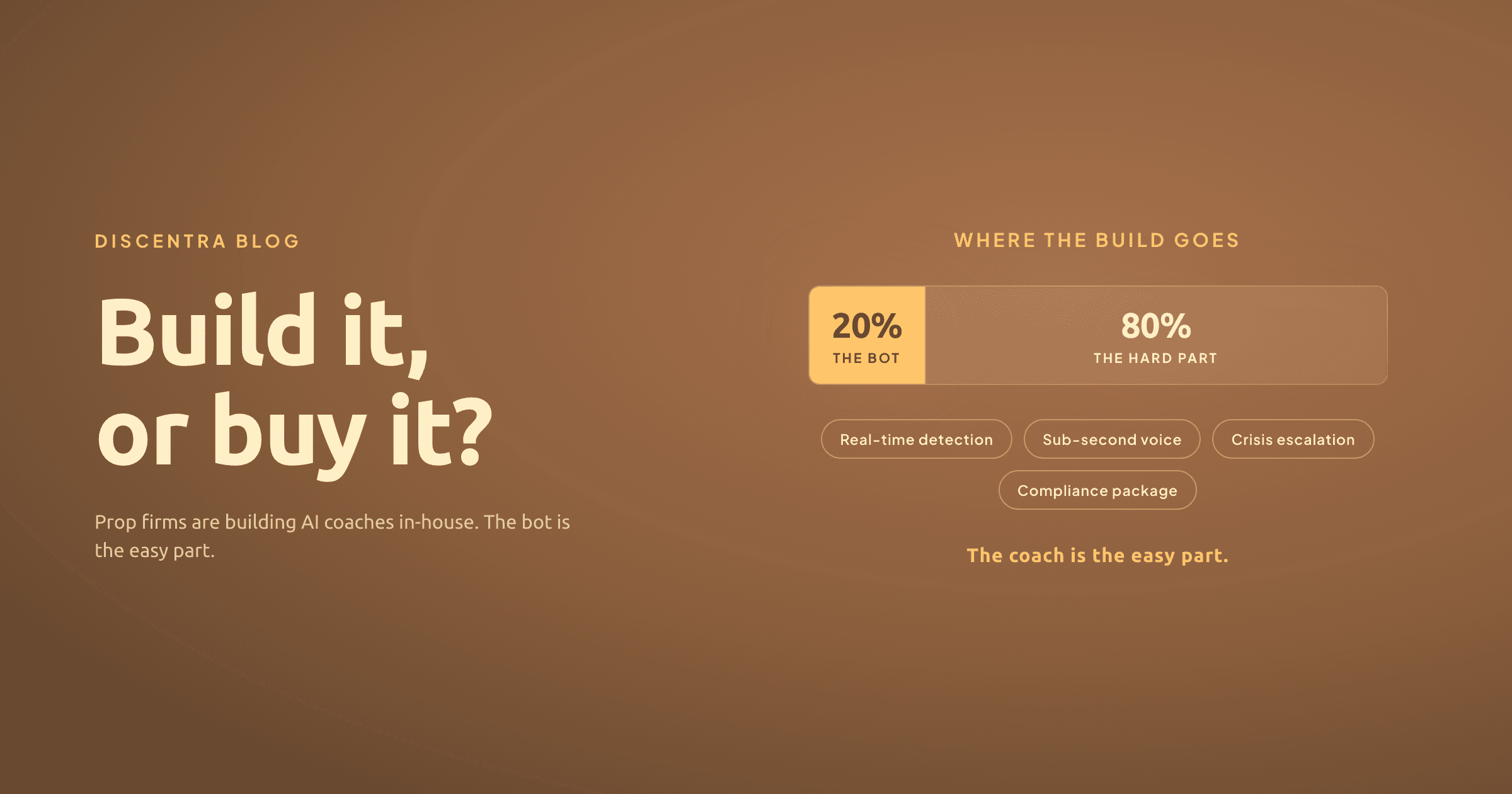
Building the coach is the easy 20%
A language model with a trading-psychology prompt is a weekend project. It will talk to a trader about tilt, reference a trading plan, sound calm and supportive. It demos beautifully. Most of what ships under the label "AI coach" is exactly this: a chatbot with a trading prompt in front of it. What firms have built in-house so far mostly grades the trade after it is done.
It does almost nothing for retention. Retention is not decided in a chat window the trader opens when calm. Most funded accounts die behaviourally, in the few minutes between a trigger and the next oversized trade, when the trader is staring at a red screen and not opening a chat window at all. A coach that waits to be opened is a journal with a personality. By the time they open it, they are already three losses deep.
The gap between a thing that demos and a thing that retains is not the chatbot. It is everything around it.
The 80% nobody scopes
Here is what stands between a demo and a coach you can point at a live funded account.
Real-time behavioural detection. The coach has to know a trader is tilting before the trader admits it, from live trade data, in under a second. A loss followed by a larger position inside 60 seconds, five trades in fifteen minutes, a drawdown limit approached and ignored: the patterns that precede a blow-up. That is a streaming behavioural engine running on every trade event, not a report someone reads the next morning.
Voice that interrupts, fast enough to feel human. Text gets swiped away in the time it takes to dismiss it, which is why a voice call breaks a tilt loop where a notification does not. But voice only works if the response feels human, and that means sub-second latency. Two years ago that number was five to ten seconds and the call sounded like a robot reading a script. Today the voice response runs in the low hundreds of milliseconds. Hitting that bar in-house means a real-time audio pipeline, not an API call inside a loop.
A crisis path with a human on it. A coach that detects a trader in genuine financial distress and has nowhere to send them is a liability, not a feature. Crisis escalation needs a human handoff and a designated contact, designed in from the start. A bot that talks to a desperate person and then hangs up is the headline no firm wants.
The compliance package. This is where in-house builds stall. A system that places automated calls and records them needs trader consent under PECR and TCPA. A system whose voice is synthetic needs an AI disclosure on every call, which becomes enforceable in the EU in August 2026. A system that handles trader data needs a data-protection assessment and an audit trail before a procurement or security team will sign off. None of this lives in the language model. All of it lives in the build.
None of these four are the coaching. They are what makes the coaching safe to ship.
The real cost of build, after the demo
The demo is a week. The product is a realistic 12 to 18 months. That is an estimate to pressure-test against your own team and stack, not a published benchmark.
The part most build estimates leave out is what happens after launch. A voice-coaching system is not a project you ship and walk away from. It carries standing maintenance:
- Latency tuning as call volume scales from ten traders to ten thousand.
- Regulatory-drift tracking. The EU AI Act timeline alone has already split into two enforcement dates, and the calendar keeps moving.
- Voice-persona tuning, so the coach lands one way for a loss spiral and another way for an overconfident win streak.
- Carrier plumbing. SMS registration runs through a two to three week carrier vetting process nobody warns you about, and it gates whether your early-warning text even sends.
That is a standing team, not a finished feature. The build-or-buy question is really a question about where your best engineers spend the next year.
When to build, when to buy
The decision is cleaner than it looks once the hidden 80% is on the table.
| Build in-house | Buy a platform | |
|---|---|---|
| Runway | 18-month horizon to first safe deployment | Live this quarter |
| Team | Dedicated voice, ML, and compliance headcount | Your engineers stay on the trading platform |
| Compliance | Built as its own workstream | Arrives with the product |
| Best fit | The coaching layer is core IP you want to own | The coaching layer protects the product you already sell |
A handful of the largest firms clear the build bar, and they are the ones who shipped first. Most firms do not, and that is not a failure of ambition. It is a question of where the next engineering year is best spent.
The middle path, building a chatbot and calling it a coach, is the one to avoid. It costs real engineering time and produces the thing that demos well and does not move the retention number.
The layer, bought
What a platform buys an operator is the 80%, already built and already carrying the compliance package. Detection inside the window. Voice that interrupts at sub-second latency. A crisis path with a human on it. The consent, the disclosure, the audit trail, and the data-protection work done before the first call. Bought, the firm owns the deployment, owns the trader data, and brands the layer as its own.
Discentra is the first-mover in voice-based behavioural intervention for prop firms, built compliance-first because the compliance is most of the work. It reaches the trader in the window where discipline collapses and prompts them back to their own plan. It does not recommend trades, size positions, or predict prices. Coaching, not financial advice.
The build-or-buy maths comes down to one question. Is a voice-coaching platform the product you are in business to build, or the layer you want protecting the product you already sell?