Chatbots solved support. They did not solve behaviour.
The trading industry adopted chatbots over the past five years. Brokers use them for account FAQs. Prop firms deploy them for evaluation questions. Crypto exchanges run them for deposit and withdrawal support. The use case is clear: deflect repetitive tickets, reduce support costs, respond at 3am.
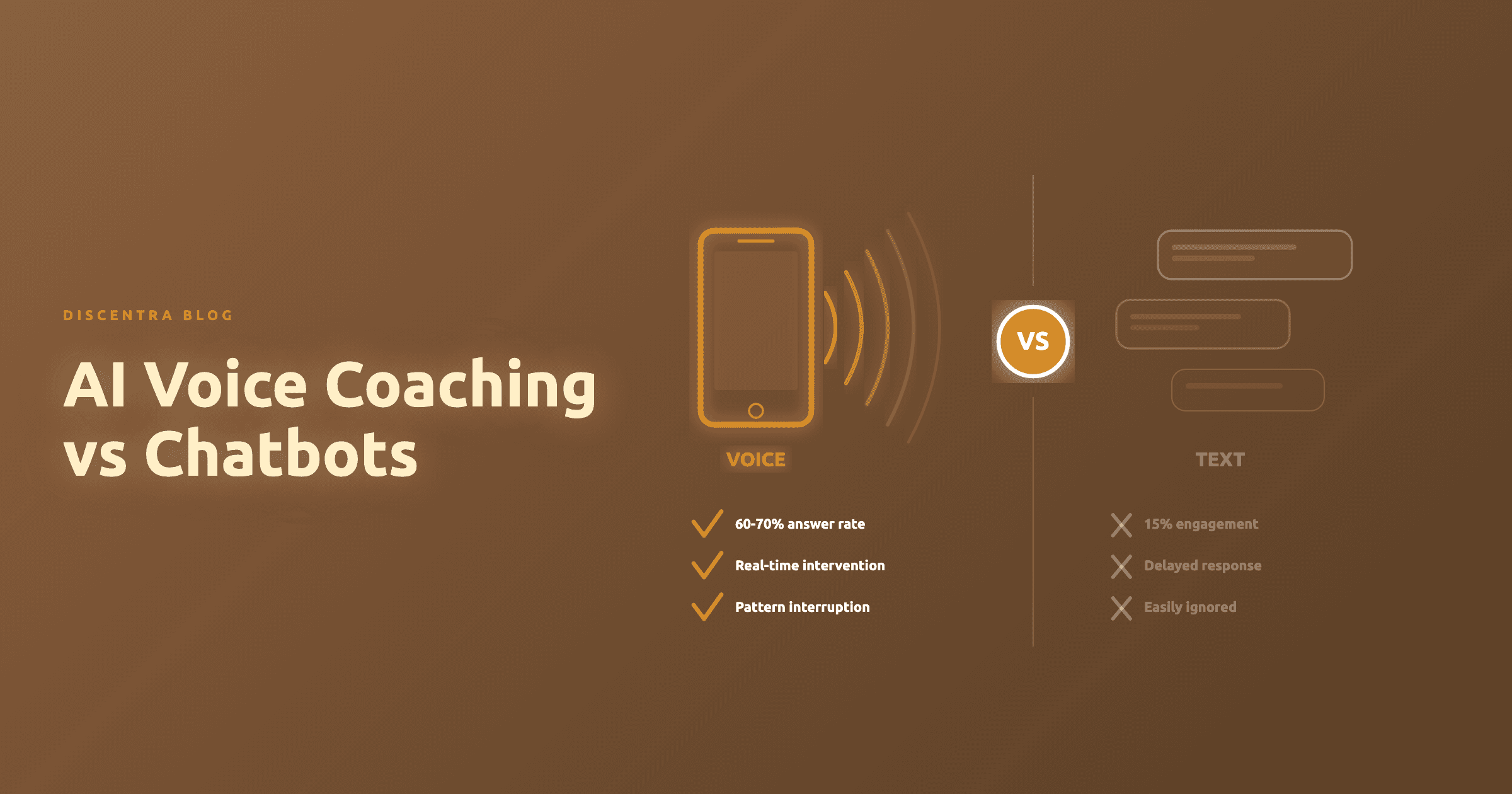
For support automation, chatbots work. For behavioural intervention, they fail. The reason is not the quality of the AI. It is the medium. Text does not interrupt behaviour. Voice does.
How chatbots show up in trading today
The current generation of chatbot deployments in financial services covers four main categories.
Support automation
The most common use case. "How do I reset my password?" "What is the maximum position size?" "When do payouts process?" These are high-volume, low-complexity queries. Chatbots handle them at scale. Support tickets drop 30 to 50%. Response time drops to seconds. The ROI is straightforward.
FAQ and knowledge base bots
Some firms connect chatbots to their rule documentation, educational content, or platform guides. A trader asks "What happens if I hit my daily loss limit?" and the bot retrieves the relevant rule. This reduces the support team's workload and gives traders self-service access to information.
In-app notifications and push alerts
Not technically chatbots, but part of the same text-based category. "Your drawdown has reached 4%." "You have 2 trades remaining on your evaluation." "Your session P&L is -$500." These appear as banners, modals, or push notifications on the trader's device.
Proactive engagement sequences
Automated email or in-app messages triggered by inactivity, milestones, or account events. "You haven't logged in for 7 days." "Congratulations on passing Phase 1." "Your account balance has dropped below the alert threshold." These are lifecycle messages, not real-time interventions.
All four categories share one characteristic: they deliver text. Text on a screen, text in a notification, text in an inbox. The trader reads it (or does not) and continues what they were doing.
The notification problem
A trader mid-tilt has their visual attention locked on one thing: the screen. The charts. The P&L number. The order entry panel. Their eyes are focused. Their hands are on the keyboard or mouse. Their cognitive bandwidth is consumed by the next trade.
Into this state arrives a push notification: "Your drawdown has reached 5%."
The trader dismisses it in 0.3 seconds and goes back to the chart.
This is not a failure of content. The message was accurate. The timing was right. The information was relevant. The medium was wrong. Text-based alerts compete for the same visual attention channel the trader is already using to trade. The notification occupies the same screen, the same field of vision, the same cognitive pathway as the chart, the order book, and the position display.
Under stress, the brain prioritises the primary task. Trading is the primary task. The notification is noise. The brain filters it out the same way it filters a banner ad: in fractions of a second, without processing the content.
Research on notification blindness confirms this pattern. Users who are engaged in a high-attention visual task dismiss interruptions on the same channel without processing the content. The notification was delivered. The message was not received.
Why voice is different
A phone rings.
The trader's hands stop. Their eyes move from the screen to the phone. The auditory channel activates. To answer the call, they must pick up the device, break their posture, shift their attention from the screen to the voice on the line.
This is not a notification. This is an interruption. The difference is structural.
The channel switch
Text notifications compete with the visual channel the trader is already using. A voice call activates the auditory channel, which is not occupied during trading. The trader is looking at charts. They are not listening to anything (or listening to background noise they have learned to ignore). A ringing phone cuts through because it operates on a different sensory pathway.
Interruption theory confirms the mechanism. Cross-modal interruptions (visual task disrupted by auditory stimulus) are harder to ignore than same-modal interruptions (visual task disrupted by visual notification). The brain processes them through separate pathways. A sound demands attention that a screen banner cannot.
The forced context switch
A push notification can be dismissed without breaking the primary task. The trader swipes and keeps trading. A phone call requires a decision: answer or reject. If they answer, the primary task stops. They are no longer trading. They are talking. The screen becomes secondary. The voice becomes primary.
This forced context switch is the mechanism that breaks a behavioural pattern. The tilt loop (loss, stress, impulsive trade, larger loss) runs on momentum. It requires continuous engagement with the trading screen. A phone call breaks that engagement. The loop pauses. The trader's prefrontal cortex, suppressed by the stress response, gets a window to re-engage.
The social engagement effect
Humans respond to voice differently than text. A voice on the phone activates social processing circuits. The trader is no longer alone with their screen and their stress. They are in a conversation. Social engagement dampens the amygdala response. The cortisol cycle slows.
Human coaching calls produce the same effect. The mechanism is the medium: auditory, conversational, requiring active participation. A text notification requires nothing from the trader. A voice call requires them to speak, listen, and respond. That engagement shifts the cognitive state from reactive to deliberate.
Why voice reaches more traders
The structural difference shows in how the two media behave under stress.
Voice calls cut through. The trader sees an incoming call, recognises it is related to their trading (the number is registered, the context is set during onboarding), and picks up. What the first sentence of that call says is its own design problem. A ringing phone forces a decision: answer or reject.
Push notifications compete with the screen the trader is already staring at. Most get dismissed inside a second. Of the ones that register, many are glanced at and forgotten without changing behaviour. Notification blindness is a well-documented response to high-stress visual tasks.
The gap between the two is not marginal. For a firm trying to reduce tilt-driven churn, the channel choice changes the economics of the entire retention programme. Voice reaches materially more traders than text does, at the one moment reach matters.
What AI voice coaching looks like
AI voice coaching for traders is a contextual, adaptive conversation driven by the specific behavioural data that triggered the call.
The AI knows what happened. Three consecutive losses in 8 minutes. A position size spike to 2.5x the trader's rolling average. A drawdown acceleration that crossed the threshold. The conversation starts from that context.
"You have taken three losses in the last 8 minutes. Your last position was two and a half times your usual size. Your trading plan has rules for situations like this. Walk me through what those rules say."
The trader responds. The AI listens, asks follow-up questions, and coaches them through a structured assessment of their current state. Are they trading their plan? What does their risk management framework prescribe here? What would they advise a friend in the same situation?
The call lasts 3 to 4 minutes on average. The trader's stress response has time to subside. The prefrontal cortex re-engages. The trader makes their next decision from a calmer cognitive state.
Three boundaries define every call. The AI does not recommend trades. It does not predict prices. It does not suggest position sizes. This is coaching, not financial advice. The AI's role is to help the trader access their own plan, their own rules, and their own judgement. Not to replace it.
The technology shift that makes this possible
Five years ago, AI voice coaching at scale was not feasible. Three barriers blocked it.
Latency
Early voice AI systems had 5 to 10 seconds of delay between a user speaking and the AI responding. A 10-second pause in a conversation feels broken. Traders would hang up. The coaching conversation requires natural turn-taking, which requires sub-second response times.
Current voice AI platforms operate at 300 to 800 milliseconds of latency. The conversation feels natural. The trader does not notice the AI processing time. This threshold was crossed in 2024 and has continued to improve.
Cost
Voice AI cost $0.50 to $1.00 per minute three years ago. A 4-minute coaching call cost $2 to $4. At 10 calls per trader per month, the unit economics did not work for a B2B platform selling at $4 to $24 per trader per month.
Current costs sit at $0.13 to $0.14 per minute all-in (voice synthesis, language model, telephony). A 4-minute call costs $0.52 to $0.56. At 10 calls per month, the voice cost per trader is $5.20 to $5.60. The unit economics work at every tier.
Quality
Early AI voices sounded robotic. The uncanny valley triggered distrust. Traders would not engage in a coaching conversation with a voice that sounded artificial. The psychological mechanism (social engagement, cortisol dampening) requires the trader to feel they are in a real conversation.
Current voice synthesis from providers like ElevenLabs produces voices that are indistinguishable from human speakers in blind tests. The AI can modulate tone, pace, and emphasis based on the conversation context. A coaching conversation about a losing streak sounds different from a check-in after a winning session. The voice adapts.
All three barriers fell within the past 18 months. The technology is production-ready. Most firms have not adopted it because the category did not exist until now. Chatbots were the default "AI in trading" tool. Voice coaching is a different category.
What firms should evaluate
Keep the chatbot. Support automation, FAQ handling, and lifecycle messaging are valid use cases that text handles well.
The question prop firms, brokers, and exchanges should ask: "Do we have anything that intervenes in real time when a trader is mid-tilt?"
For most firms, the answer is no. Analytics dashboards, trading journals, education platforms, and chatbots all serve the minutes, hours, days, and weeks around a trading session. The 4 minutes during the session where discipline collapses have no coverage.
Voice coaching adds that layer: real-time behavioural interruption at the moment it counts. This is coaching, not financial advice. The AI asks questions that re-engage the trader's own plan and rules.
Firms that evaluate this category first build data, case studies, and operational experience before competitors begin the procurement process. In a market with 250+ prop firms offering identical rules, 6 months of production data is a durable advantage.
Once a firm decides it needs that layer, the next question is whether to build it in-house or buy it. We break down the build-vs-buy maths for an AI coach.
Chatbots notify. Voice interrupts.
A chatbot sends a message the trader can ignore. A voice call forces the trader to stop, answer, and engage. Under stress, when cortisol has suppressed rational decision-making and the next revenge trade is 45 seconds away, that forced stop is the intervention.
~75% of retail traders quit within 90 days. The events that drive them out happen in real time. Text-based support tools handle the operational layer well. Voice-based coaching tools handle the behavioural layer, the one that determines whether a trader stays or leaves.
Firms that add voice intervention to their retention stack keep more traders. The data on answer rates, engagement depth, and pattern interruption all point the same direction.