The failure your risk stack was built for
Every prop firm's risk system is built around one picture of a trader in trouble. A loss lands, the trader wants it back, and the next position is too big. The revenge trade breaches the daily loss limit or the trailing drawdown, the account is flagged, and the risk desk has a record of exactly what happened. It is loud, it is fast, and it is legible. The whole detection stack, max-loss caps, position-size limits, breach alerts, is tuned to catch it.
That failure is real. It is also only half of what stress does to a trader, and it is the half that is easy to see.
The failure it cannot see
The science of stress and risk points in the opposite direction to the intuition. Sustained cortisol, the slower of the two stress hormones, does not reliably make traders bolder. Kandasamy and colleagues at Cambridge, working from stress-hormone levels measured in active traders, ran a controlled study in which volunteers received hydrocortisone over eight days. They became more risk-averse, with their certainty equivalent falling 44%, from £25 to £14. A single acute dose produced no such effect, so this is the multi-day mechanism rather than the one that fires in the minutes after a loss. The same person, offered the same gamble, now needed almost twice the certainty before they would take it.
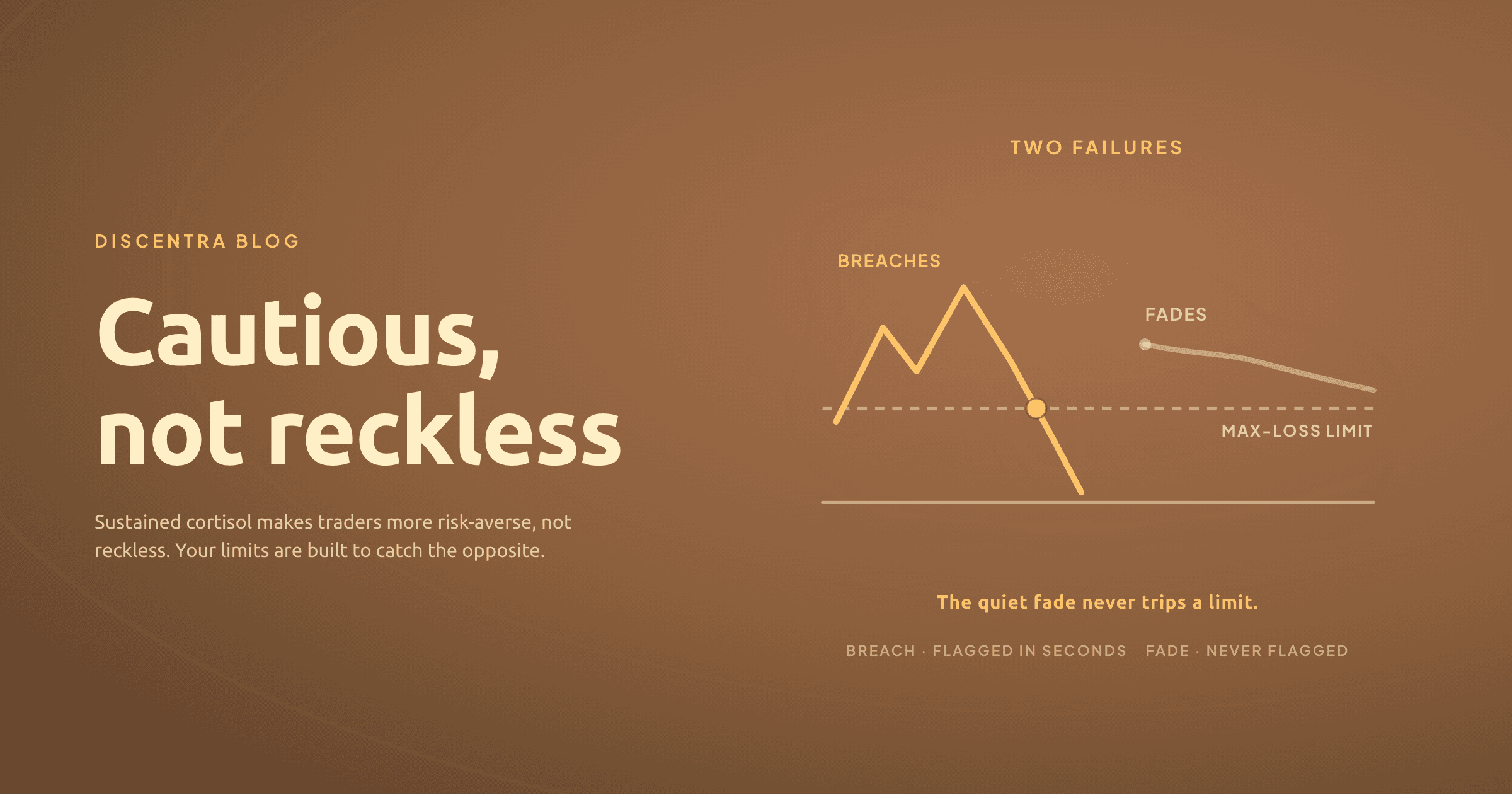
Play that forward on a funded account. A trader under sustained stress does not only blow up. More often they shrink. Winners get cut early to lock in relief, size drifts below the plan, and the setups that fit the strategy go untaken because every one now feels like a threat. The account breaches nothing. It bleeds down through a hundred small, cautious, defensible decisions until there is nothing left to trade.
No max-loss rule fires on that, because no limit was broken. A position-size cap only cares about positions that are too large. Breach detection only speaks the language of breaches. The quiet fade is a failure mode assembled entirely out of behaviour that stays inside every rule, which is exactly why the detection stack is silent while it happens.
| The loud failure | The quiet fade | |
|---|---|---|
| The behaviour | Oversizing after a loss | Undersizing, cutting winners, skipping setups |
| The driver | Adrenaline, within seconds | Sustained cortisol, 20 to 30 minutes |
| Your limits | Breached | Never touched |
| On the risk desk | Flagged | Invisible |
How does cortisol affect a trader's risk-taking?
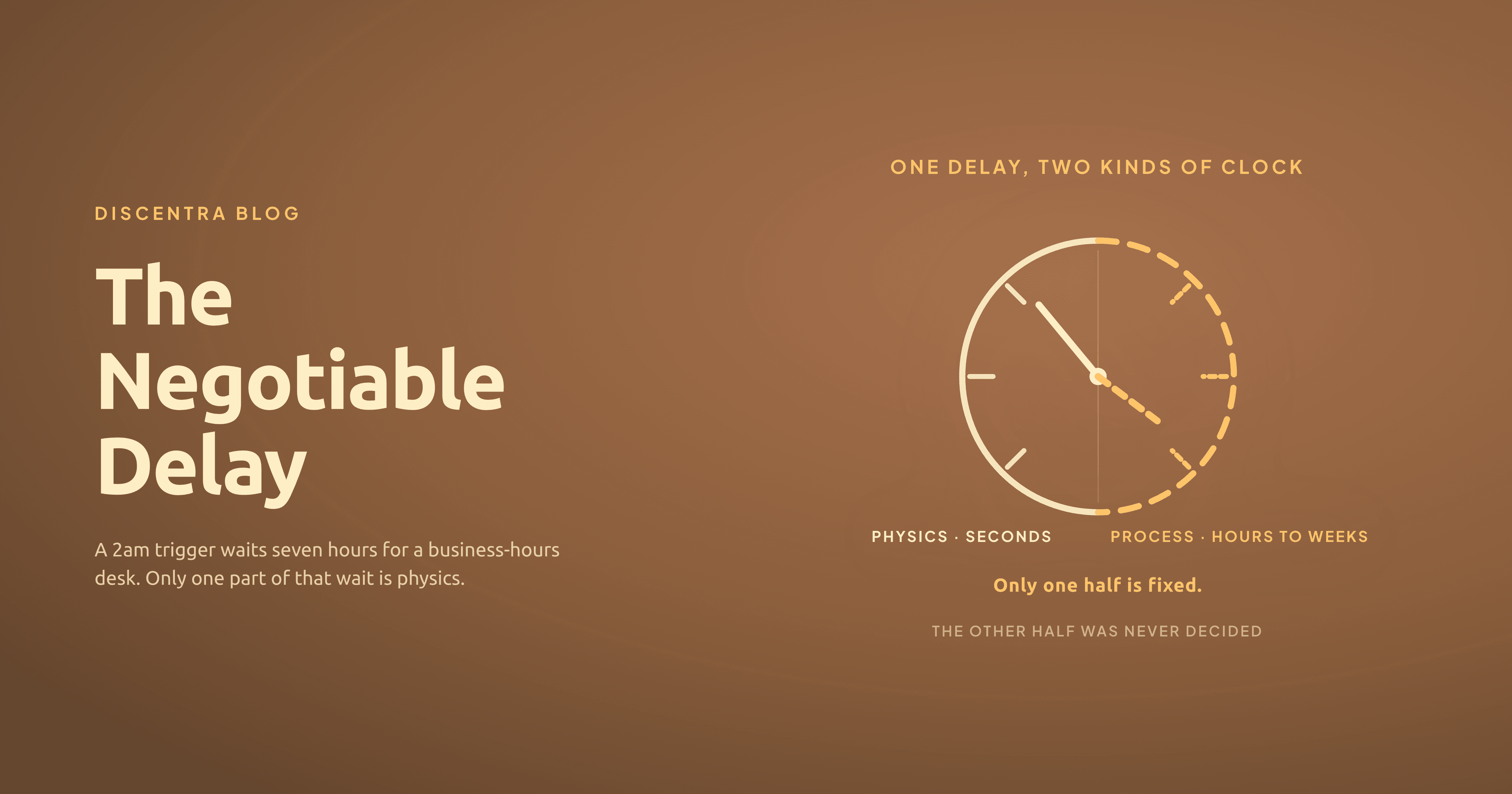
It makes them more cautious, not more reckless. Two stress responses fire after a loss, on two different clocks. Adrenaline arrives within seconds and drives the immediate urge to act; that is the engine of the visible revenge trade. Cortisol rises behind it through the HPA axis, peaks roughly 20 to 30 minutes later, and reshapes how the trader prices risk for as long as it stays elevated. It is this slower hormone that Kandasamy linked to risk aversion. We cover the full mechanism and its timeline in the cortisol glossary entry and in how long tilt lasts; here, only the direction matters. Stress does not only make traders do too much. Held high, it makes many of them do too little.
"We already have an academy"
The reflex response to any behavioural problem is to teach harder. It does not reach this one. Knowledge lives in the prefrontal cortex, the region acute stress suppresses first, so the trader who has read every risk lesson still prices risk through a chemistry that was not running when they wrote the plan. We have made the full version of this argument in the education gap. The narrower point for the risk-averse fade is sharper still: education cannot correct a failure nobody names. Every course warns traders against oversizing. None of them warns a trader that quietly disappearing is also a way to lose a funded account, because the industry does not frame the fade as failure at all. You cannot teach your way out of a pattern your curriculum does not recognise.
What your detection layer cannot see
For a Head of Risk, the consequence is uncomfortable and specific. The instruments on the desk, the dashboards, the drawdown monitors, the alerting thresholds, are all calibrated for the failure that announces itself. They are doing their job. They are watching the wrong door. The trader who bleeds out under sustained stress presents as a run of unremarkable sessions: smaller, quieter, more hesitant, every one of them compliant. By the time the number on the account is low enough to notice, the decisions that got it there are weeks gone and were never flagged, because not one of them broke a rule. Each of those accounts still cost $200 to $2,000 to acquire, spent against a failure the desk was never built to see.
This is not an argument for tighter limits. Tighter limits catch the loud failure sooner; they do nothing for a failure built from compliance. It is an argument that a detection stack made only of thresholds is blind on one side, and that the blind side is where a real share of funded accounts quietly ends.
The window is the whole game
If the failure is behavioural and invisible to thresholds, the response has to read the behaviour itself, and it has to arrive while the trader can still be reached. Cortisol opens a window: the trader is impaired but not yet calm, and the account-ending decisions land inside it. A review the next morning arrives after the hormone has cleared and after the trades are placed. A dashboard the risk desk checks tomorrow is a record, not an intervention. What changes the next decision is contact inside the window, the few minutes Discentra operationalises between the trigger and the next trade, by a voice rather than a notification, because a call interrupts the loop where a message gets swiped away. Coaching, not financial advice.
What the quiet fade looks like
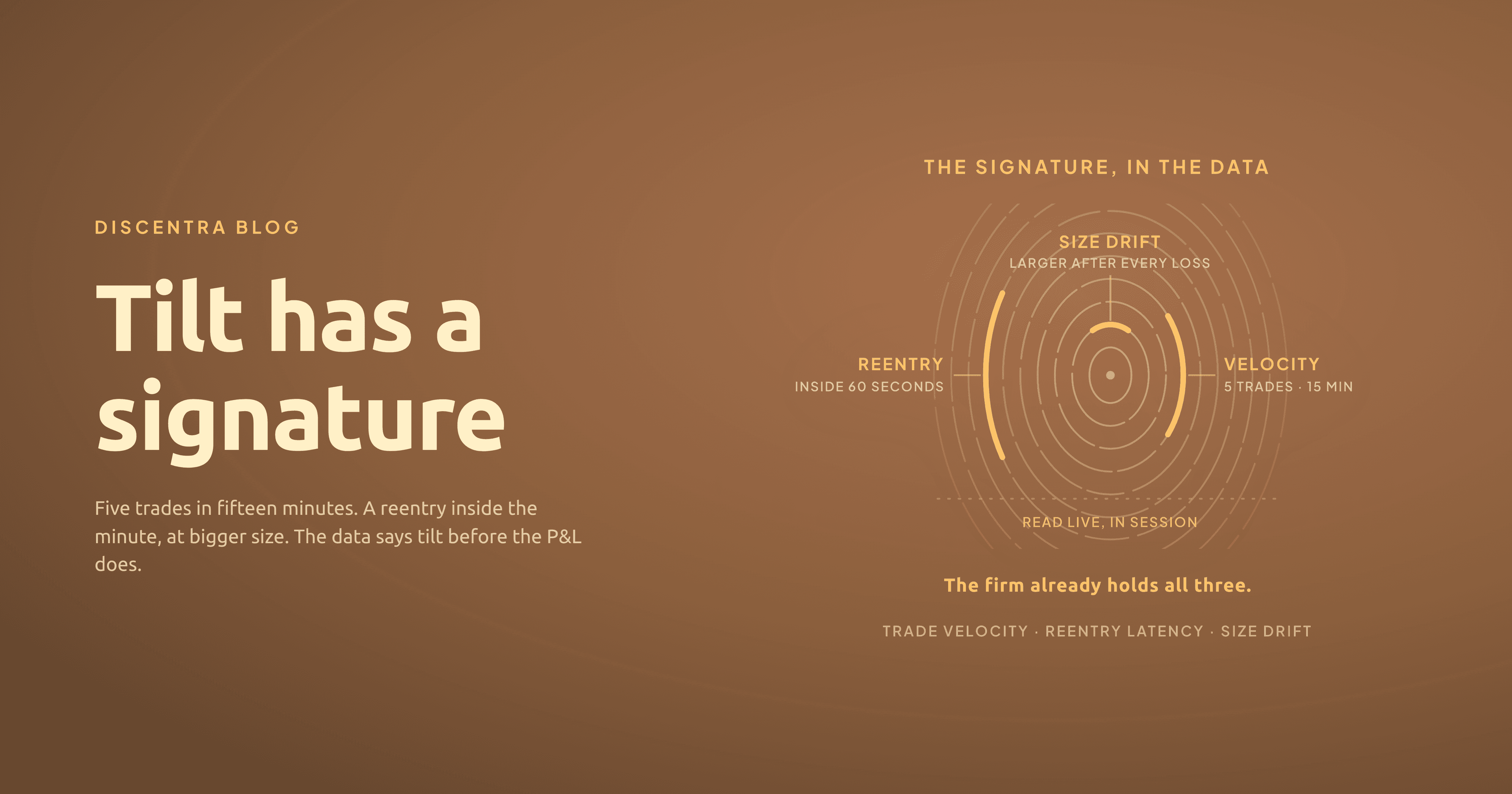
The fade is invisible to limits, but it is not invisible to a layer watching the behaviour. It shows up as a signature that never touches a threshold: session frequency dropping off, position sizes compressing below the trader's own baseline, winners cut faster than the plan allows, longer and longer gaps before re-entry. Read individually, each is defensible. Read together, in real time, they are a trader fading out under load. The five metrics that predict churn and the case for a pre-breach behavioural layer cover how a firm turns that signature into a signal it can act on. The detection problem this post describes is the reason that layer has to exist alongside the limits, not instead of them. The wider retention picture, acquisition cost included, sits in our churn statistics library and the trader retention playbook.
~75% of retail traders quit within 90 days. The loud failures are counted, flagged, and understood. A share of the quiet ones are sitting inside your active cohort right now, trading smaller every week, breaching nothing, on their way to zero.
Sources and notes
- Cortisol and risk aversion (certainty equivalent fell 44%, £25 to £14, under sustained cortisol): Kandasamy et al., PNAS 2014, Cambridge (DOI 10.1073/pnas.1317908111). Peer-reviewed. Supporting: Coates and Herbert, PNAS 2008, on cortisol rising with market volatility among London traders.
- The two stress clocks (adrenaline within seconds via the sympathetic-adrenal-medullary response; cortisol peaking around 20 to 30 minutes via the HPA axis): standard stress-physiology, summarised in our cortisol glossary entry and how long does tilt last.
- Prefrontal suppression under acute stress: Arnsten, Nature Reviews Neuroscience 2009. Peer-reviewed. Note: the prefrontal cortex loses functional capacity under stress; it is not "physically blocked." No reliable speed ratio between the amygdala and the prefrontal cortex exists in the literature, so the multipliers that circulate online should be treated with caution. LeDoux's animal work recorded amygdala responses within about 15 milliseconds, and the human magnitude is debated.
- The intervention window (the few minutes between the trigger and the next trade): Discentra operational construct, not a peer-reviewed term.
- Acquisition cost ($200 to $2,000 per funded trader): industry-reported CAC range, varies by channel and segment.
- "~75% of retail traders quit within 90 days": industry-cited working figure, not a regulator-published statistic. Regulators publish loss rates, a different measure.