What tilt looks like in the data
Traders who have blown an account on tilt describe the same experience from the inside: they knew the next trade was wrong while they were placing it. Awareness fired. It changed nothing. That detail matters for anyone designing a retention system, because it means the fix cannot rely on the trader noticing. The signal has to be read from the outside, and it has to be read from the data.
The data cooperates. Tilt is not invisible until the account fails; it has a signature, and the signature leads the P&L.
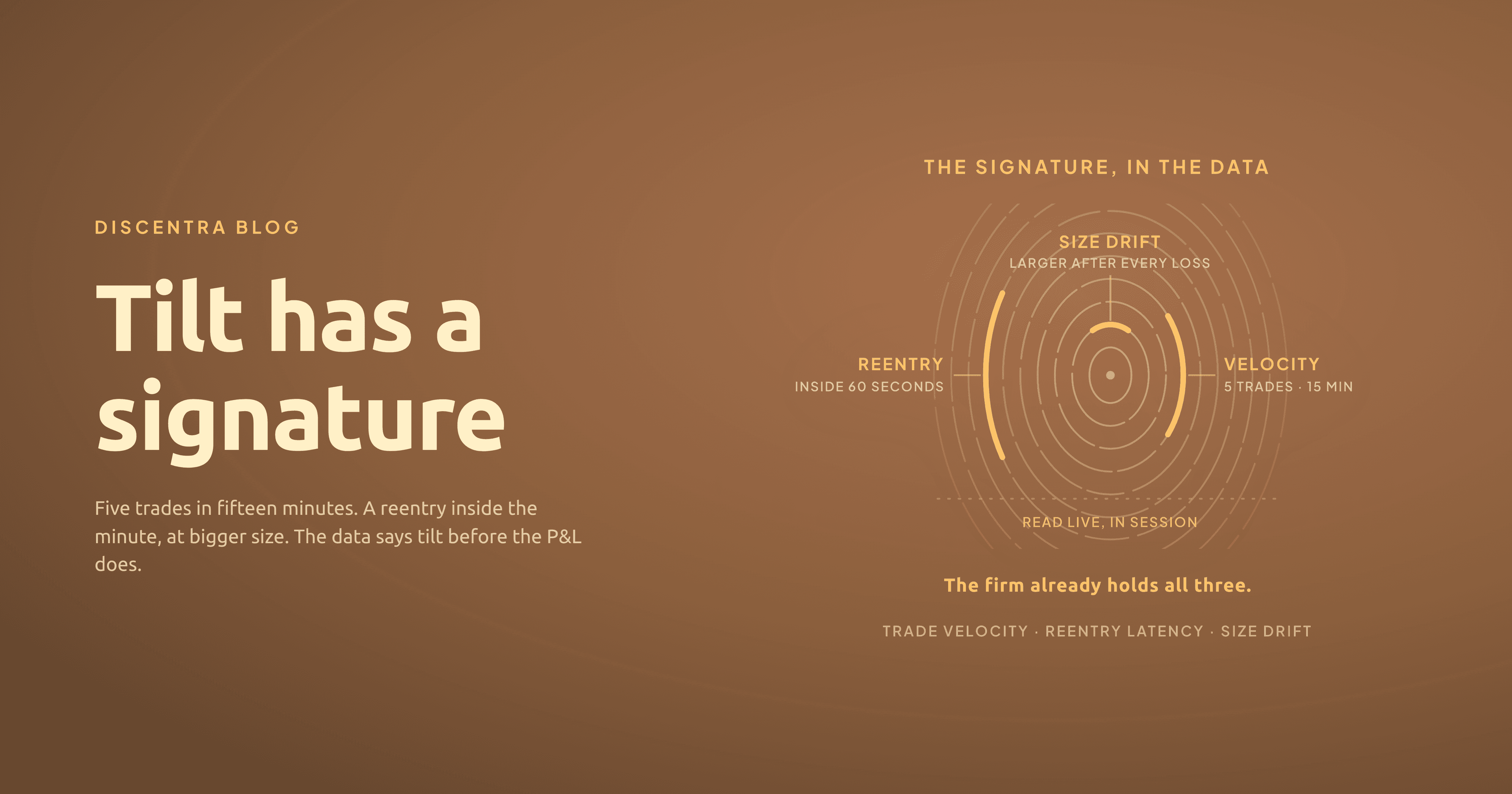
Velocity. A disciplined session has a rhythm: setups are waited for, entries are spaced out. A tilted session compresses. Trades that arrived once or twice an hour start arriving in clusters. The operational threshold Discentra runs in production is five or more trades inside fifteen minutes, measured against the trader's own baseline. That is our construct, not a peer-reviewed constant, and the reasoning behind it is simple: almost nobody's genuine strategy fires that fast, so sustained velocity at that rate is nearly always state, not strategy.
Reentry latency. The sharpest single tell is the gap between a loss and the next position. A trader following a plan absorbs a loss, reassesses, and re-enters when the setup returns. A trader chasing a loss re-enters inside a minute, at larger size. Loss, fast reentry, bigger position: that three-part shape is the revenge trading signature, and it is legible in timestamps and order sizes alone. The one-minute line, like the velocity threshold, is our operational marker rather than a published constant.
Sizing drift. Position size climbing while win rate falls. Each individual trade can look defensible. The trend across a session cannot.
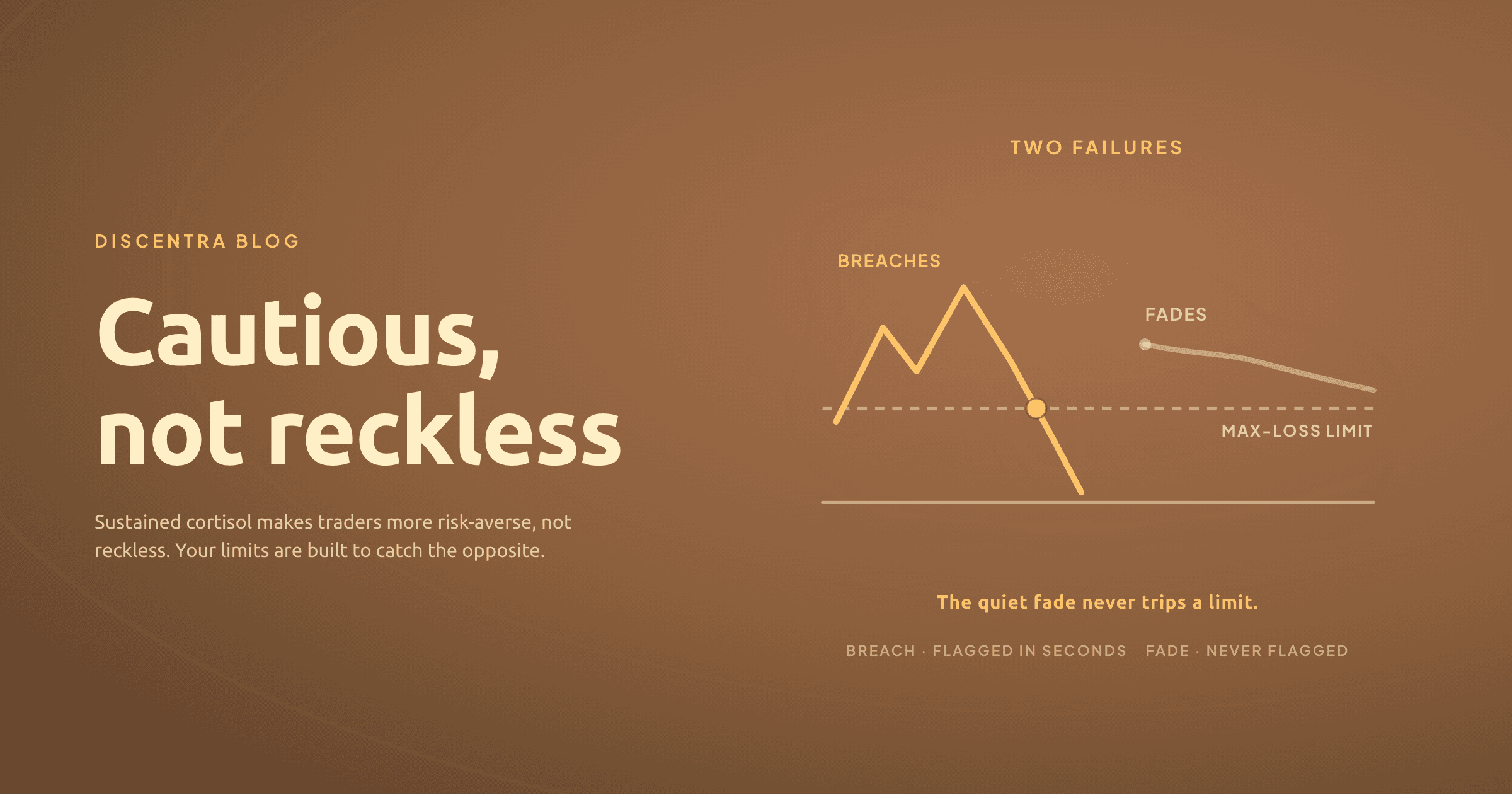
None of this requires new instrumentation. Every prop firm already holds the timestamps, the sizes, and the sequence. What tilt detection adds is the reading of them while the session is still running. The neuroscience underneath the spiral explains why the trader cannot self-interrupt; the telemetry is how the firm knows when that moment has arrived. There is also a quieter failure mode that runs in the opposite direction, where a stressed trader shrinks instead of escalating; that signature and why thresholds miss it is its own subject.
Why the existing stack reads it too late
The standard objection to all of this is that firms already monitor their traders. They do. The question is the tense.
Dashboards aggregate by day. The risk desk reviews yesterday's sessions, and the review is genuinely useful, but a signature that lives inside a fifteen-minute window has been averaged into the daily numbers by the time anyone reads them. The metrics that predict churn over weeks are real and worth tracking; they are simply a different instrument, tuned to a different timescale.
Loss limits fire at the threshold. A daily loss limit is mechanical, reliable, and always on, and it ends the sequence only after the sequence has run. The trades that carried the account from healthy to breached happened inside the window the limit does not watch.
Journals see the session at 9pm. Post-session review is where traders learn, and it is the right home for reflection. It is also, by definition, after every decision it analyses.
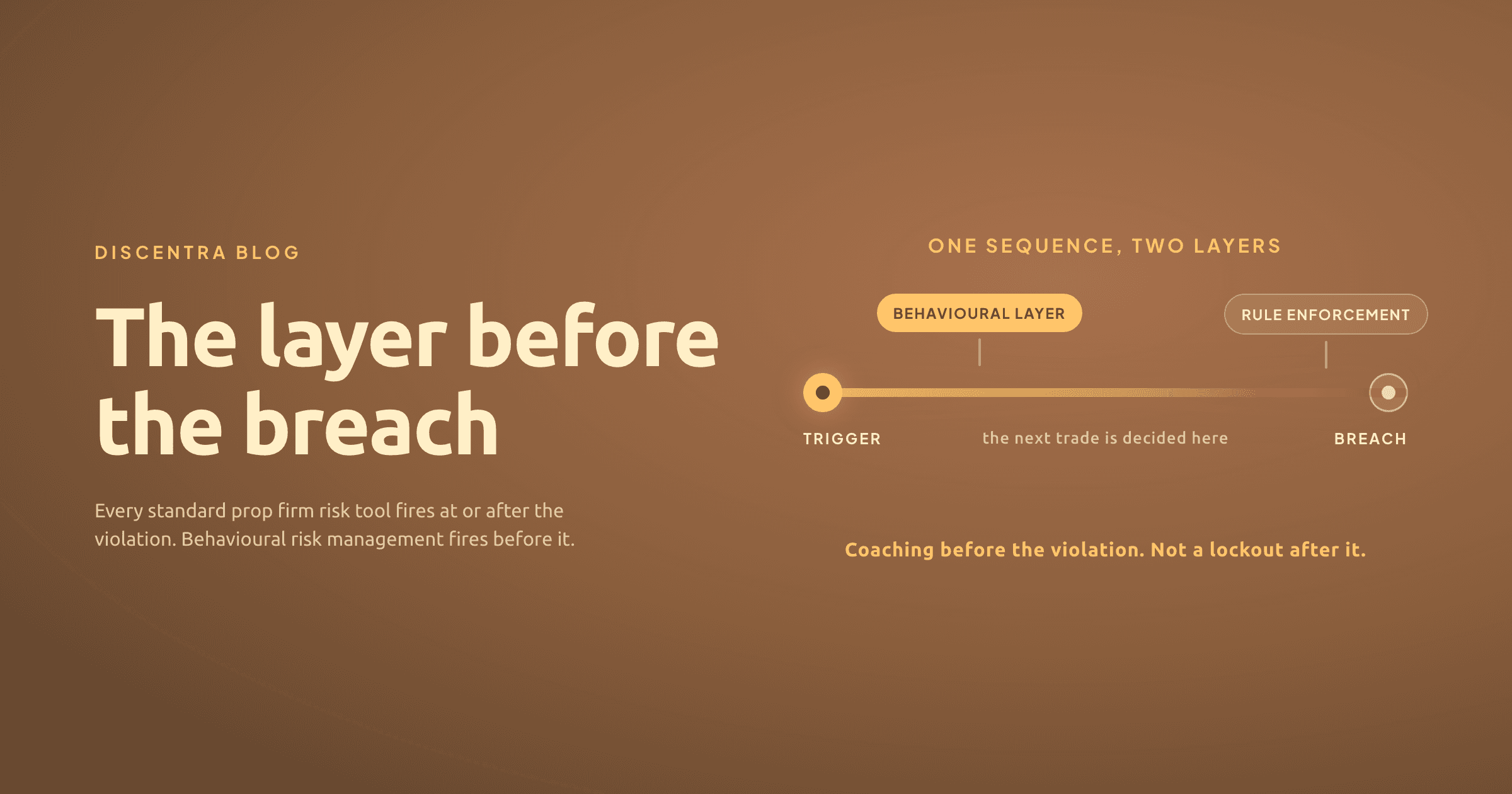
Each of these tools works at its own job. The gap is not the tooling. It is the tense: everything in the standard stack speaks about the session in the past, and tilt is a present-tense event. This is the detection half of the argument made in behavioural risk management for prop firms: rule enforcement catches the violation, and only a behavioural layer can catch the trader before it.
Who already claims tilt detection
The phrase is starting to appear on products, which makes precision worth the trouble. Three positions are occupied today, and it is worth being clear about what each one does.
Trader self-rating tools ask the trader to score their own discipline, session by session. Honest answers when calm, and structurally absent in the moment that matters, because the trader on tilt is not filling in a form about it.
Post-session analysis tools score uploaded trade history and flag revenge trades and overtrading after the fact. The signals are right. The tense is wrong: the analysis lands when the session it describes is already over.
Market sentiment gauges share the vocabulary without sharing the subject. At least one widely used futures platform ships an indicator called a tilt that shows how funded traders in aggregate are positioned across major markets. That is crowd data, updated in near real time, and it says nothing about whether one specific trader is coming apart. Market tilt and trader tilt are different measurements that happen to share a word.
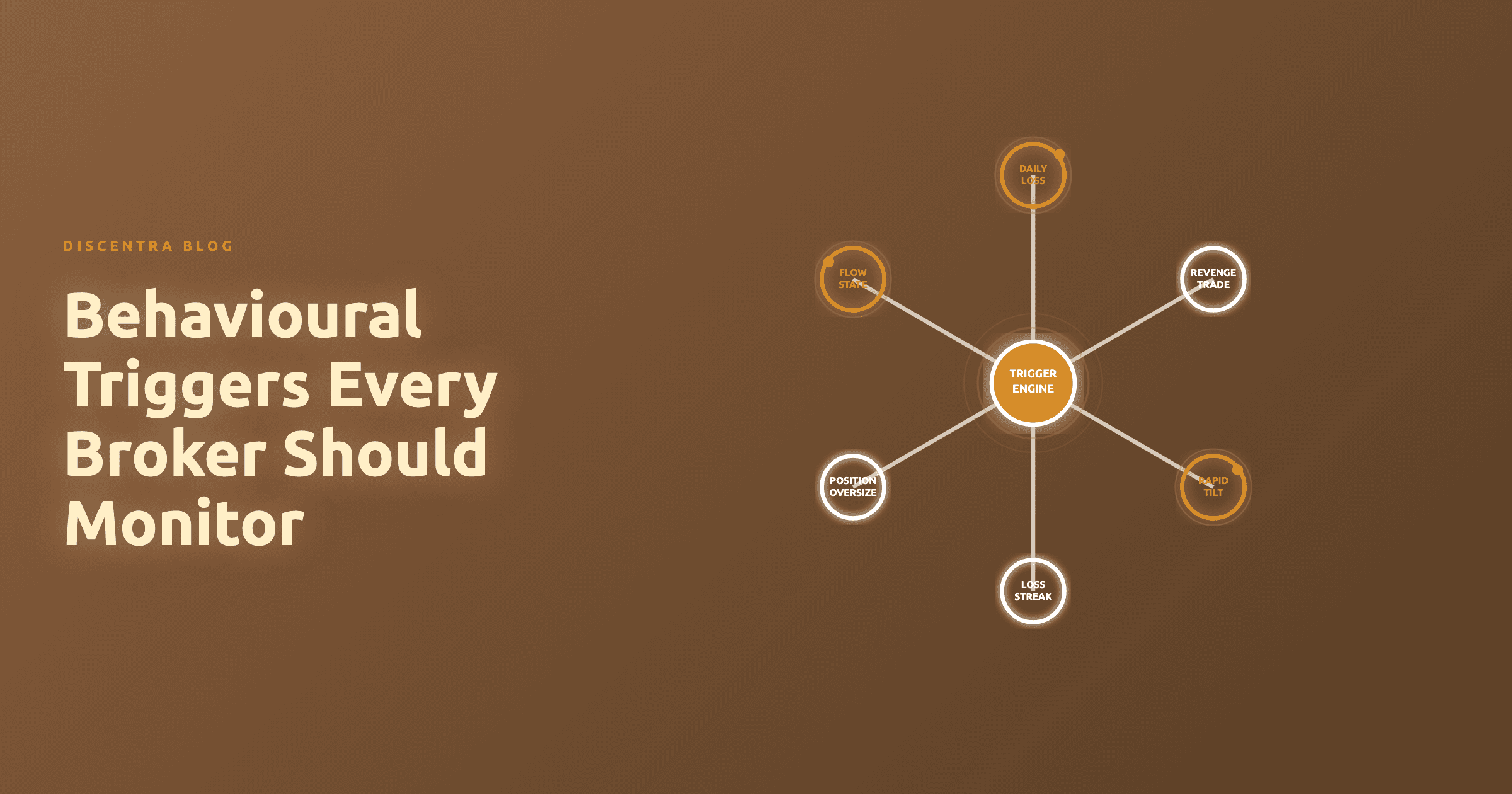
Stated precisely: detection of an individual trader's behavioural state, from live trade events, on the firm's side, wired to an intervention, is the position none of these products holds. That is a narrower claim than "nobody detects tilt," and the narrowness is the point. The behavioural triggers worth monitoring are documented; what has been missing is a system that reads them while they are happening and does something about it.
Detection is necessary, not sufficient
A firm could build everything described above and still retain nobody, because a detected signature with no intervention is a better-documented blowup. Detection finds the moment. Someone still has to call the item.
The constraint is the intervention window: the few minutes between the trigger and the next trade, which we treat operationally as a two-to-four-minute target. Inside that window, the sequence can still change. After it, the next trade is already placed and the detection produced a timestamped record of a preventable loss.
That window sets the engineering bar for the whole category. Trigger evaluation has to happen in under a second per trade event. The response has to reach the trader within seconds, not at the next dashboard refresh. And the medium matters: a voice call interrupts a tilt loop in a way a notification does not, because a notification joins the queue of things a tilted trader is already ignoring, and a ringing phone does not.
What tilt detection is not
It is not surveillance. Traders opt in, consent to the monitoring and the calls, and can leave the programme. The same telemetry read against the trader would deserve the surveillance label; read for the trader, at the moment it helps, it is the firm noticing before the damage instead of after.
It is not trade-blocking. Nothing described here closes a position, cancels an order, or sizes anything. Enforcement tools own hard stops, and the two layers should stay distinct.
And it is not financial advice. Detection triggers coaching: a voice that names what the data shows and points the trader back to their own plan. It never recommends a trade, predicts a price, or suggests a position size. Coaching, not financial advice.
What to ask a vendor who says "tilt detection"
Four questions separate a real-time behavioural layer from a relabelled analytics report.
Which signals, beyond P&L thresholds? If the answer is drawdown percentages, it is enforcement wearing a new name. Velocity, reentry latency, and sizing drift are behavioural; a loss number is financial.
Detected when? Live trade events processed in under a second, or a batch job overnight? The answer decides whether the system can ever act inside the window.
Then what happens? Detection that ends in a dashboard entry changes nothing. The follow-through, reaching the trader before the next trade, is where retention economics actually move.
And is the compliance work done? A system that monitors behaviour and phones traders carries consent, disclosure, and data-protection weight. The compliance package is most of what separates a deployable product from a demo.
Discentra is built as the answer to those four questions: behavioural trigger detection from live trade events, a coaching call placed within seconds, opt-in by design, with the compliance work done. The full retention layer runs on the detection described here. The signature is in your data today. The only question is whether anything is reading it before the next trade.