The sentence that decides the product
Every voice layer a firm might put in front of its traders will, at some point, reach a trader who is about to do something expensive. Three losses in twelve minutes, the last position at twice the usual size, the revenge trade loading. The call connects, and the next sentence decides the product's shape.
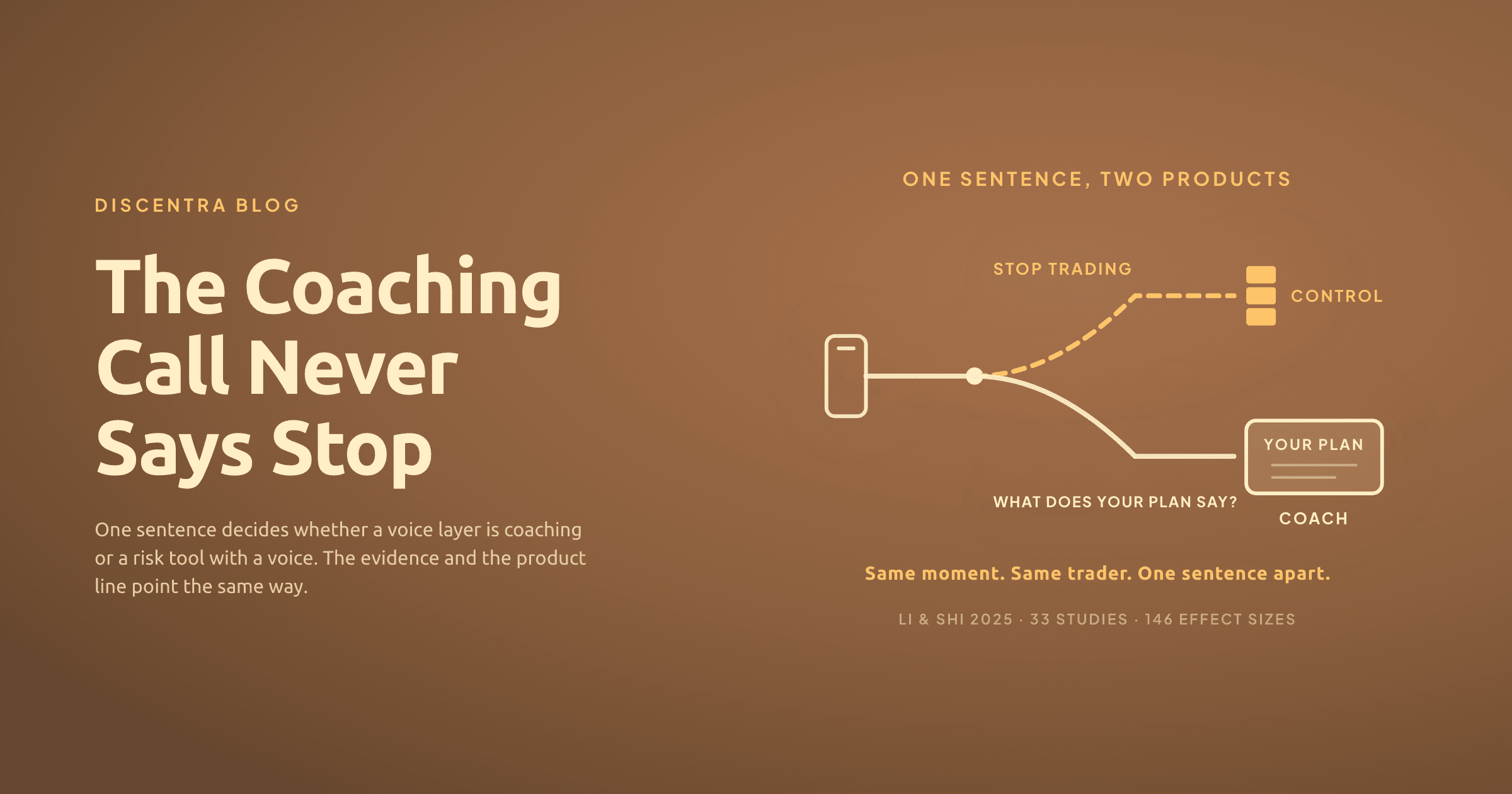
A call that says "stop trading" is giving an order about trading activity. Give that order with enough authority, often enough, and the thing on the line is a trade control that happens to speak. Firms already own one of those, in the form of a daily loss limit and a lockout, and there is nothing wrong with it. A firm cannot call that control coaching without its compliance reviewer asking why.
Discentra is a B2B AI voice coaching platform for prop firms, brokers and crypto exchanges, and the line that keeps it a coaching layer is short. The call never instructs a trade, never blocks one, never recommends one, and never tells a trader to stop. It states what the trader's own plan says and asks what they want to do with it. Coaching, not financial advice.
That sentence is a design constraint with evidence behind it, and the evidence points the same way the product line does.
The industry's default is the command
Look at what the rest of the category says at the same moment. Trader-facing tools advertise a coach that tells you when to stop, an assistant that pulls the kill switch before you cross your limit, alerts that fire the second a rule breaks. The advice content firms publish for their own traders reaches for the same register: take the loss and just stop, step away after three losses, never trade when emotional, take a mandatory break. Ask an AI search engine whether a trading coach should tell you to stop and, as of September 2026, the answer came back that a coach must step in.
None of that is foolish. The trader is about to hurt the account and the people around them want the sequence to end. The command is the instinctive shape of care, and it is also the one variable in the intervention that the category has not published a test of, because the category assumes the answer.
What the evidence says about commands
Persuasion researchers have a name for what a command does to the person receiving it: psychological reactance, the unpleasant arousal people feel when a message threatens their freedom to act, and the motivation to restore that freedom.
In 2025 a meta-analysis in Human Communication Research pooled 28 articles, 33 studies and 146 effect sizes published between 2005 and 2024. Messages using high freedom-threatening language, the must-and-should register that stop belongs to, raised anger (r = .21), negative cognitions about the message (r = .17) and psychological reactance itself (r = .20), compared with low freedom-threatening language, which leaves the decision with the reader. Anger and negative cognitions were in turn associated with lower persuasion (r = -.23 and r = -.18). Framing the same message as a gain or as a loss made no measurable difference to any of it.
Label the evidence before leaning on it. These are persuasion and health-message studies, not trading studies. The outcomes are attitudes and intentions, not trades, and the correlations are small to moderate. The part that transfers is the shape, not a forecast about traders: whether a message commands is a variable that moves how the message lands, in a consistent direction, and how the message is dressed does not.
An earlier review of the same literature, by Steindl and colleagues in 2015, put the mechanism in two sentences: "Persuasive messages arouse reactance especially by using forceful and controlling language, such as the terms should, ought, must, and need. This language has been shown to be perceived as more threatening and as eliciting more reactance than noncontrolling language, such as the terms consider, can, could, and may." That is the distance between "stop trading" and "your plan has a rule for this situation. What does it say?"
Why it bites hardest in the window
The trader on the receiving end is not a calm reader of a health leaflet. In the minutes after a loss they did not plan for, the fast stress response is already running, and the part of the trader that wrote the plan is not the part making the next decision. The mechanism is in why you cannot stop revenge trading and the neuroscience of tilt; here only the consequence matters.
Put a command into that state and read it from the trader's side. A voice they did not ask for tells them to stop, in the register their platform's warning banner uses. The message is about their freedom to act, aimed at someone whose freedom to act is the thing the loss has just threatened. The reactance research reports no result for that specific situation, and this post will not pretend it does. The design inference is ours: a command is a threat aimed at a system that already feels threatened, and a question is a route back to the plan that was written when the system was calm. It hands the next decision to the author.
What the call does instead
The shape of the call is fixed. The call says which firm placed it and that it is that firm's AI coach; the first sentence has its own post. It says what it noticed, as an observation rather than a verdict: five trades in fifteen minutes, the last two larger than usual. It asks one open question before any coaching and lets the trader speak. Then it references the trader's own rules, in the trader's own words, and asks what the plan says to do now. The intention for the next few minutes is the trader's to set. The trader can decline the call, or take it and say they are fine, and that is by design: a layer that could not be declined would be a control.
At the crisis tier the call changes role and says so: it is an AI, and either a person at the firm is coming on the line or the trader is asked to ring a crisis line now. Even there, the call points the trader toward a person, never toward a trade.
Nothing in that shape prevents a trade. Rule enforcement does that after the breach, and the firm's consistency rules do it before the account is funded. The coaching layer sits between them, interrupting a tilt inside the window with the one thing neither rule can supply: the trader's own judgement, retrieved. The sample line we published in the intervention gap is still the whole script in miniature. Your trading plan has a rule for this situation. What does it say?
The line a compliance reviewer will draw
A reviewer looking at a voice layer asks a narrow question: does this thing advise, instruct or block trades? If the script contains "stop trading", "cut the position" or "get out now", the answer is yes, and the product is a control, whatever the vendor calls it. If the script contains observations, the trader's own plan and questions, the answer is no, and the product is what it claims to be.
| The call says | What it is |
|---|---|
| Stop trading. Cut the position. The account is locked. | A control |
| I noticed five trades in fifteen minutes. How is your headspace? What does your plan say to do now? | A coach |
That is why the register is a product decision, and why it belongs in the buyer's diligence rather than in the vendor's marketing. Ask any voice layer, including ours, for the transcript of a call, and read what it says at the moment the trader was about to act.
The industry wrote "stop" into its advice because stopping is the right outcome. The call never says it, because saying it is the wrong route to the outcome and the wrong product.
Sources and notes
- The meta-analysis (28 articles, 33 studies, 146 effect sizes, 2005 to 2024; high freedom-threatening language raised anger r = .21, negative cognitions r = .17 and psychological reactance r = .20; anger r = -.23 and negative cognitions r = -.18 were negatively associated with persuasion outcomes; gain versus loss framing showed no significant differences): Li, Z. and Shi, J., "Message effects on psychological reactance: meta-analyses", Human Communication Research 52(1), 2026, pp. 38 to 52, published online 30 June 2025 (DOI 10.1093/hcr/hqaf016). Peer-reviewed. Scope: persuasion and health-message studies, not traders; outcomes are attitudes and intentions, not behaviour in a market; effects are small to moderate and were moderated by behaviour repetitiveness and communication modality.
- The mechanism and the language finding (controlling language such as should, ought, must and need is perceived as more threatening and elicits more reactance than noncontrolling language such as consider, can, could and may): Steindl, C., Jonas, E., Sittenthaler, S., Traut-Mattausch, E. and Greenberg, J., "Understanding Psychological Reactance: New Developments and Findings", Zeitschrift für Psychologie 223(4), 2015, open access. Peer-reviewed review article; the language finding is cited there from Miller et al. 2007 and Quick and Stephenson 2008.
- No trading study has tested commanding language on traders mid-loss. The inference from the reactance literature to the intervention window is Discentra's own design reasoning and is labelled as such above.
- The fast stress response (adrenaline within seconds; the plan-writing part of the brain suppressed under acute stress): covered with their own sourcing in the linked posts on revenge trading and tilt.
- The intervention window (the minutes between the trigger and the next trade): Discentra operational construct, not a peer-reviewed term.
- What the call says: Discentra's own script rules, stated as design, not as an outcome claim. No client data underlies this post.