How long does tilt last?
Long enough to lose an account, and in two stages that are easy to run together.
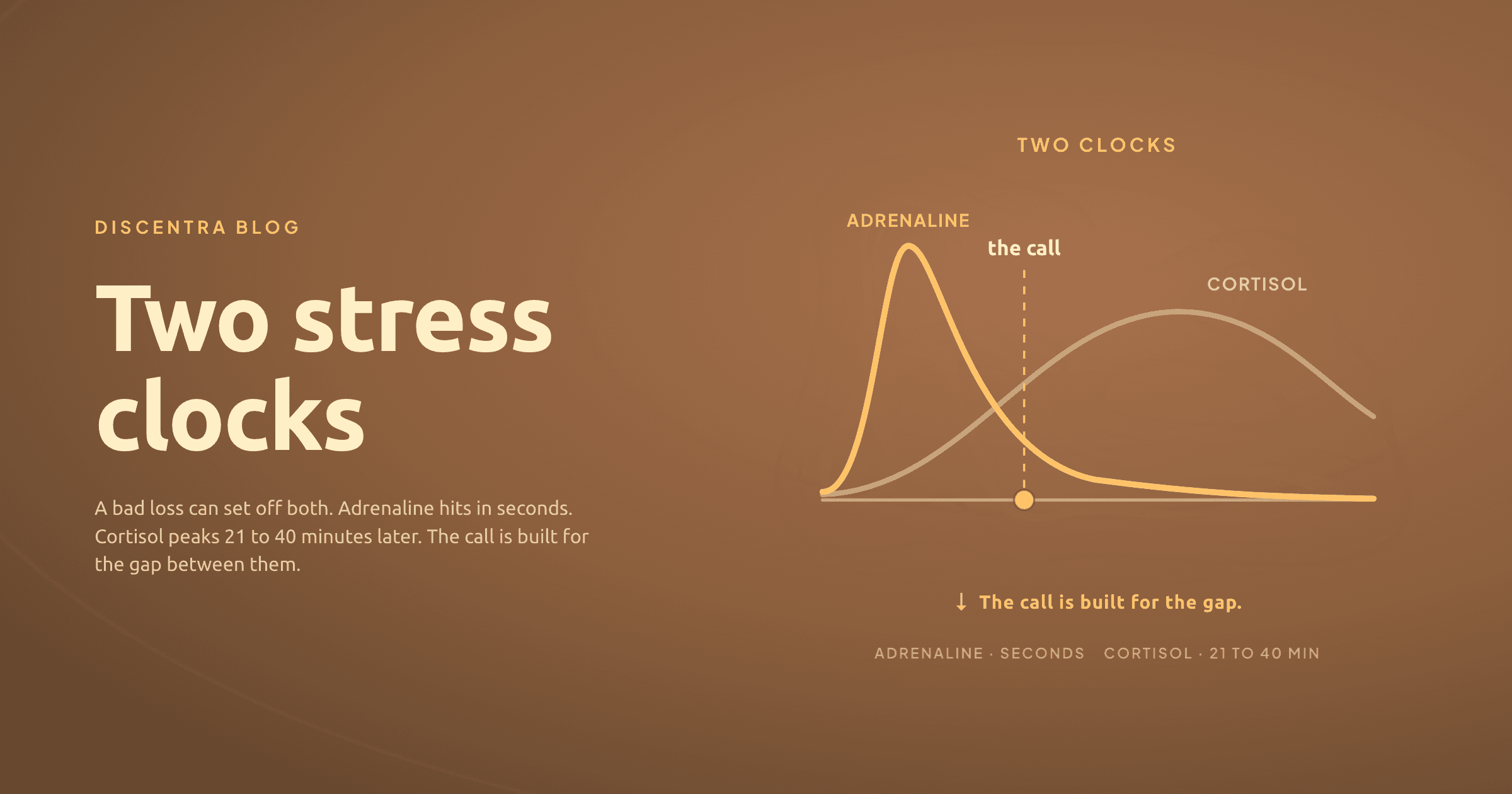
A trader who just took a loss they did not expect will tell you it felt instant. The heart rate, the heat, the urge to win it back. What they feel in that first moment is adrenaline, and it arrives within seconds. What they do not feel is the second clock already running underneath it. Cortisol, the slower stress hormone, peaks around 21 to 40 minutes after the loss, long after the adrenaline rush fades.
So the honest answer to "how long does tilt last" is not a single number. The fast clock runs in seconds. The slower clock runs far longer: cortisol peaks 21 to 40 minutes after the loss and can still be raised close to an hour after the stress ends. The trade we worry about is the next one, placed in the gap between the two, and that is where the call is aimed.
For an operator running a challenge-and-funding model, this is not a wellness point. It is the difference between a tool that fires inside the window and one that fires outside it.
The two clocks
The body runs two separate stress responses to a sudden loss, on two separate timescales.
The first is the sympathetic-adrenal-medullary response. Adrenaline and noradrenaline release within seconds. Heart rate rises and the body readies itself to act. Threat signals reach the amygdala before the cortex has finished evaluating them. In LeDoux's animal studies the amygdala responded to a threat cue within about 15 milliseconds, ahead of the slower cortical route that supplies context, though how wide that gap runs in humans is still debated.
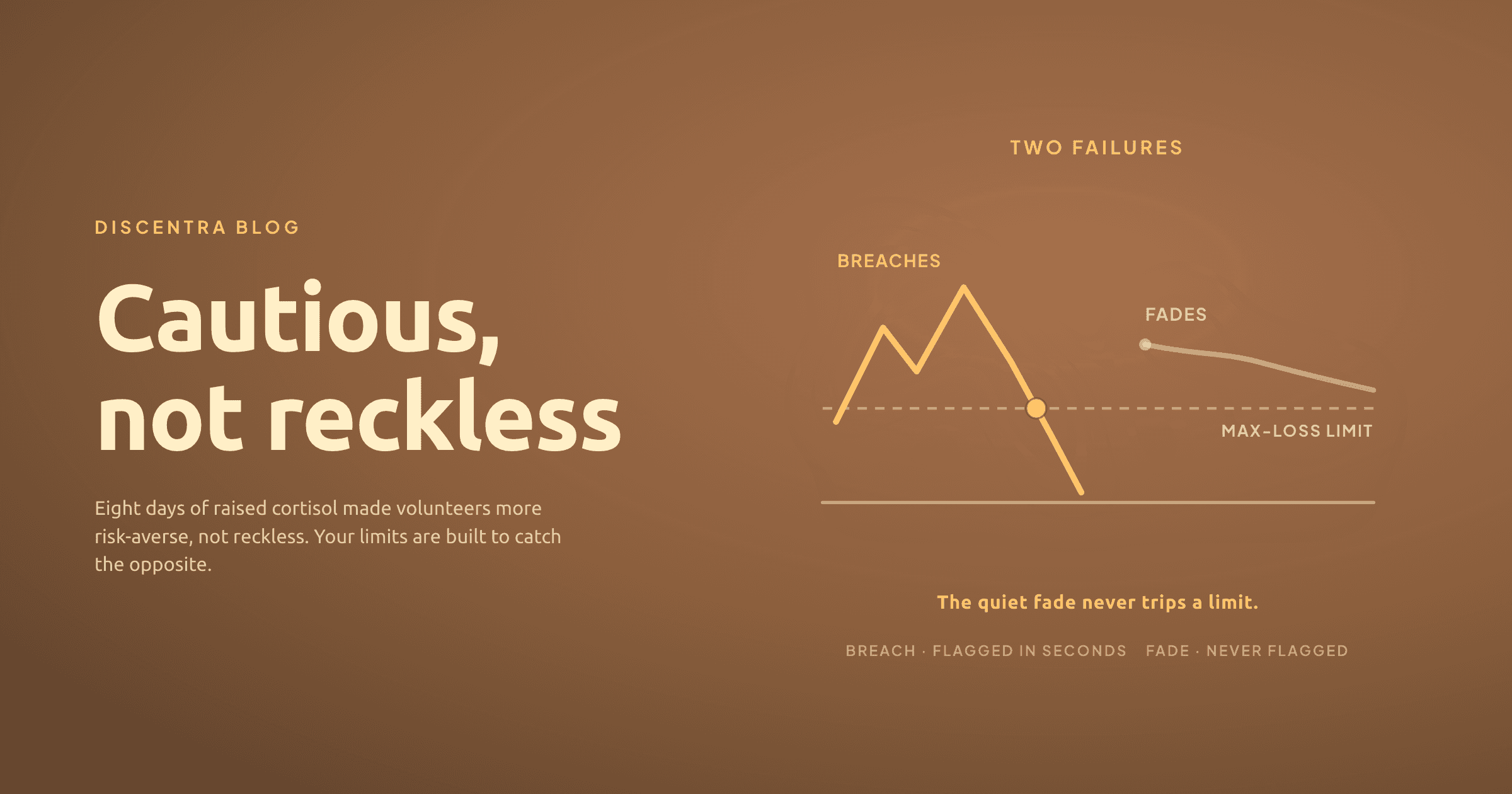
The second is the hypothalamic-pituitary-adrenal response. Cortisol rises behind it and peaks around 21 to 40 minutes after the stressor begins. In Dickerson and Kemeny's 2004 review of 208 laboratory studies, it was back to baseline within 41 to 60 minutes of the stress ending on average, and the only stress still keeping it raised at that point was the kind that is both uncontrollable and open to judgement by others. Cortisol does not produce the spike of panic. It runs on the slower clock. In a controlled study, Kandasamy and colleagues at Cambridge dosed volunteers over eight days and found sustained cortisol made them more risk-averse, with their certainty equivalent falling 44%. A single acute dose produced no such effect, so that study describes stress sustained across days in volunteers, rather than the hour after a loss in a trader. Loss aversion, which makes a loss feel worse than an equivalent gain, is a separate effect.
Set the two clocks on one timeline.
| Time after the loss | What the body is doing | What a trader might do (illustration) |
|---|---|---|
| 0 to 10 seconds | Adrenaline released. Heart rate up. | Feels the hit. The urge to do something. |
| 1 to 4 minutes | Adrenaline clearing; cortisol rising. | May place the revenge trade: sizes up, re-enters. |
| 21 to 40 minutes | Cortisol peaks (laboratory studies). | May still be trading, still convinced. |
| 41 to 60 minutes after the stress ends | Cortisol back at baseline on average; still raised after stress that is both uncontrollable and open to judgement by others (laboratory studies). | Reads the damage. |
The four-minute window is our own marker for that gap, not a number from the literature. It is the slice we design for: the minutes before the next trade.
Short fuse, long burn
Read how traders describe revenge trading and you can hear the two clocks.
The fuse is short. Traders describe not wanting to accept the loss, wanting to get it back, feeling that they need to do something. That reads as a reflex, not a calm ten-minute deliberation, and it sits on the fast clock.
The burn is long. They describe revenge trading themselves deeper and deeper, the red mist, feeling like a cornered animal while the conscious mind checks out. That sounds like the slow clock. Cortisol can still be raised close to an hour after the stress ends, but the cortisol studies measured a hormone, not trades, so whether the first bad trade becomes three in that stretch is something a firm can see in its own trade data.
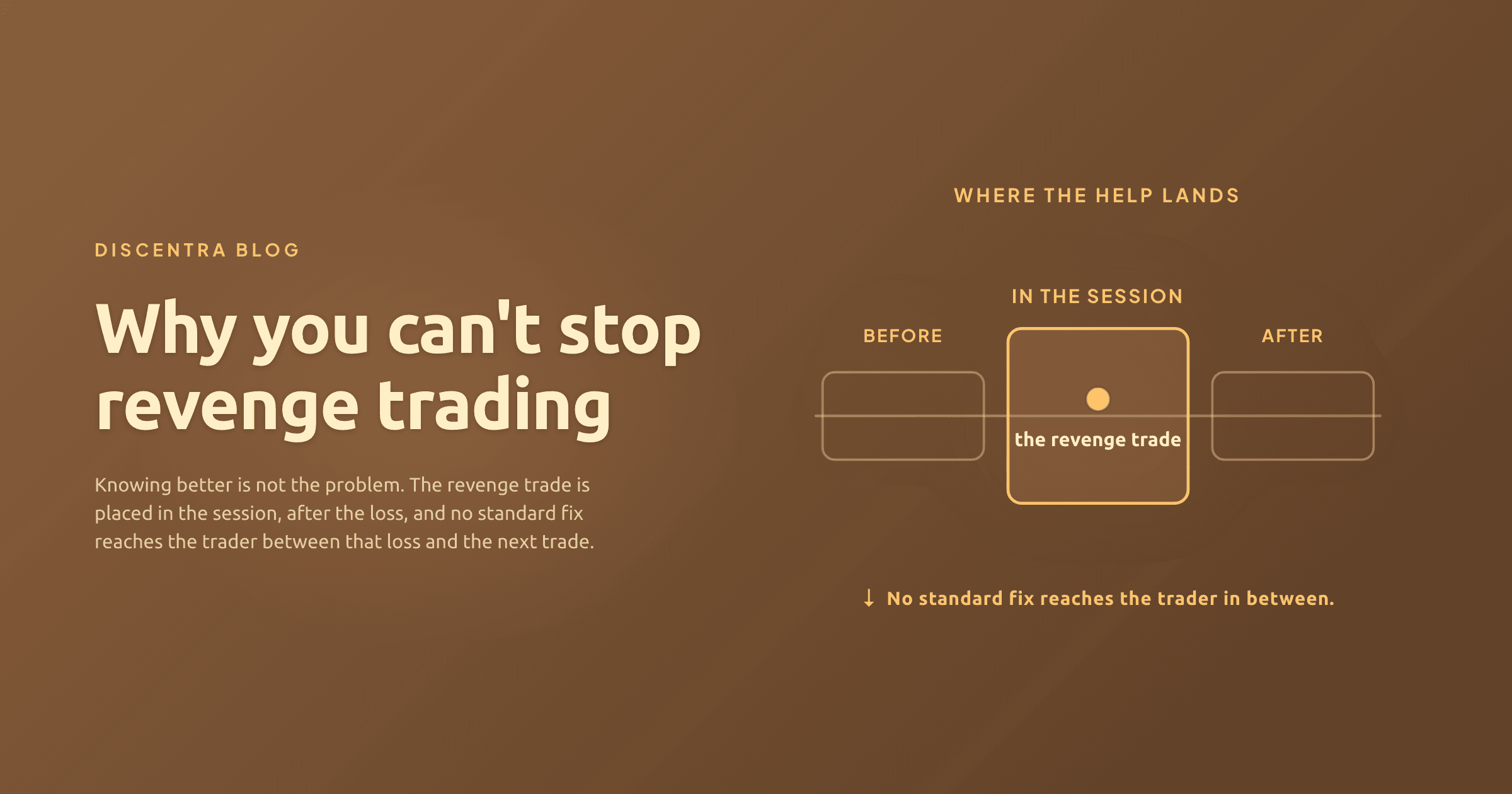
The standard advice is to walk away for 30 minutes after a loss. It is good advice, and it depends on the trader remembering it before the next trade. The call is built for those minutes, so the trader does not have to remember it alone. We have written before about why we treat tilt as a stress response, not a character flaw. The two-clock timeline is why the timing of any response matters as much as the response itself.
The reframe: time the response to the two clocks, not to the end of the day
This changes what an operator should build.
We set the window by the two clocks, not by the trader's motivation. Adrenaline arrives in seconds and cortisol peaks 21 to 40 minutes in; the four-minute window we design for sits at the start of that span, before the next trade.
That rules out two familiar approaches at once.
Education happens in a calm review; the trade happens straight after a loss. Knowing you should not revenge trade and not revenge trading at 14:07 after a loss are two different competencies. A firm can test what its own academy does for retention: compare 90-day retention for traders who finished it with those who did not (more on the education gap).
You cannot catch them after the window either. A report at 9pm, a delayed payout, a flag in tomorrow's dashboard. By then the cortisol has cleared, the trader is calm, and the trade is already in the account. Every tool that activates after the damage shares this flaw. It measures a window it was never inside.
A response that arrives after the next position cannot change it. Ours is built to reach the trader during the burn, before the next position.
What sits outside the window, and what sits inside it
It is worth being precise about which features that touch trader emotion act inside the window and which only look like they do.
A daily-loss notification fires on a threshold, not on the behaviour. A sentiment dashboard shows the desk's mood in aggregate, a number a manager reads, not a hand on the trader's shoulder. A multilingual voice assistant that explains account rules and payout phases is a support tool. It answers questions a calm trader types. None of these is in the room when a trader sizes up after a loss. They inform, they restrict, or they log. They do not interrupt.
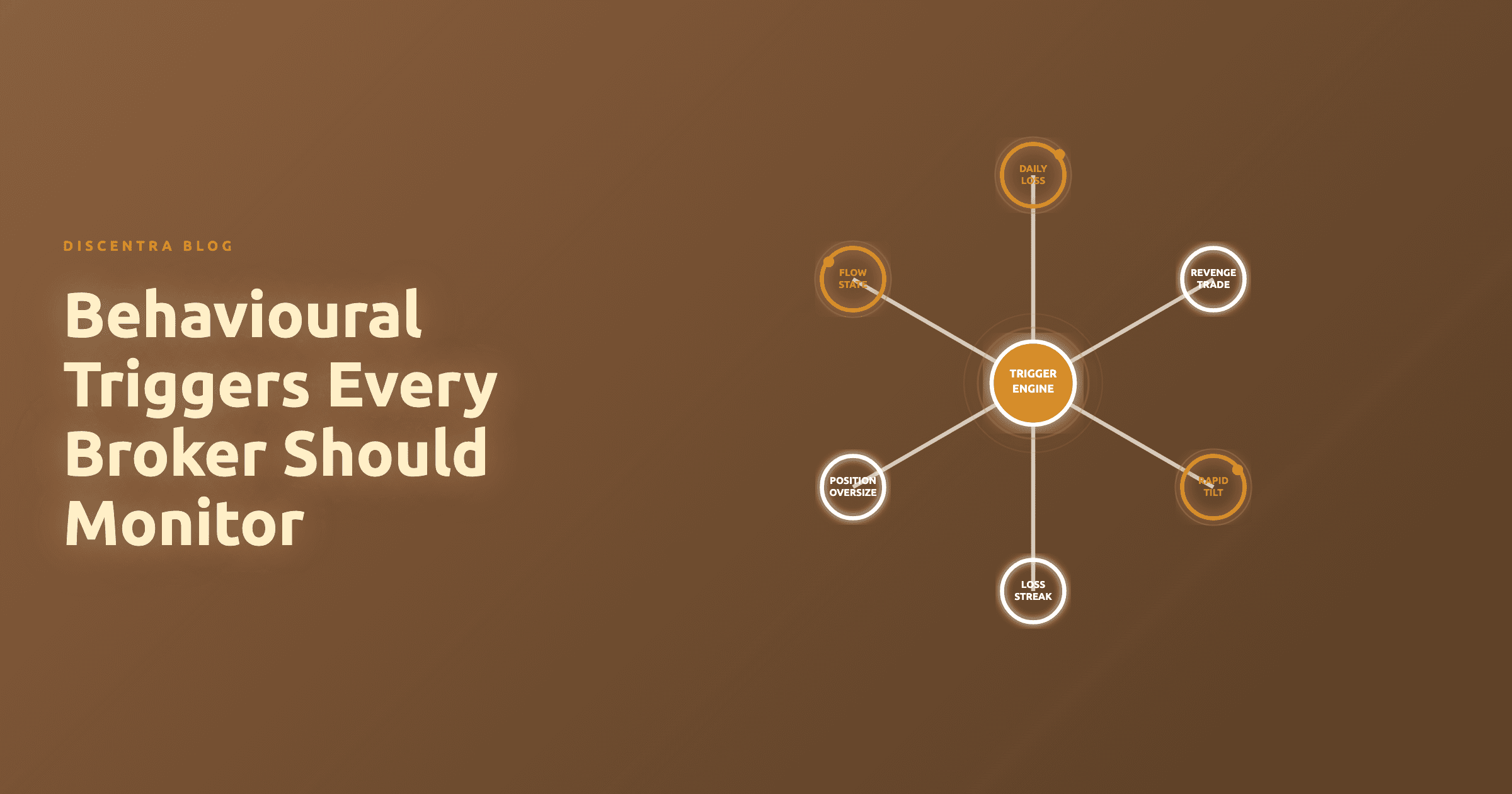
A behavioural engine is built for the other job. It watches the trading data for the patterns we flag: the revenge entry, the rapid-fire sequence, the trade above the firm's maximum lot size for that symbol, the run of consecutive losses. Whether they warn of churn, and how early, is a test a firm can run on its own accounts. When one fires, the engine is built to reach the trader inside the window and interrupt revenge trading before the next trade is placed. A text nudge at the warning threshold. A voice call at active tilt, ringing within seconds of the trigger.
The difference is not the feature. It is the timing.
| Notification, dashboard, support bot | Real-time coaching call | |
|---|---|---|
| When it acts | Before in general, or after in the report | Inside the window, before the next trade |
| What it does | Informs, restricts, or logs | Built to interrupt the trigger behaviour |
| Reaches the trader at active tilt? | No | Yes, within seconds |
| What the trader gets | A message to read later, calm | A coach in the corner, in the moment |
A voice assistant is not an intervention. The two can share a microphone and do different jobs. One answers a question. The other is built to interrupt a cascade.
Is this surveillance?
No, and the design draws the line. The trader opts in. The engine watches trading behaviour, the same data the firm already holds, for the kinds of pattern the trader has consented to be called about. A trader who gets the call is not being policed. They are being reached by something they agreed to, built to watch out for them after a loss. The framing that matters is support, not surveillance: a trader opts in so that something is watching the minutes after a loss with them.
Does this make Discentra a risk tool?
No. Discentra does not block trades, enforce a rule, or make a firm compliant. It is a performance-coaching layer. The daily loss limit, the consistency rule, and the drawdown cap stay exactly where they are. The coaching sits underneath them and does a different job. It reaches the trader during the burn and reflects their own plan back to them. The coach does not recommend a trade, suggest a size, or predict a price. Coaching, not financial advice.
Three questions for your retention stack
-
Does anything you have deployed reach the trader in the minutes after a loss, before the next trade, or only before and after that window? A daily-loss notification fires on a threshold, not on the behaviour, and a report at end of day arrives after the window.
-
When a trader tilts, does your stack inform someone, or interrupt the trader? A dashboard tells a manager. An intervention reaches the trader. They are not the same product.
-
Is your newest "voice" feature answering questions, or interrupting cascades? A support assistant and a behavioural intervention can both speak. Only one is built to act in the minutes after a loss.
Tilt does not last four minutes, and it does not last forever. A bad loss can set off two stress clocks, and we design for the gap between them, before the next trade. Features that mention trader psychology are easy to add. The question for a firm is whether anything it runs acts in those minutes, while the trader can still be reached.
Coaching, not financial advice. The plan stays the trader's. The intervention is a coach reading that plan back to the trader in the minutes after a loss.
What behavioural churn costs a firm is a question for its own data. The figures we use, each labelled by source or as our own estimate, are here.