You are measuring churn wrong
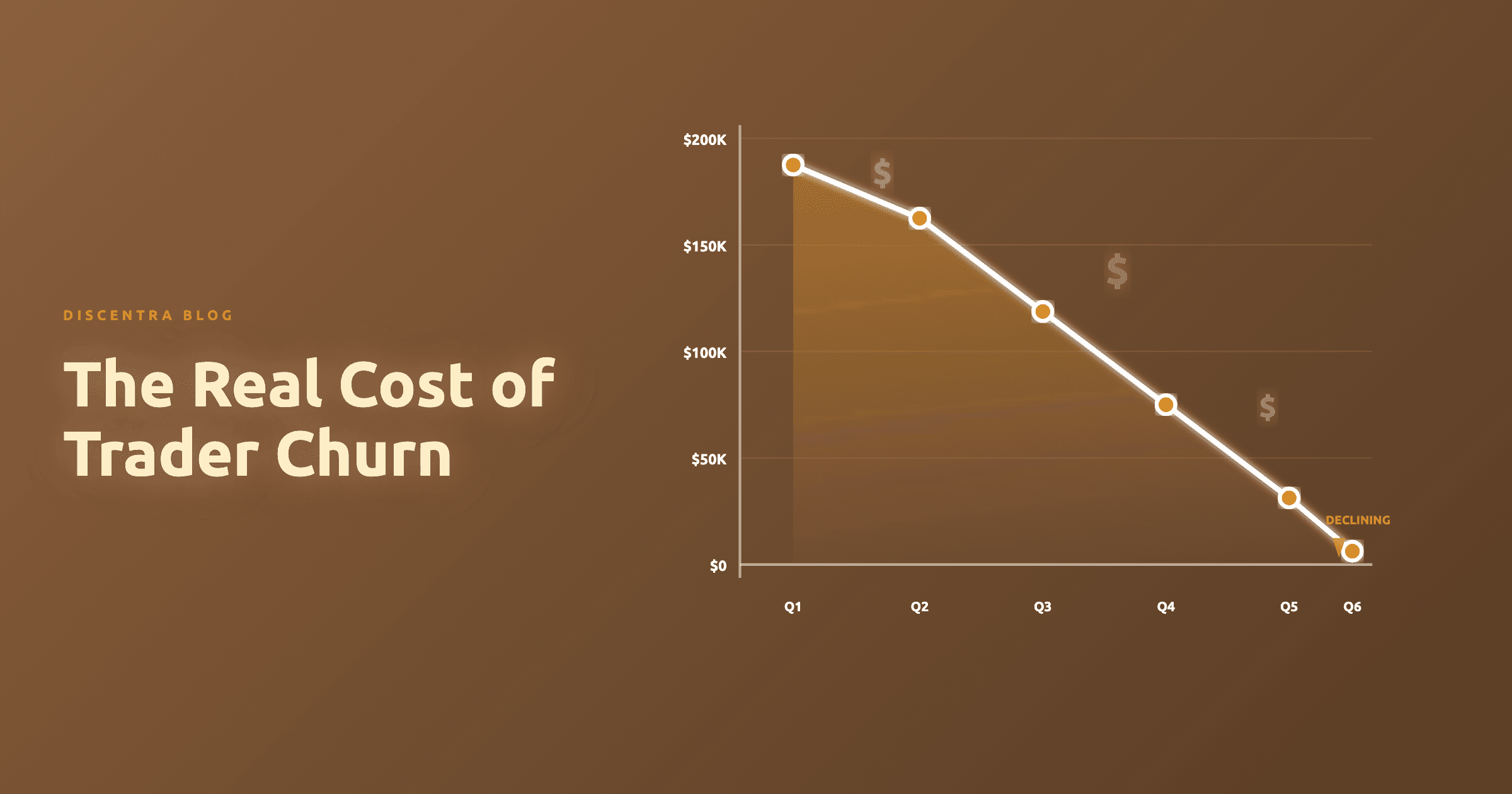
Every prop firm and retail broker tracks churn rate. The number appears on a dashboard, gets reported quarterly, and triggers a conversation about marketing spend. Churn rate is a lagging indicator. By the time it moves, the trader is already gone, the account closed, the CAC burned.
Measuring churn rate is like checking the temperature of a building after it burns down. Accurate, but useless.
Five metrics, all detectable in real-time trading data, predict churn days or weeks before a trader quits. Firms that track these can intervene while the trader is still active, still funded, still reachable.
Metric 1: Session frequency decline
A trader who logged in every market open for six weeks and now trades twice a week is not "busy." They are disengaging.
Session frequency is the earliest leading indicator of churn. Trading is habitual. Consistent traders build routines around market opens, specific sessions, and personal schedules. When that routine breaks, something has changed: a losing streak, frustration with the platform, a shift in confidence. The cause matters less than the pattern.
The signal is relative, not absolute. A trader who always traded twice a week is fine at twice a week. A trader who dropped from daily to twice a week is at risk. The metric requires a baseline per trader, calculated from their first 30 days of activity.
How to measure it
Track login frequency and active trading sessions per week. Compare the current 7-day window against the trader's personal 30-day rolling average. A decline of 40% or more sustained for two consecutive weeks correlates with churn within the following 30 days.
Do not confuse this with seasonal patterns or market closures. Normalise for holidays and low-volatility periods. The signal is trader-specific deviation from their own baseline, not deviation from the firm's average.
Metric 2: Position size volatility
Consistent traders trade consistent sizes. They have a plan, a risk model, and a position sizing framework. When position sizes start swinging between 0.5x and 4x normal, the plan has left the building.
Position size volatility measures the standard deviation of a trader's recent position sizes against their historical norm. A trader who risks 1% per trade and enters a position at 4% is not following a new strategy. They are emotional.
Two distinct patterns emerge. The first is a single large spike: one trade at 3x to 5x normal size, after a loss. This is the revenge trade, an attempt to recover the money in a single position. The second is oscillation: sizes jumping between 0.5x and 3x normal with no consistent pattern. This trader has lost confidence in their sizing model and is guessing.
How to measure it
Calculate the coefficient of variation (standard deviation divided by mean) of position sizes over a rolling 20-trade window. Compare against the same metric from the trader's first 50 trades. A CV increase of 50% or more flags emotional sizing. A sustained increase over 10 or more trades suggests the trader has abandoned their risk model.
Position size volatility accelerates account depletion. A trader who tilts at 1x size loses over weeks. A trader who tilts at 4x size can blow a funded account in a single session. The metric predicts both churn and the severity of the exit.
Metric 3: Time between loss and next trade
This is the revenge trading indicator. It measures whether a trader pauses after a loss or re-enters the market within seconds.
A disciplined trader takes a loss, reviews the setup, checks their daily P&L against their plan, and waits for the next valid signal. This process takes minutes. Sometimes it takes the rest of the session. The gap between loss and next trade is a direct measure of impulse control under stress.
When that gap drops below 60 seconds, the trader is not analysing. They are reacting. The trade that follows a sub-60-second re-entry after a loss has a lower win rate than the trader's baseline. The position size is larger. The holding time is shorter. Every variable moves in the wrong direction.
How to measure it
Record the timestamp of every closed trade and the timestamp of the next opened trade. Filter for cases where the closed trade was a loss. Calculate the gap in seconds. Flag any instance where the gap is under 60 seconds and the subsequent position size exceeds the trader's 20-trade rolling average by 20% or more.
A single instance is a data point. Three instances in a 5-day window is a pattern. Five or more instances in a 10-day window is a trader in active tilt who will either blow the account or quit within weeks.
Metric 4: Drawdown velocity
Most firms track whether a trader hits their drawdown limit. Few track how fast they approach it.
A trader who loses 5% over 30 trading days is having a rough month. A trader who loses 5% in 90 minutes is in crisis. The drawdown limit is the same. The trajectory is not. Velocity tells you whether the trader is grinding down or falling off a cliff.
Drawdown velocity matters because the psychological response is different. A slow drawdown gives the trader time to adjust, reduce size, and reassess. A fast drawdown triggers fight-or-flight. The amygdala overrides the prefrontal cortex, and decision-making quality collapses. The trader who lost 5% in 90 minutes is about to lose 10% in the next 30.
How to measure it
Calculate the rate of P&L decline per hour during active trading sessions. Establish a per-trader baseline from their first 30 days. Flag when the current session's drawdown velocity exceeds 3x the trader's historical average.
The intervention window on fast drawdowns is narrow. A trader approaching their daily loss limit at 3x normal velocity will hit it within the current session. If the firm's retention strategy activates after the limit is breached, the strategy activates too late.
The trader has already experienced the worst moment. They have already decided how they feel about the firm.
Track velocity at the session level, not the daily level. A trader who loses 3% in the morning, breaks for lunch, and loses 2% in the afternoon has a different experience than one who loses 5% in a continuous 90-minute spiral.
Metric 5: Support ticket sentiment shift
The first four metrics live in trading data. This one lives in customer support. Less precise, but it captures a dimension the others miss: the trader's relationship with the firm.
Traders who are learning submit tickets that sound like this: "How do I set a trailing stop?" "Where can I find my daily P&L report?" "What are the rules for scaling into positions?" The language is curious, forward-looking, and solution-oriented.
Traders who are leaving submit tickets that sound like this: "Why did my trade get stopped out early?" "Why was my payout delayed?" "Your platform cost me money." The language shifts from "how do I" to "why did you." From learning to blaming. From building a relationship with the platform to building a case for leaving.
How to measure it
This requires basic sentiment analysis on support ticket text, something most modern helpdesk platforms offer out of the box. Tag tickets as positive, neutral, or negative. Track the ratio per trader over time. A shift from neutral/positive to negative, combined with any of the four trading metrics above, is a strong churn signal.
The sentiment shift often precedes the trading behaviour changes. A trader who feels the firm is unfair starts trading with less discipline on that firm's platform. They care less about preserving the account because they have decided the account is not worth preserving.
Building a composite risk score
Each of these five metrics catches a different facet of disengagement. Session frequency measures commitment. Position size volatility measures emotional regulation. Loss-to-next-trade gap measures impulse control. Drawdown velocity measures crisis trajectory. Support sentiment measures relationship health.
No single metric is a reliable predictor in isolation. A trader might reduce session frequency because of a holiday. Position sizes might spike because of a legitimate strategy change. The power is in the composite.
A simple weighted scoring model works. Assign each metric a score from 0 (no signal) to 10 (strong signal). Weight them according to their predictive power in your specific trader population. Start with equal weights and adjust based on historical churn data.
A sample framework:
Session frequency decline (40%+):     0-10  × 0.20  = 0-2.0
Position size CV increase (50%+):     0-10  × 0.25  = 0-2.5
Loss-to-next-trade gap (<60s):        0-10  × 0.25  = 0-2.5
Drawdown velocity (3x baseline):      0-10  × 0.20  = 0-2.0
Support sentiment shift:              0-10  × 0.10  = 0-1.0
────────────────────────────────────────────────────────────
Composite churn risk score:                           0-10.0
Set thresholds that trigger escalating responses. A score of 3 to 5 might trigger an automated check-in. A score of 5 to 7 might trigger a more direct intervention. Above 7, the trader is in the red zone and leaving without action.
What to do when the score spikes
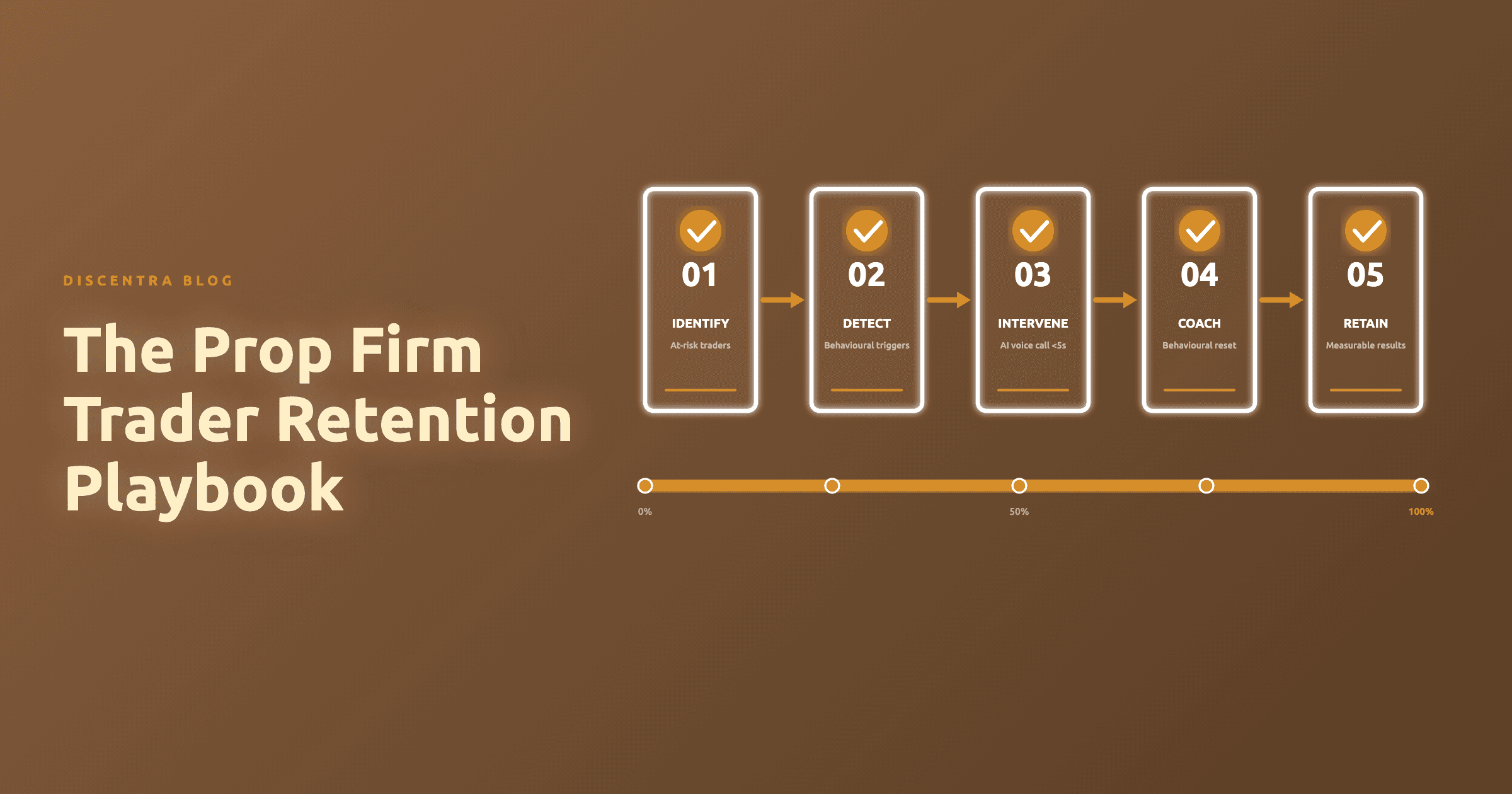
Detection alone is monitoring. Pairing detection with a response turns it into intervention.
When a composite score crosses the threshold, the firm has options. The worst option is nothing. The second worst is a generic email. The trader is in emotional distress or active disengagement. A templated "We noticed you haven't logged in" message confirms they are a number in a database.
Effective interventions share three characteristics. They arrive while the behaviour is happening or within hours. They reference the actual pattern, not generic encouragement. They help the trader return to their own plan rather than prescribing a new one.
This is performance coaching, not financial advice. No trade recommendations. No position sizing suggestions. A prompt to pause, review, and re-engage with the process the trader already has.
~75% of retail traders quit within 90 days. The data to predict which ones, and when, sits in the systems these firms operate today. Firms that build the detection layer and pair it with real-time coaching interventions (coaching, not financial advice) will retain traders that their competitors lose by default.
The metrics are knowable. The patterns are detectable. The question is whether you build the system to catch them before the trader is gone.