The plan is present at the blow-up
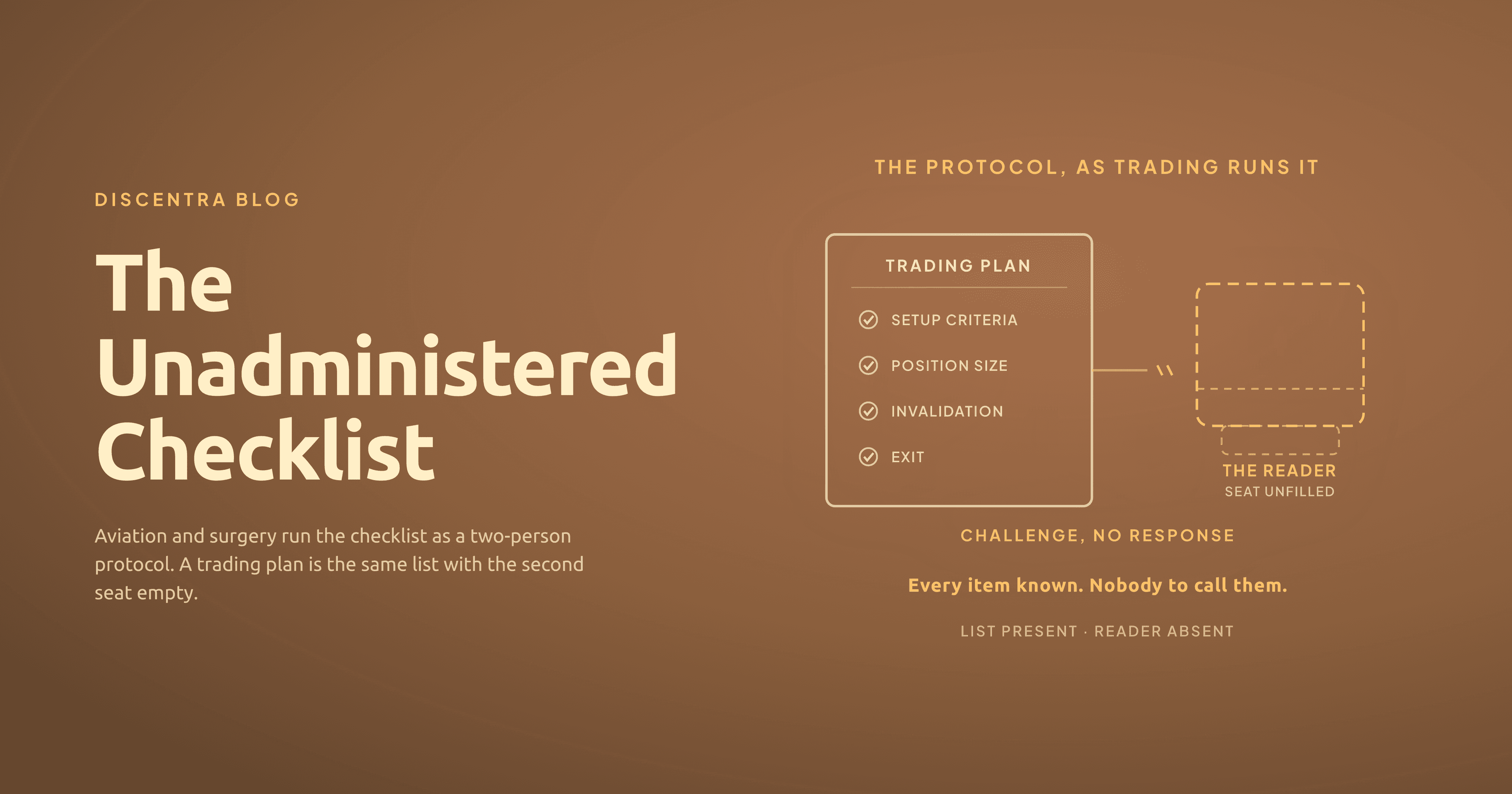
The plan is usually on the second monitor when the account dies. It names the setups, fixes the size, defines invalidation, sets the exit. The trader wrote it, believes in it, and may have submitted it to their firm at evaluation. Then a losing morning arrives, and every rule in it gets broken in sequence while the document sits open.
Traders describe this from the inside in the same words: the plan gets abandoned at the first sign of real pressure. It is not revised, and it is not consulted and overruled. It is abandoned, by a person who could recite it from memory.
The industry's answer to this is more plan. Better templates, stricter rules, education programmes, and a comparison that appears across the sector's own content: pilots and surgeons use checklists, so traders should too. The comparison is right. It is also incomplete in a way that decides whether it works, because the industries being borrowed from do not use checklists the way trading recommends them. When they adopted the list, they built the reader in from the start.
The cost of the gap lands on the firm, not only the trader. Behavioural spirals sit behind the churn that removes ~75% of retail traders inside 90 days, and each departure takes acquisition spend with it.
What aviation concluded in 1935
On 30 October 1935, Boeing's Model 299, the prototype of the B-17, took off from Wright Field with a veteran test crew that included the chief of the field's Flying Branch, Major Ployer Hill. The aircraft climbed, stalled, and burned. The accident board ascribed the direct cause to a single missed item: an elevator control lock that was never released.
The instructive part is what happened next. Critics argued the aircraft was too big to handle. The Air Corps rejected that reading and named the real constraint: the limiting factor was human memory, not the aircraft's size or complexity. Their response was not to demand more disciplined pilots. It was to write checklists the crew would follow for takeoff, flight, before landing, and after landing.
The list was written for the crew, plural. Aviation's formal definition calls a checklist an "informational job aid used to reduce failure by compensating for potential limits of human memory and attention." The compensation is structural: on an airline flight deck the checklist is run as challenge and response between two people. One pilot flies. The other reads each item aloud and waits for the confirmation. The pilot under load does not keep the list.
Surgery ran the experiment
Aviation's conclusion might have stayed an analogy. Surgery turned it into a measured result.
Peer-reviewed: Haynes et al., New England Journal of Medicine, 2009. Eight hospitals in eight cities, 3,733 patients before and 3,955 after. Major complications fell from 11.0% to 7.0% (P<0.001). Inpatient deaths fell from 1.5% to 0.8% (P=0.003). Before-and-after design, not a randomised trial; the paper's own conclusion says "associated with".
Nobody in those operating rooms learned new medicine. Every item on the 19-item list, confirm the patient, confirm the site, confirm the airway risk, was already known to every professional present. What changed was the administration.
The WHO's implementation manual is specific about the mechanism. A single person is made responsible for the checks, a designated coordinator, and having one person lead the process is described as essential to its success. Steps are checked verbally with the responsible team member, not assumed. And the coordinator can and should prevent the team from progressing to the next phase until each step is satisfactorily addressed. A designated voice in the room, confirming each step verbally, with authority to pause the case.
The study tested that whole protocol, communication changes included, so the credit belongs to the system rather than any single part. But the shape of the system is the point. What it never tested is the version trading runs: the same list, handed to the operator, alone.
The checklist was never the technology. The administration was.
Trading runs the control condition
Now place the funded trader inside that frame. The plan was written by their calm self and is executed by their stressed self, and author, operator, and coordinator are the same nervous system. The plan exists precisely for the moments that nervous system is compromised, the tilt window, where knowing the rule and following it come apart. Trading asks the one person certain to be under load to also be the person calling the items.
The firm's side of the protocol, today, is the crash boundary. Max-loss lockouts and daily pauses are real controls, and they work, but they are aviation's ground-proximity alarm: they sound when the mountain is already filling the windscreen, after the losses, at the end of the sequence. Aviation keeps that alarm, and the alarm has saved aircraft. It treats it as the last line of defence, though, not as the system, and the safety record rests on the administered layers that run before it. Rule enforcement catches the breach; the behavioural layer works earlier, and the two are different instruments.
Education does not close the gap either, because the gap was never knowledge. A firm can teach sizing and invalidation to every trader in the book and still run the unadministered version of the protocol, the configuration the safety-critical fields never adopted.
Operators, to their credit, tend to see this structurally. Show a room of them behavioural churn data and almost nobody prescribes willpower; they reach for hard stops or for redesigned rules. Both are structure. Both are also one-party: set in advance, enforced at a boundary, with no voice in the middle. Between the rule that was written calmly and the boundary that fires after the damage sits the intervention window, the whole phase of the trade where the plan is supposed to hold. Today, in almost every trading operation, that phase has no reader.
The question the analogy leaves
Aviation's fix required a second seat. Surgery's required one designated voice with the standing to pause the room.
So the comparison the industry keeps reaching for ends at a question rather than a template. Every firm that requires trading plans has already agreed the checklist matters. The open item is the reader: who, in your operation, can call an item while a trader is mid-tilt, and what, short of the crash boundary, can pause the sequence?