The desk that owns it today
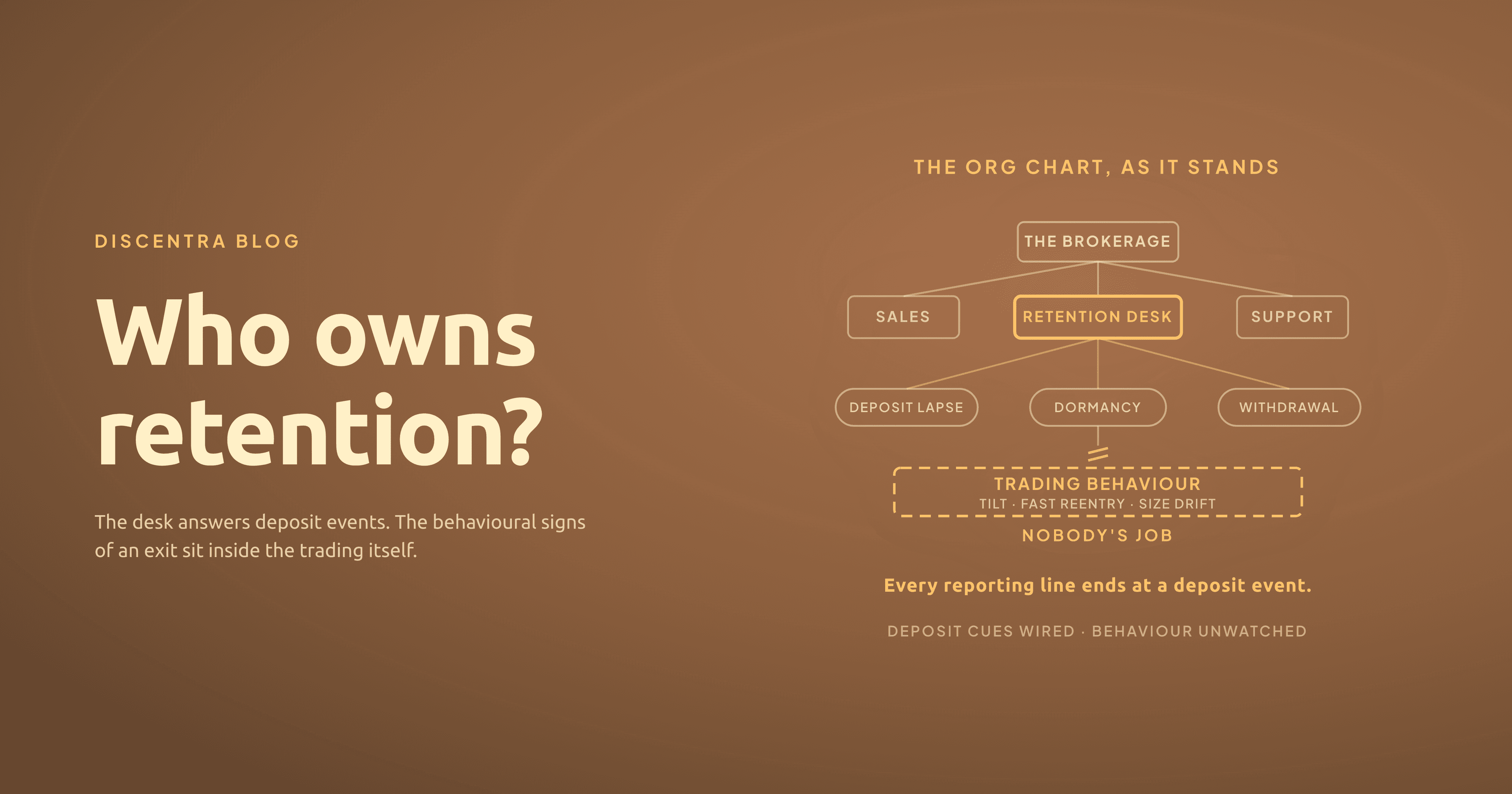
Job boards make the current owner easy to find. The "retention" listings we read at retail brokerages describe a consistent job. Outbound calls to existing clients. Reactivation campaigns for dormant accounts. Targets linked to funding activity. In those listings, the team sits under sales or marketing, works a CRM, and gets its leads from commercial triggers: an account that stopped depositing, a client who went quiet, a withdrawal request that suggests the relationship is ending.
Say this clearly first: the problem is not the desk. Measured on its own brief, a good retention team recovers real accounts, and no version of this argument should read as a critique of the people running it. Nobody staffing an outbound desk could be asked to watch live trading behaviour across an entire book, and the tooling they are given, a CRM fed by deposit and login events, could not show it to them anyway.
The open question is whether the job the desk has been given is the one that decides how long clients stay.
The cues arrive last
Look at the cues that page the desk. A lapsed deposit. A dormancy flag. A withdrawal request. Each of these is the end of something, not the start. Where the cause is the trading, the chain can run like this: the client traded badly, felt it, pulled back, decided, and only then did the thing the CRM can see. A firm can check what its own clients' trading looked like in the weeks before each lapse, dormancy flag or withdrawal.
The desk's spend watches commercial events, which are operational and easy to instrument. In that chain, the cause sits in behaviour, and the commercial events confirm it after the fact. A brokerage that only reads deposit signals is reading the outcome of churn and calling it the warning.
We have set out what churn costs, using our own working estimates, in the economics of trader churn: acquisition is expensive, replacement is slow, and every churned active client restarts the meter. The desk exists because firms know this. It is positioned at the wrong end of the chain.
What the cues cannot see
The behavioural signs of an exit are not hidden. They sit in data every brokerage already collects, and a firm can test, in its own records, whether they move before its deposit events do.
A loss followed by a fast re-entry at larger size. Trade frequency spiking against the client's own baseline. Position sizes drifting upward through a losing streak. Session rhythm falling away, not to zero, but below what is normal for that specific client. We have catalogued the trigger patterns in the behavioural signals every broker should monitor, and the case for reading them as leading indicators in five metrics to watch before a trader churns.
None of these events would page a retention desk, because none of them is a deposit event. A client can run the entire behavioural arc, tilt, spiral, blow-up, and the first the desk hears of it is the dormancy flag, by which point the call is a reactivation attempt aimed at someone who has already decided.
The incentive is a design fact, not a conduct failure
There is a second, quieter constraint on the desk, and it needs stating carefully.
A desk whose targets are linked to deposits can only be pointed at deposits. That is not an accusation of misconduct. It is what the incentive design makes visible: give a team redeposit targets and deposit-cued leads, and deposit recovery is what you have bought, done in good faith by people hitting the numbers they were given.
But it does shape what the retention motion can say for itself when someone outside the firm asks about it. Under the FCA's Consumer Duty, a regulated firm must monitor the outcomes its retail customers receive, and the FCA expects it to be able to evidence them. A programme whose measurable output is "clients deposited again" answers a different question from one whose output is "clients traded within their own plan for longer". Same word, retention, two different evidentiary positions.
What behavioural retention is measured on
This is also where the measurement question gets a concrete answer.
Behavioural retention is measured on active-client retention against a matched baseline, not on deposits. A pilot is judged on what clients do after each warning sign, with retention reported alongside. Deposit volume, redeposit rate, and lifetime-value uplift are reported as secondary evidence, never contracted as the success criterion.
The reasoning is worth showing. A metric that rewards clients depositing more is indistinguishable, from a reviewer's chair, from the incentive shape described above, whoever is holding it. A retention metric read against a matched baseline has no such ambiguity, and it still carries the entire commercial case, because retained active clients are the lifetime value: a client who is still trading in month four does not need to be re-acquired, re-marketed to, or won back at a discount.
The scale of what is being retained against is a matter of public record. ASIC reported that 68% of Australian retail CFD clients realised a net loss after fees in FY2023-24. A loss rate does not say why clients lose: ASIC notes that fees account for part of it. A firm's own trade data can show how much of the rest is tilt, revenge sequences or sizing drift. That is the layer the deposit-cued desk cannot reach, in any market.
Two jobs, one book
Put the two motions side by side and the shape of the answer is obvious.
The desk answers commercial cues on a clock of days to weeks, and recovers accounts. A behavioural layer answers trading cues on a clock of minutes, and is built to keep accounts from needing recovery: it reads the trigger from live trade events, aims to reach the client before the next trade, and coaches them back to their own plan. Discentra builds that layer for financial institutions as voice: the trigger fires, a call is placed within seconds, and the conversation is coaching against the client's own stated process. It never blocks a trade, never advises one, and hands off to a human on the firm's side when a conversation needs one. Coaching, not financial advice.
Nothing about that competes with the retention desk. The desk cannot see the trigger; the behavioural layer has no business making win-back calls. A brokerage does not have to choose between them. It can run both, with an owner named for the behavioural layer. What that looks like on a brokerage book is here.
Ask the question at your own firm: who owns what happens inside a client's worst session?
Sources and notes
- ASIC loss-rate figure (68% of retail CFD clients realised a net loss after fees, FY2023-24): ASIC Report 828, "Risky business: Driving change in CFD issuers' distribution practices", January 2026. Regulator-published. Scope: 195,386 retail clients of 52 Australian AFS-licensed CFD issuers; net loss is measured after fees, and ASIC notes 5% of retail clients would have made a net profit but for fees.
- The retention-desk composite (outbound calls, reactivation campaigns, deposit-linked targets, CRM under sales or marketing): drawn from public job listings for retention and account management roles at retail brokerages, reviewed August 2026. Operational observation; no individual firms are identified and none should be inferred.
- FCA Consumer Duty: Principle 12 of the FCA Handbook says "A firm must act to deliver good outcomes for retail customers." The rules in PRIN 2A require firms to monitor those outcomes and to report the results to their governing body, which reviews and approves the report at least annually. The FCA's guidance (FG22/5) expects firms to be able to evidence the outcomes their customers receive. It applies to FCA-authorised firms' retail market business. Regulator-published framework, cited here as context, not as legal analysis.
- Active-client retention vs a matched baseline: our own methodology, not a reported result; a pilot is judged on one success test set out in writing before go-live.
- Behavioural trigger patterns and leading indicators: covered in detail, with their own sourcing, in the linked posts above.