The session that loses the client is already in your data
The behavioural share of a broker's churn arrives as a session that went wrong: a loss, a quick second trade to win it back, a bigger third one, and then an account that goes quiet. ~75% of retail traders quit within 90 days, and when a retention call does come, it is about the account: a desk ringing once the deposits have stopped.
The session sits in the broker's own records. Every trade a client places leaves one: when it opened, when it closed, how big it was, what it made or lost. The warning signs of tilt are patterns in those records: a new position soon after a loss, size jumping above the last position, a burst of trades inside a quarter of an hour, a run of losses in a row.
Two earlier posts cover the patterns a broker can watch and how tilt reads in the sequence of trades. A broker's technology and data-protection leads will ask a narrower question first: which fields, and which ones not?
A trade record has a limit worth stating first. It shows what a client did and when, and not why. A behavioural layer infers the client's state from the pattern. It does not see the reason, and it should not claim to. It also has one job: deciding when to reach the client with coaching, by call or text. It does not sort clients for pricing, execution or routing.
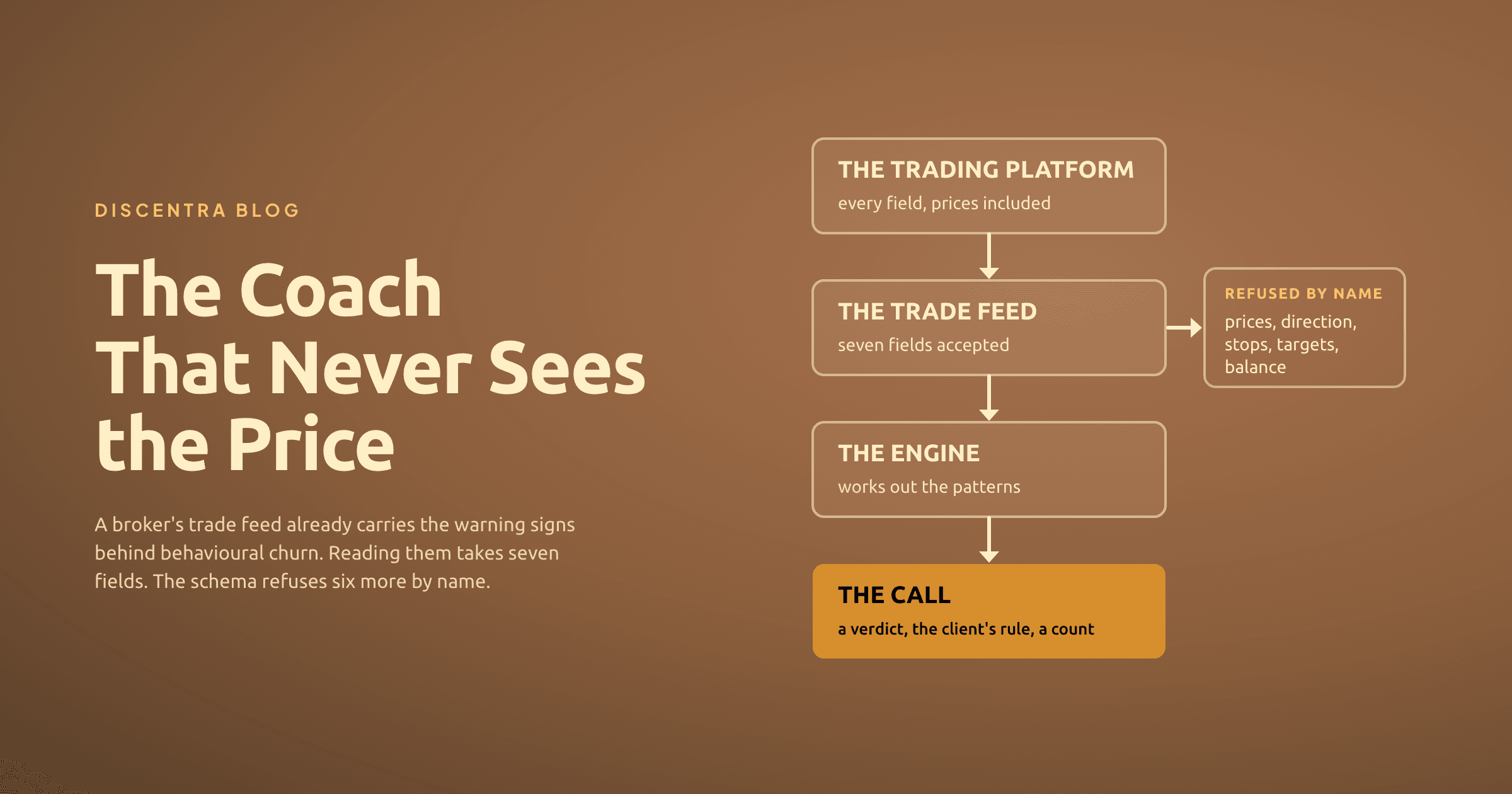
Seven fields in
Discentra's trade-event schema accepts seven fields. The list is exhaustive: there is no optional eighth.
| Field | What it is | What it is for |
|---|---|---|
| Trader ID | A pseudonymised identifier the broker assigns, with no name or email | Ties each trade to one client, so the engine reads every pattern against that client's own trading |
| Trade ID | The broker's identifier for the trade | Pairs each open with its close |
| Event type | Opened or closed | Separates a new position from a result |
| Timestamp | When the event happened | The gap between a loss and the next order; the count of trades in a short window |
| Instrument | The market the trade was in | Keeps size comparisons within one market, since a lot means very different exposure in different markets |
| Size | The position size | A jump against the previous position in the same market; a size threshold the broker sets for coaching |
| Profit or loss | Sent when the trade closes | Losses, losing and winning runs, drawdown, and a daily loss threshold the broker sets for coaching |
The engine works out everything the warning-sign rules need from those seven: how often the client is trading, how soon a new order follows a loss, whether size is climbing, how long a losing or winning run has gone on. The broker sends none of these.
The thresholds are not client data either. The broker sets the loss, drawdown and size thresholds as coaching thresholds: a daily loss figure, a drawdown figure and a position size at which a call is worth placing. They decide when the coach rings and restrict no trade. The engine compares the derived patterns with the broker's thresholds and with the client's own recent trades.
Six fields refused, by name
| Refused field | Why the coaching never needs it |
|---|---|
| Entry price | No warning-sign rule reads a price level |
| Exit price | The result arrives as profit or loss; the level adds nothing to a behavioural pattern |
| Stop-loss | Where a client put a stop is a trading decision, and judging it is a view on the trade |
| Take-profit | A target is part of the trade idea; the coaching reads only the behaviour around it |
| Trade direction | Long or short changes nothing about how soon the next trade came or how big it was |
| Account balance | The engine reads size against the client's own trades and the broker's threshold; a balance adds financial detail that no rule reads |
The rule behind the table fits in one line: no warning-sign rule reads a price level, a trade direction or a balance, so the schema accepts none of those fields. If a payload carries any field outside the seven, the specification refuses the whole payload and stores none of it, rather than dropping the extra field and keeping the rest.
UK data protection law asks that personal data be "adequate, relevant and limited to what is necessary" for the purposes it is processed for. The purpose here is coaching on behaviour, and a price level is not necessary for it. That is our reading of our own design, not a regulator's view of it. Its value is that a data-protection lead can check it against the schema in one sitting.
The advice line, held in the data
The usual way to keep an AI tool on the right side of the advice line is a sentence. An instruction tells the model not to recommend trades. A line in the footer says the output is not advice. Both are worth having, and Discentra has both kinds: Discentra instructs the coach never to recommend a trade, predict a price, size a position or time an entry, and every call opens by saying it is an AI coach that gives coaching, not financial advice.
A sentence is a promise about behaviour. The schema adds a limit on information. With no price, no direction and no stop, nothing in the system can judge whether a trade was a good one. The engine holds which market, when, how big, how often and how each trade ended. The coach on the call holds less again: the engine's verdict, the client's own rule as written, and a count of events. No price, position size or profit figure reaches the call. That is enough to name what the pattern shows and to point the client back to their own plan, which is what the call is designed to do.
A client on a call can still say a price out loud, or ask what to do next. The feed never gave the coach that price, and the coach is designed to decline the question and return to the process. That is the honest limit of the design: the coach can talk only about the client's own pattern.
The effect on your data-protection review
For the broker, a narrower feed means fewer data categories to review. The trader ID is pseudonymised: the broker can link it back to a person, and the trade feed carries no name, email or account details. In the design, the phone number sits apart from the trade feed under field-level encryption and is used only to reach the client by call or text. The design keeps trade data for the length of Discentra's contract with the broker and deletes it within 30 days of that contract ending, unless the broker tells us in writing that a regulatory requirement means keeping it longer. The full list of what the design collects, and what it never collects, is on our security page.
None of that settles a data-protection review on its own, and we do not claim it does. It means the first questions a data-protection lead asks have short answers they can check, because we wrote the design around them.
The same restriction holds on the hardest call. If a call turns up distress rather than tilt, the coaching stops and Discentra alerts a named person at the broker. The call that gets there starts from the same seven fields, and the escalation needs no price either.
Sources and notes
- The seven fields and the six refusals: Discentra's record of processing, which lists the received, derived and refused fields as three separate groups, and its trade-event specification, which defines the closed schema. Product design, described here rather than quoted.
- The warning-sign rules: the same specification's rule set (daily loss, drawdown, revenge trading, tilt detection from a burst of trades, losing and winning runs, position size). The loss, drawdown and size thresholds are values the broker sets for coaching; the others are set in the specification. None restricts a trade.
- What reaches the call: the record of processing for the voice layer, which receives the engine's verdict, the client's own rule and event counts, and no prices, position sizes or profit figures.
- Data minimisation: UK GDPR Article 5(1)(c), read on legislation.gov.uk (latest revised version) on 4 October 2026. The law's wording, quoted; not a regulator's view of Discentra.
- ~75% of retail traders quit within 90 days: industry-cited, not regulator-published. The sourcing and the range of published estimates are on the churn statistics page.
- The opening line and what the coach does on a call: Discentra's call design, set out in the post on disclosure and the post on what the call asks.
- No firm, vendor or platform is named.