What a lack of requests can show
Silence is easy to read as an answer. If no trader has asked for coaching, a firm has grounds to conclude that none of them wants it, and a firm is right to be careful about what it adds.
That reading runs two questions together. One is whether there is a need. The other is whether traders want the help. They have different tests, and listening for requests answers neither well, because a request depends on the trader's own view of how they are doing. A body of research on stock investors has measured how good that view is.
Investor memory bias: what investors remember
In 2021, Daniel Walters and Philip Fernbach published three pre-registered studies of real investors in the Proceedings of the National Academy of Sciences. The design: ask investors about their trades from memory, then have them open their statements and answer again.
In the first study, 411 investors in the United States wrote down the returns on the two investments that had moved their portfolio most in 2019. From memory, the two averaged 44.1% and 40.6%. From the statements, the two biggest averaged 39.8% and 33.5%, a gap of 4.3 and 7.1 percentage points.
The second study asked for more. Its 144 investors, each with at least 10 trades in 2020, listed the 10 trades from the first half of that year that had the biggest effect on their portfolio, gains or losses. They did it from memory first and from their statements second. When the same trade appeared on both lists, it carried a higher return from memory: 30.6% against 27.0%. The authors' summary opens: "Investors were biased to recall their past trading performance as better than achieved."
The two lists also differed in which trades were on them.
The losses go missing more often
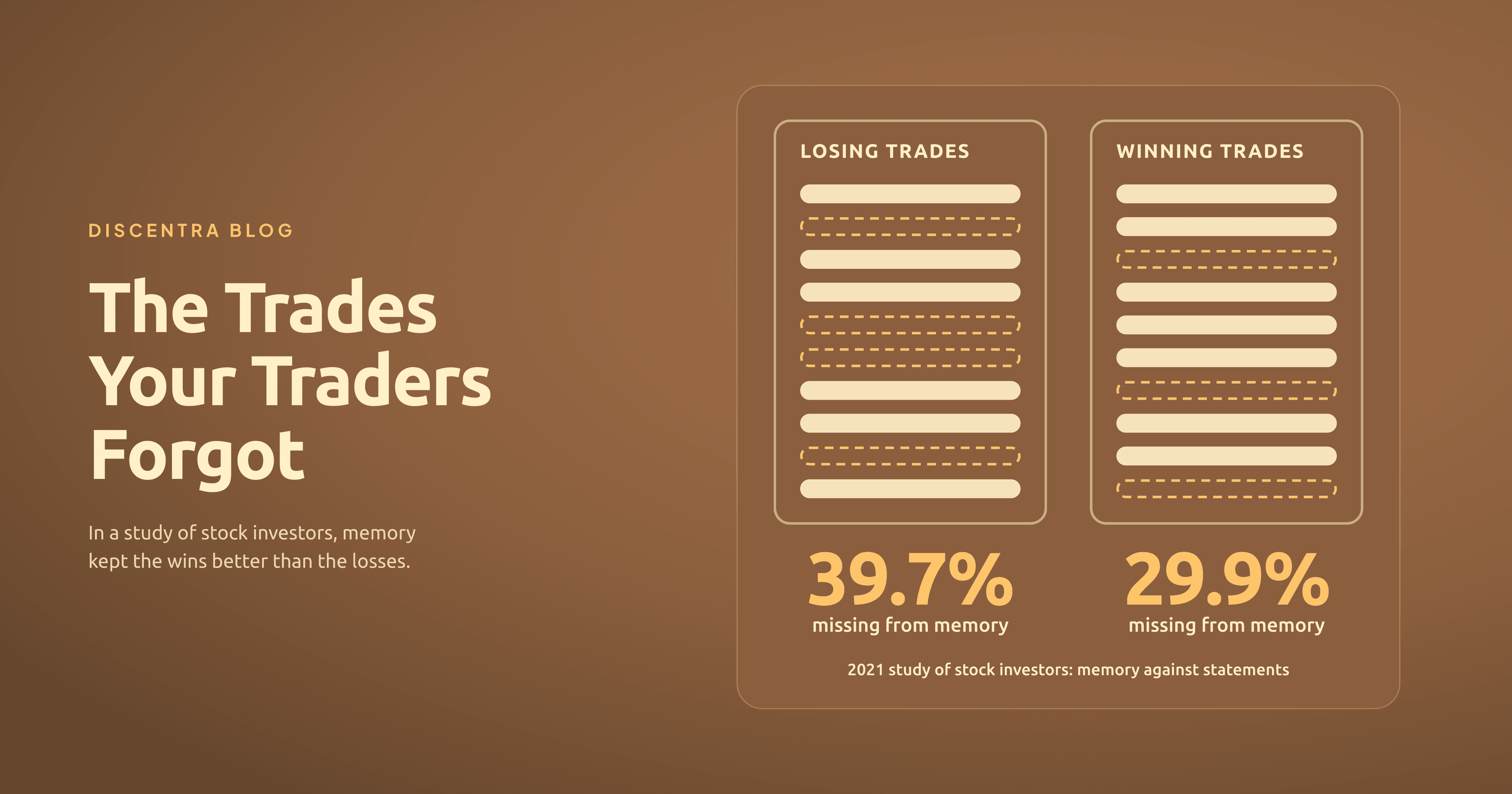
The analysis covered 1,161 trades from the statement lists (26 more, with a return of exactly zero, were left out). The paper reports that "784 (67.5%) were remembered, 377 (32.4%) were forgotten", meaning about a third of the trades that mattered most were absent from the lists written from memory. The missing trades leaned one way. In the paper's words, "participants forgot their losses at a higher rate (M = 39.7%)" than their gains, at 29.9%.
| On the statement lists | Trades | Missing from memory | Share missing |
|---|---|---|---|
| Losing trades | 302 | about 120 | 39.7% |
| Winning trades | 859 | about 257 | 29.9% |
| All trades | 1,161 | 377 | 32.4% |
The paper prints the percentages and the totals. The two figures marked "about" are our arithmetic from them, and they add up to the paper's 377. The effect on the overall picture: averaged per investor, losing trades were 23.6% of the statement lists and 19.3% of the memory lists. (The table pools every trade, which on our reading is why its losing share is 26.0%.)
The limits belong beside the number. These were stock investors recalling trades that were months old, recruited online, not funded traders or CFD clients minutes after a loss. The statement figures were typed in by the participants from their own statements; the researchers verified two participants' statements in the first study. Participants could leave lines blank, and they entered fewer trades from memory (7.0 on average) than from statements (8.2), so part of what counts as forgotten is a shorter list. The authors add that they "cannot fully rule out self-presentation bias as an alternative interpretation" most directly for the first two studies: some people may have been presenting themselves well instead of misremembering. They add that even in the experiment below, looking up returns may have worked by deflating participants' self-image. For a firm, our reading is that the difference changes little. Either way, the account an investor gives is kinder than the record.
Why the gap matters to a firm
The gap went with behaviour. In both studies, investors whose memory ran further ahead of their statements were more overconfident, measured as how far they expected to beat the market, and they traded more often. Those results are associations.
The third study was an experiment. The researchers recruited 366 investors from investment forums and split them at random into two groups. One group looked up the returns on their two biggest-impact stocks of 2018 before answering anything else; the other looked up the sectors they had held. The group that had seen their own returns expected to beat the market by 5.8%, against 9.2% for the others. Asked how many trades a month they would buy, at $1 each, if picked for a follow-up study with real money, they chose 13.2 against 16.4. The authors' conclusion: "Simply making investors aware of their past returns reduces overconfidence, though it does not eliminate it completely."
Put the pieces together and an inference follows, which we label as ours. The investor whose memory flatters them most is the one most confident in their own trading, and so the one least likely to think they need help. A separate study, of Dutch households and the clients of a large Dutch bank, found something close in its own field: "people with higher confidence in their own financial literacy are less likely to seek financial advice, but no relation between objective measures of literacy and advice seeking." That study concerns financial advice to households and bank clients, which is not coaching, and its result is an association. If the pattern carries over to traders, a firm may hear least from the traders whose own account sits furthest from their record.
The experiment also has a cost side for a firm. One measured effect of seeing the record was fewer planned trades. A firm that earns on volume will notice that, and the studies do not say what happens next: none of them followed investors to see whether a truer view of their record changed how long they kept trading.
Other studies point the same way
The 2021 authors write of their memory findings: "No published paper has shown these effects with investors." The wider observation is older. In 1997, a study of mutual fund investors' recollections reported that "investor memories exhibit a positive bias". In 2007, a questionnaire study of 215 investors at an online broker found them "hardly able to give a correct estimate of their own past realized stock portfolio performance"; experience improved the arithmetic of estimating a return, and did not seem to improve investors' view of how good they were.
A different research group ran experiments, first circulated in 2019 and published in 2025 in The Review of Financial Studies: "Individuals overremember positive investment outcomes of chosen assets and underremember negative ones." The 2021 paper cites the 2019 version, so this is a parallel line of work and not a later test of it. A 2025 study in The Quarterly Journal of Economics surveyed retail investors in China and merged the answers with their transaction records. It addresses a neighbouring question, what investors' expectations are built from: "Recalled experiences can explain cross-investor variation in return expectations and, in our setting, dominate actual experiences in their explanatory power." Its abstract says a rising market prompts more positive recall; it does not say recall always leans toward the wins.
We found no later study that repeated the 2021 design, and one search for a failed replication or a published critique found none. That is one search, and it does not show that none exists. For all five supporting papers, the four above and the Dutch study, we read the abstract and not the full text.
What each of a firm's sources starts from
Most of what a firm hears about whether its traders want or need help reaches it through the trader's own account.
| Source | What it starts from | What it is good for |
|---|---|---|
| No requests for help | The trader's own view of how they are doing | Knowing what traders will raise unprompted |
| A survey | What traders recall and choose to report | Satisfaction, and what traders say they want |
| An account manager's check-in | The same account, given to a person | Context, and the relationship |
| A trading journal | What the trader chooses to write down | The trader's own reflection |
| A review written after an account closes | One person's account, later | What the firm did that people objected to |
| The trade record | What was done, with a timestamp | What happened |
Each of the first five has a use, and none of them is dishonest. Each starts from the trader's own account, which, if the investor research carries over, tilts toward the wins. The trade record does not pass through memory. Its limit is different: it shows what was done and not the reason for it.
Two tests a firm can run
Is there a gap?
A firm can repeat the study's design at its own scale. Ask a small group of traders for their biggest trades of the last quarter, from memory, and set the answers beside their statements. That shows whether the gap exists in the firm's own book and about how wide it is. If the two lists agree, the argument in this post does not apply to that firm's traders. The test does not show which traders need help, and a small group cannot carry a percentage.
The authors suggest a use for their own result: "Brokers could easily implement this intervention by displaying prior returns on their trading platforms." That is their proposal. Their experiment tested investors looking up their returns once, inside a survey.
Would traders take up coaching?
Whether traders want coaching is a fair question. The way to answer it is to offer the help and count what traders do. Three counts carry it: how many traders consent to the calls, how many pick up, month by month, and how many withdraw. A pilot can also measure effect, which is a separate question, by comparing what traders do after a warning sign with a call against warning signs where the call was held back at random, never on a sign of crisis.
How Discentra is designed
Discentra builds AI voice coaching for prop firms and brokers: coaching, not financial advice. Its intervention calls are designed to be placed when a behavioural trigger fires on the trade events the firm sends, so a call starts from the record of what was done. Under our contract template, no trader is enrolled without consent first, asked separately for calls, texts and recording, and a trader can withdraw. Those consent counts would show a firm whether its traders take the calls up. Every call is designed to open by saying it is the firm's AI coach, and it stays on the trader's own trading process: no trade recommendations, price predictions, position sizes or entry timing. On the higher contract tiers a trader can also book a coaching session. The how it works page shows how a trade event becomes a call.
What we do not claim: the 2021 experiment tested investors looking up their own returns, not a phone call. None of the studies here tested coaching calls, and none of this has been measured on a firm's traders.
Sources and notes
- Investor memory and overconfidence. Walters, D. J. and Fernbach, P. M. (2021). Investor memory of past performance is positively biased and predicts overconfidence. Proceedings of the National Academy of Sciences 118(36), e2026680118. doi 10.1073/pnas.2026680118. Evidence type: peer-reviewed, three pre-registered studies of stock investors (two correlational, one randomised experiment). Statement figures were reported by the participants; recall was of trades months old; the authors cannot fully rule out self-presentation, most directly for the first two studies; 26 statement-list trades with a return of exactly zero were excluded. Full text read 13 November 2026.
- Investors estimating their own past performance. Glaser, M. and Weber, M. (2007). Why inexperienced investors do not learn: they do not know their past portfolio performance. Finance Research Letters 4(4), 203-216. doi 10.1016/j.frl.2007.10.001. Evidence type: peer-reviewed questionnaire study, 215 online broker investors. Abstract read 13 November 2026, in the working-paper version's wording; the full text was not read.
- Mutual fund investors' recollections. Goetzmann, W. N. and Peles, N. (1997). Cognitive dissonance and mutual fund investors. Journal of Financial Research 20(2), 145-158. doi 10.1111/j.1475-6803.1997.tb00241.x. Evidence type: peer-reviewed questionnaire study. Abstract read 13 November 2026.
- Experiments by a different group. Gödker, K., Jiao, P. and Smeets, P. (2025). Investor memory. The Review of Financial Studies 38(6), 1595-1640. doi 10.1093/rfs/hhaf006. Evidence type: peer-reviewed experiments, by a different research group; first circulated as a working paper in 2019, which the 2021 paper cites. Abstract read 13 November 2026.
- Field evidence. Jiang, Z., Liu, H., Peng, C. and Yan, H. (2025). Investor memory and biased beliefs: evidence from the field. The Quarterly Journal of Economics 140(4), 2749-2804. doi 10.1093/qje/qjaf035 (earlier NBER Working Paper 33226). Evidence type: peer-reviewed; a survey of retail investors in China merged with transaction records. It is about what shapes return expectations, not a repeat of the 2021 design. Abstract read 13 November 2026.
- Confidence and seeking advice. Kramer, M. M. (2016). Financial literacy, confidence and financial advice seeking. Journal of Economic Behavior & Organization 131, 198-217. doi 10.1016/j.jebo.2016.08.016. Evidence type: peer-reviewed analysis of a Dutch household survey and a Dutch retail bank's investors; an association. It concerns financial advice from an adviser, which is not what a coaching call gives. Abstract read 13 November 2026.
- The table of missing trades. The percentages and totals are the paper's. The counts marked "about" are our own arithmetic (39.7% of 302 and 29.9% of 859), rounded.
- The carry-over to trading firms. Our inference. None of the studies sampled funded traders or CFD clients, and none tested a coaching call.
- Discentra's design. Described from our own client contract and trader consent form. Evidence type: our own documents, not independent evidence.