10% of what?
Every retention pitch arrives with a percentage. A firm that buys on one is buying a sentence until it knows two things: what the percentage is a percentage of, and how many traders stand behind it.
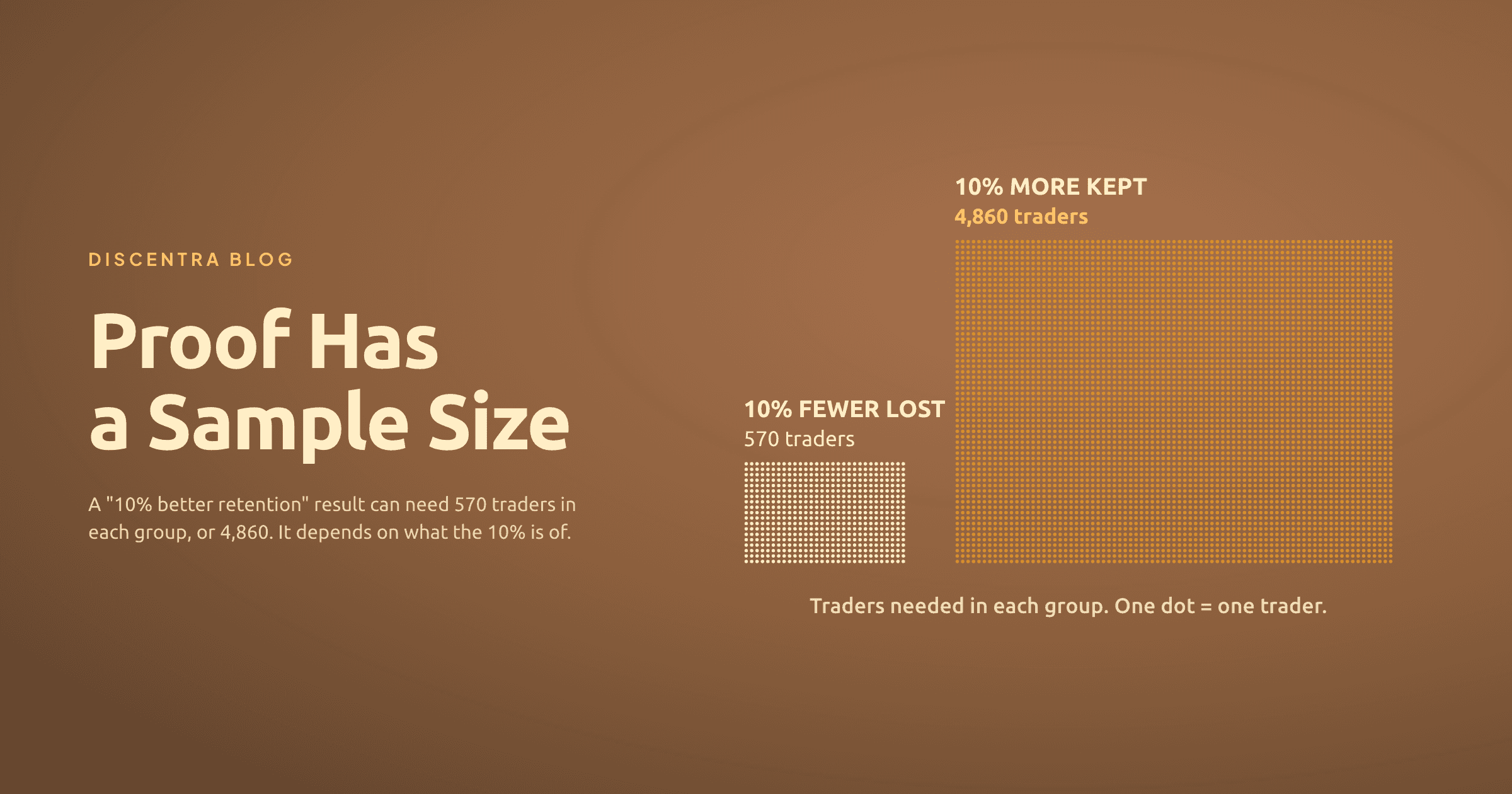
Start with the first. Take a cohort where 25 of every 100 new traders are still active at day 90, in line with the widely repeated figure that ~75% of retail traders quit within 90 days, a working number no regulator publishes. "10% better" can then describe two different outcomes:
| What "10% better" means | Still active at day 90 | Change | Traders needed in each group |
|---|---|---|---|
| 10% fewer traders lost | 25% → 32.5% | +7.5 points | about 570 |
| 10% more traders kept | 25% → 27.5% | +2.5 points | about 4,860 |
The headline is identical, and the second outcome needs about eight and a half times as many traders to detect. "Traders needed" means enough in each group, coached and not coached, to see the change 80% of the time at the usual 5% significance level. The working is in the notes at the end.
How many traders a retention pilot needs
A 90-day retention figure gives each trader one answer: still trading or gone. One answer per trader carries little information, so chance moves a small group's figure a long way. If the true share staying is 25%, a group of 150 will show anything from about 18% to 32% in 95 of every 100 groups that size. A real improvement of a few points sits inside that noise.
The numbers grow as retention moves toward the middle of the range, because a share near 50% varies the most:
| Still active at day 90, before | +2 points | +5 points | +10 points |
|---|---|---|---|
| 25% | 7,547 | 1,248 | 326 |
| 40% | 9,490 | 1,531 | 385 |
| 60% | 9,333 | 1,468 | 354 |
Each cell is the number of traders needed in each group to see that change 80% of the time, at two-sided 5% significance.
A pilot of 150 coached traders, compared with 1,000 who were not coached, sees a change four times in five only once it reaches about 12 points: from 25% to about 37%. Below that, a pilot can fail while the tool works and pass by chance. These are best-case figures. They assume traders were assigned to the two groups at random. A comparison group matched on paper after the fact adds error on top.
A pilot can measure the next trade
A behavioural coaching layer acts at the moment a warning sign appears: a fast re-entry after a loss, a jump in size, a burst of trades. Those warning signs recur. A trader on a bad run can set off several in one afternoon. Each one is a point at which help either arrives or does not, followed by an outcome the firm can measure within minutes: how soon the next trade came, and how large it was.
Health researchers hit the same problem with help built to arrive at the moment it is needed, and they devised a trial for it. In a micro-randomised trial, the choice to help is randomised at each moment rather than once per person. In the words of the paper that set out the design, "Micro-randomization involves randomly assigning an intervention option at each relevant decision point", so a study lasting weeks or months "may randomize each person hundreds or thousands of times". Those comparisons within each person, the authors write, "enable micro-randomized studies to require far fewer participants than traditional full factorial designs."
One trial shows the scale. HeartSteps sent activity suggestions to people's phones at up to five moments a day for 42 days. Of the 44 people recruited, 37 were analysed, and between them they contributed 6,061 moments. At first, a suggestion raised the step count in the following 30 minutes by 66% (167 steps). The effect then fell by about 2% a day and could no longer be told apart from zero by the 28th day. Averaged over the six weeks, the gain was 14% (p = .06, just above the usual threshold for significance).
Two things carry over to a trading firm: the design, and the warning in the result. The step counts do not, because walking is not trading. The design would compare the next trade after warnings that got help with the next trade after comparable warnings that did not, and a trader who sets off many warnings contributes many comparisons. Some moments are never left to chance: the most severe warning signs stay out of any comparison, and a call that turns up distress is passed to a person at the firm.
The warning is that an effect that is strong in week one can fade until it can no longer be told apart from zero by week four. A single 90-day average hides that fade, and a record kept moment by moment shows when it happens.
Repeated moments from one trader are not independent, and the analysis has to allow for traders who set off many warnings.
Retention is still the result that pays
The result a firm banks is a trader who stays, because each trader lost takes acquisition spend and future revenue with them. So retention stays in the report. It belongs there with its group sizes and a range, never as a lone percentage, and it is read as supporting evidence until the cohort is large enough to carry a conclusion.
The two measures still have to be connected. A later, smaller next trade does not by itself prove that the trader stays longer. The design paper hedges the point: short-term outcomes "often can be seen as mediators of the desired distal outcome". The link has to be checked over time, in the firm's own data.
Before any pilot, ask your own history
One question needs no pilot and no intervention: do the warning signs come before traders leave, in this firm's own book? A firm can check it on data it already holds, across every trader it has onboarded. Did the traders who showed the pattern early leave sooner than those who did not? That question has thousands of traders behind it on the first day.
The check shows whether the two go together. It cannot show that one causes the other, because a trader who sets off warnings may differ in ways the data does not record. It still answers the first thing worth knowing before paying anyone to act on the signs: whether they matter in this firm's book at all. Tilt shows up in the sequence of trades, which the firm already holds.
Held to the same arithmetic
Discentra builds behavioural coaching for prop firms and brokers: coaching, not financial advice. Any result it reports should state what its percentage is a percentage of and how many traders stand behind it. Proof has a sample size.
Sources and notes
- Traders needed in each group: our calculation, using the standard comparison of two proportions: n = (1.96 + 0.8416)² × [p₁(1 - p₁) + p₂(1 - p₂)] / (p₂ - p₁)², for two-sided 5% significance and 80% power, equal groups and random assignment. Every result is rounded up to a whole trader. The pooled-variance and arcsine versions of the formula agree within three traders per group. The chance of detection for 150 coached traders against 1,000 others uses the same normal approximation with unequal groups, counting a significant improvement only (45.5% and 9.4%; counting a significant result in either direction, the second is about 10%). The range for a group of 150 is the 95% interval around a true share of 25%: plus or minus 1.96 × √(0.25 × 0.75 / 150), about 6.9 points.
- ~75% of retail traders quit within 90 days: a widely repeated working number with no traceable primary source. Regulators publish loss rates, which measure something different. It sets an illustrative starting point here, and the second table shows other starting points. More on the churn statistics page.
- The micro-randomised trial design: Klasnja, Hekler, Shiffman, Boruvka, Almirall, Tewari and Murphy, "Micro-Randomized Trials: An Experimental Design for Developing Just-in-Time Adaptive Interventions", Health Psychology 34 (Supplement), 2015, pages 1220-1228. Author manuscript read on PubMed Central on 9 October 2026. A methods paper: it reports no effect for any intervention.
- HeartSteps: Klasnja, Smith, Seewald, Lee, Hall, Luers, Hekler and Murphy, "Efficacy of Contextually Tailored Suggestions for Physical Activity: A Micro-randomized Optimization Trial of HeartSteps", Annals of Behavioral Medicine 53(6), 2019, pages 573-582, published online in September 2018. Read on PubMed Central on 9 October 2026. Physical activity in 37 adults, not trading: the design and the fading effect carry over, the effect sizes do not.
- No firm, vendor or platform is named.