Will clients tire of the calls?
A firm weighing outbound coaching calls to its clients has a fair first question: will they tire of them? A call rings at a moment the client did not choose. If the second call is heard less than the first and the tenth barely at all, the firm is paying for rings, and a client who has learned to let the phone ring will miss the call that mattered.
A count of reach (messages sent, clients contacted, calls placed) cannot tell a firm whether its tenth call is still heard. Research on alarms and reminders points to two separate reasons it might not be, each with a setting a firm can control.
Repetition wears a response down
Habituation is the name researchers give to a response fading as its trigger repeats. A 2009 paper by 14 researchers who study it across species updated the description of its defining characteristics. Three of them bear on a call. A stimulus that repeats draws a weaker response each time, down to a floor. Other things being equal, the more often it comes, the faster or deeper the response falls. And if the stimulus stops for a while after that decline, the response recovers, at least in part. These characteristics are drawn from simple responses in many species, so for a phone call they suggest which way the effect runs, without saying how large it is.
A result that points the same way in messages to people comes from medicine. In a randomised trial in rural Kenya, 431 adults who had started HIV treatment within the previous three months received no reminders, or short or long text reminders sent daily or weekly, for 48 weeks, while electronic caps on their pill bottles recorded each opening. With weekly reminders, 53% reached at least 90% adherence, measured as monitored bottle openings against prescribed doses, against 40% with no reminders. Daily reminders, seven times as many messages, came out at 41%, no better than none. The authors offered habituation as a possible explanation, not a tested one: "Habituation, or the diminishing of a response to a frequently repeated stimulus, may explain this finding." They added that daily messages "might also have been considered intrusive."
A second study points the same way for messages that compete for attention. In a trial with 528 health care providers, each extra local public health message per week went with a 41.2% fall in the odds of recalling the content of a study message. That was an observed link inside a trial, not a comparison of frequencies assigned at random.
A warning that is often wrong gets discounted
The second cause is being wrong. In 1995, Bliss, Gilson and Deaton set out to measure what researchers call the cry-wolf effect. They gave 138 students a demanding task to do while alarms went off, with 25%, 50% or 75% of the alarms true. In the study's words, "most subjects (about 90%) do not respond to all alarms but match their response rates to the expected probability of true alarms". About 1 in 10 responded to every alarm or to none.
In a later laboratory study, of 32 students working with an automated aid, false alarms also cost more than missed ones; the authors concluded: "False alarms appear to be more damaging to overall performance than misses".
The far end of this is a hospital ward, where the problem has a name: alarm fatigue. Researchers in five intensive care units recorded every monitor alarm for 461 adult patients over 31 days: 2,558,760 alarms, 381,560 of them audible, "an average alarm burden of 187 audible alarms per bed per day". Of 12,671 heart-rhythm alarms that nurse scientists checked one by one, 88.8% were false. The authors note that alarms may be "silenced at the central station without checking the patient or permanently disabled by clinicians who find the constant audible or textual messages bothersome". Nurses are not traders and a monitor is not a phone call. The ward has both conditions at their most extreme; the study counted the alarms, not how staff responded to them.
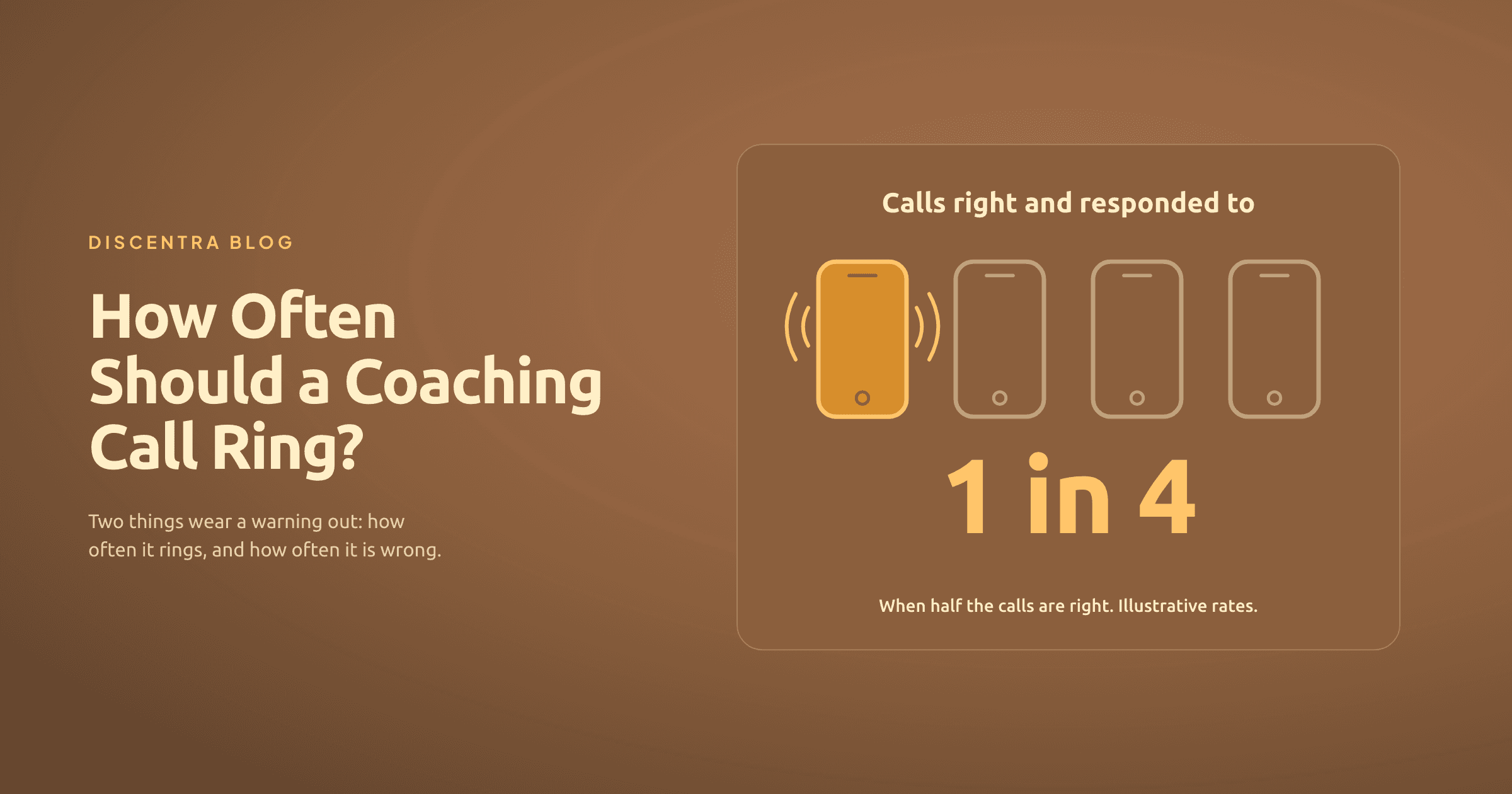
The arithmetic of alert fatigue: 1 call in 4 when half are right
Put the alarm finding into numbers. Suppose a firm's clients respond to its calls the way most people in the 1995 study responded to alarms: at about the rate the calls turn out to be right, without being able to tell in advance whether a given call is one of the right ones. Then the share of calls that are both right and responded to is the hit rate multiplied by itself.
| Calls that are right | Calls responded to | Calls both right and responded to |
|---|---|---|
| 1 in 4 | 1 in 4 | 1 in 16 (6%) |
| 1 in 2 | 1 in 2 | 1 in 4 (25%) |
| 3 in 4 | 3 in 4 | 9 in 16 (56%) |
| 9 in 10 | 9 in 10 | 81 in 100 (81%) |
A single wrong call costs a client little. In this model it also lowers the response to the calls that follow, the right ones included. That changes where a firm should spend its effort. Take 100 calls, half of them right: about 25 are both right and responded to. Keep the 50 right calls and cut the wrong ones by two thirds, to about 17. The firm now makes 67 calls, three in four of them right, and about 37 are both right and responded to. That is 33 fewer calls and about 12 more that are both right and responded to.
The model has limits. The 1995 finding comes from students in a laboratory, responding to cockpit-style alarms during a demanding task, not clients taking phone calls, and about 1 in 10 of them did not match. A 2015 paper that applies the same idea to hospital alarms describes it as a "postulated" model of how clinicians respond. In that paper's model, a tiered alarm that tells clinicians how severe the change is gave them a better chance of reaching the patients who needed them. The hit rates in the table are illustrative, not measurements of any firm's rules, including ours.
Where the effect does not show up
The cry-wolf effect is not automatic. A study of 495 midair conflict alerts in en route air traffic control found 45% of them false. Centres with more false alerts had more alerts go unanswered, but the authors found "no evidence that these were nonresponses to true alerts or that response times were delayed". The authors describe controllers acting in anticipation, changing aircraft trajectories before the alert. Our reading of that one study: when a person can already see what a warning is about, a wrong one costs less. That is one reason a coaching call should say what it noticed before it asks anything.
Three settings a firm controls
Our reading, for calls at risky moments: the research above points to fewer calls, each more likely to be right, with space between them. In our view, that is a reason not to add a touchpoint whenever trader retention slips. A firm controls all three through its settings.
How often the rule is right
A rule fires on behaviour, and right here means the behaviour the rule describes was really happening, not a copied account or a data error. A firm can check how often its rules would have fired on its own clients' history, and how many of those firings it recognises as real, before switching anything on, as part of testing a vendor itself. Weaker signs can get a text first, with a call only if trading continues, so the call rings on behaviour that has persisted instead of on a single event. The intensive care researchers propose the same kind of fix for monitors: delays before some alarms sound, and some alarms limited to when a condition starts and ends.
How many calls a client can get
A monthly cap per client, written into the contract, limits how many calls a run of bad trading days can bring. The reminder trial above is the case for one: daily messages, seven times as many as weekly ones, bought no measurable improvement over none.
How far apart they come
A firm can allow one call decision for each episode, instead of a call for every event inside it. The 2009 habituation paper lists recovery among the defining characteristics: if a repeated stimulus is withheld after the response has declined, the response recovers, at least in part. Spacing gives it the time to.
Count response as well as reach
From its call records a firm can see, month by month and for the same clients, how many calls are answered and how many clients withdraw from the calls. A pilot can go further and compare what clients do after a call with warning signs where the call was held back at random, never on a sign of crisis, which raises its own sample-size question. A falling answer rate months in is the sign to look again at the rules and the limits behind them.
How Discentra is designed
Discentra builds AI voice coaching for prop firms and brokers: coaching, not financial advice. Its calls are designed around these three settings. Each behavioural trigger has a tier that sets the channel: the weaker ones get a text only, or a text and then a call if trading continues, and the stronger ones get a call at once. Under the contract, a call that falls due on a warning sign starts a fixed 30-minute episode, and no further call is placed for warning signs inside it; a sign of crisis always follows its own protocol. Each active trader has a monthly cap on these calls, set by the contract tier: six a month on a pilot. The firm declares the limits the rules use, such as its daily loss limit, and the rules are written into the contract. Every trader must agree to the calls first and can withdraw from them, and every call is designed to open by saying it is the firm's AI coach. The how it works page shows how a warning sign becomes a call.
How many calls suit one firm's clients will differ from another's, and a firm's own answer counts, month by month, will show it.
Sources and notes
- Habituation. Rankin, C. H. and colleagues (2009). Habituation revisited: an updated and revised description of the behavioral characteristics of habituation. Neurobiology of Learning and Memory 92(2), 135-138. doi 10.1016/j.nlm.2008.09.012. Evidence type: peer-reviewed consensus description. It describes simple responses across many species; we apply it to calls by analogy. Full text read 6 November 2026.
- Daily against weekly reminders. Pop-Eleches, C. and colleagues (2011). Mobile phone technologies improve adherence to antiretroviral treatment in a resource-limited setting: a randomized controlled trial of text message reminders. AIDS 25(6), 825-834. doi 10.1097/QAD.0b013e32834380c1. Evidence type: randomised controlled trial. Patients and medication, not traders; habituation is the authors' suggested explanation, not something the trial tested; the weekly result was driven by the short weekly messages. Full text read 6 November 2026.
- Message volume and recall. Baseman, J. G. and colleagues (2013). Public health communications and alert fatigue. BMC Health Services Research 13, 295. doi 10.1186/1472-6963-13-295. Evidence type: an observed association within a randomised trial; the figure is a change in odds, not in probability. Abstract read 6 November 2026.
- Responding to alarms of varying reliability. Bliss, J. P., Gilson, R. D. and Deaton, J. E. (1995). Human probability matching behaviour in response to alarms of varying reliability. Ergonomics 38(11), 2300-2312. doi 10.1080/00140139508925269. Evidence type: peer-reviewed laboratory study, 138 students. Abstract read 6 November 2026; the full text was not read.
- False alarms against misses. Dixon, S. R., Wickens, C. D. and McCarley, J. S. (2007). On the independence of compliance and reliance: are automation false alarms worse than misses? Human Factors 49(4), 564-572. doi 10.1518/001872007x215656. Evidence type: peer-reviewed laboratory study, 32 students. Abstract read 6 November 2026.
- The model applied to hospital alarms. Bailey, J. M. (2015). The implications of probability matching for clinician response to vital sign alarms: a theoretical study of alarm fatigue. Ergonomics 58(9), 1487-1495. doi 10.1080/00140139.2015.1021861. Evidence type: theoretical modelling paper. Abstract read 6 November 2026.
- Intensive care alarms. Drew, B. J. and colleagues (2014). Insights into the problem of alarm fatigue with physiologic monitor devices: a comprehensive observational study of consecutive intensive care unit patients. PLoS ONE 9(10), e110274. doi 10.1371/journal.pone.0110274. Evidence type: peer-reviewed observational study. Full text read 6 November 2026.
- Air traffic control. Wickens, C. D. and colleagues (2009). False alerts in air traffic control conflict alerting system: is there a "cry wolf" effect? Human Factors 51(4), 446-462. doi 10.1177/0018720809344720. Evidence type: peer-reviewed analysis of operational data. Abstract read 6 November 2026.
- The table and the 100-call example. Our own arithmetic from the probability-matching model, with illustrative hit rates that are not measurements of any system. It assumes clients cannot tell a right call from a wrong one in advance and have learned the hit rate over many calls.
- Discentra's design. Our client contract template and technical specification (warning-sign tiers, the 30-minute episode, monthly call caps, the limits the firm declares, trader consent in contract sections 8.6 and 8.7), the Trader Consent Form (section 6, the right to withdraw) and our Compliance FAQ (the opening disclosure). Evidence type: our own documents, not independent evidence.